The enigmatic tribe of the “Viking” in the heart of Asia. The disturbing secrets of the most mysterious populations on Earth


One of the most mysterious discoveries in the history of mankind took place in the Tarim basin in northwestern China. It is about a significant number of mummies, naturally kept in the desert, belonging to an enigmatic population, without any connection with the Asian ones.
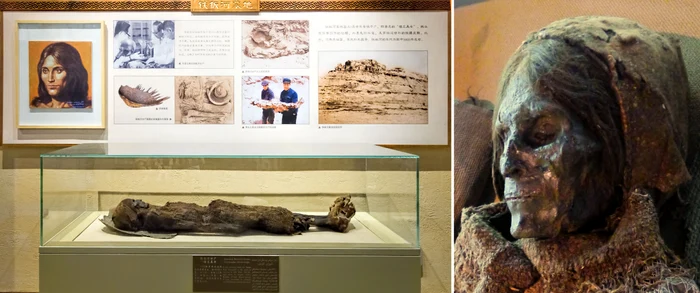
“Beauty in Loulan” one of the most famous mummies in the Tarim photo Wikipedia basin
Since the beginning of the 20th century, in the Terim basin in Xinjiang, North-West China, various explorers, merchants or simply adventurers handled through this oasis in the middle of the central-Asian desert have discovered the earthquake evidence of an unknown and missing civilization. These are numerous naturally preserved bodies, generic called “mummies”. Their strange preservation state is not due to any anthropic process, such as the famous Egyptian mummies, but rather to extreme aridity and saline soils in the area. The extremely cold winters also played a significant role in stopping the processes of rot and decomposition of human remains. The mummies are found in bizarre cemeteries along the southern and eastern edges of Taklamakan, one of the most arid deserts in the world, located in the center of the Terim basin. The “mummies” in the Terim basin have gained a special popularity in the 1990s.
A true scientific controversy has appeared around them. The bodies belonged to a bizarre population for the central-Asian area. That is, they had more Europoid features, with tall stature, blod and red hair, plus an unmoved clothing in the respective geographical area. We are not talking about the fact that the “mummies” were deposited in a boat -shaped coffin. The mystery of this unique, isolated population, in the middle of a world with Asian characteristics, has been deepened even more by the new discoveries from genetic tests of mummies by Chinese, European and American specialists.
The mysterious blonde and reddish mummies in the middle of Asia
The Terim basin is one of the last places populated on Earth. Prior to 2000 BC, there is no evidence of a permanent dwelling of this area, dominated by the desert and sporadic oases. Only from the Bronze Age, starting with 2000 BC, the region has become a turning plaque of trade, linking the east and west area of Eurasia, through its welcoming oases and its fascinating civilization. Hundreds of naturally preserved “mummies” by the dryness of the desert have been discovered in mysterious cemeteries along the Tarim basin.
The most famous is the Xiaohe cemetery where the bodies were discovered in the basket in the form of boats. The tombs, located on a mound, were marked with vertical pillars and funeral stones in the form of a row. In addition, some bodies had pieces of cheese. What attracted attention was the color of the hair of these individuals. Most were blond or reddish. They also had a totally unusual clothing for the region in which they were discovered. For example, they wore wool, felt and skin clothes. They had impressive hats, but also numerous accessories, like huge woolen shawls. “They are so enigmatic. Since they were discovered, almost by chance, they have raised so many questions. Many aspects of these mummies are either unique or contradictory.”said Christina Warinner, anthropologist at Harvard University in Massachusetts and at the Max Planck Institute for the science of human history for “Live Science”.
Their western appearance, Europoid, aroused the interest of scientists. Moreover, cheese, wheat and millet found in their unusual tombs suggest that they were shepherds. Some specialists claimed that they were migratory nations in the western Asia steppes or rejected farmers in the Central Asia Mountains. “The mummies have long fascinated scientists and the public at the same time since their original discovery. Beyond the fact that they are extraordinarily preserved, they have been found in an extremely unusual context and present various and extended cultural elements.”added Christina Warinner, this time for CNN. Others supported a European origin of these populations. It is certain that no one could explain the connection between boats, rows and desert for a long time. We are not talking about the fact that no one could figure out how a Europoid population in Central Asia came, without any connection with the other populations in the area.
A mysterious and unique tribe that avoided mixing with other populations
The mystery of the populations in the Terim basin was partially elucidated through a new study, published in 2021 in Nature magazine and conducted by an interdisciplinary team of Chinese, Europeans and Americans. The specialists analyzed the DNA of over 13 mummies sequesting their genomes for the first time. The results were amazing. The mysterious tribe of red and blond people in the Terim basin came neither from Siberia, neither from Europe nor Western Asia. It was, in fact, a local group, descendants of an old Asian population remaining there precisely from the glacial era, that is, descendants of the hunter-curator tribes, can mix even with the latest Neanderthal human populations. It was a genetically isolated population, say the specialists, who did not resemble any of the neighbors. “We found strong evidence that they actually represent an extremely genetically insulated local population.”Warinner added, for CNN World.
The peak, although they were extremely genetically isolated, unique in the central-Asian landscape, these people were not as economically and technologically insulated. The tribe of the “blondes” in the Terim basin created a fascinating civilization, being open to new ideas and technologies, borrowing elements from their neighbors and farmers, transforming the area into a turning plaque in the Central Asian Bronze Age.
“This was an incredible confluence region. There was a northern vibrant mixture, south, east and west, which extends over a period of up to 5,000 years.”said Michael Frachetti, professor of anthropology at Washington University in Saint Louis, for CNN World. Although they were extremely cosmopolitan and open to economic and technological exchanges, the mysterious tribe of the Asian “blonds” has retained its genetic uniqueness, that is, it did not mix with any other population with which they came into contact.
The “mummies” were direct descendants of a group that was once widespread in the North Asian area during the glacial era, but which disappeared largely 10,000 years ago. The last remnants of that group settled in the Terim basin. And with a mysterious stubbornness, perhaps religiously or socially motivated, have retained their genetic uniqueness. The populations from which they came were called northern-eustatic and part of their genome also survives today only in the indigenous populations in Siberia and North America.
“Vikings” Central Asia and a mysterious mystery
This study based on DNA research and determinations only answers certain questions about the mysterious story of populations and civilization in the Terim basin. No one knows what that maritime or at least river tradition in the middle of the desert was looking for. What the connection had the boats, the rows with one of the most arid areas in the world. Moreover, funeral habits, partially clothing and hair color, plus other physical characteristics, lead to vikings rather than Asians.
“It buries its bodies in the boats, and no one else does this in that area. This means that the origin of this tradition remains one of the greatest enigmas of this desert population.”add Farhetti for the mentioned publication. Some specialists say that the Terim basin 4000 years ago was crossed by two large rivers or a river, passing through the desert, and the Xiaohe cemetery was actually in an area with abundant vegetation, an oasis with lush vegetation. The mystery of the mummies in the Terim basin remains one of the most fascinating in history.