NASA makes an amazing disclosure: there were probably multiple forms of life on Mars. The Red Planet has hosted inhabitable environments several times, say scientists


The NASA rover on Mars has discovered evidence that the red planet has experienced multiple episodes of water, creating conditions that could have sustained life. The researchers identified two dozen types of minerals that show a dynamic history of volcanic rocks modified by liquid water interactions in the Jezero crater, according to the Daily Mail online.
Scientists have stated that this indicates that Jezero has hosted habitable environments on several occasions.
The rocks have been chemically transformed by water into argile salts and minerals, which reveals three distinct episodes of fluid activity.
The first involved acidic water located at high, hard and slightly favorable temperatures.
The second was formed in moderate, neutral conditions, offering more hospitable environments on a larger surface.
However, the last episode created alkaline conditions at low temperature, distributed on an extended surface, considered very suitable for life.
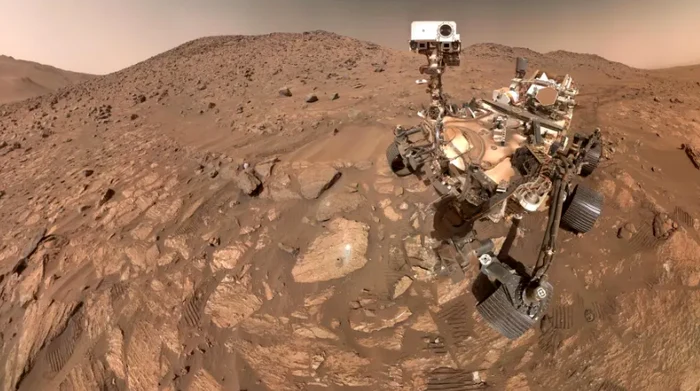
The perseverance of NASA, on Mars. PHOTO NASA/JPL-Caltech/MSSS
“The minerals we find in Jezero support the existence of several temporally distinct episodes of fluid alteration. [Acest lucru] indicates that there were several moments in Mars history when these special volcanic rocks interacted with liquid water and, therefore, more than once this location has hosted potentially suitable for life.”Says Eleanor Moreland, a student at the University of Rice, the one who led the study.
With a width of 28 miles, the Jezero crater on Mars was explored by the Perseverance Rover of its NASA since its landing in February 2021, in search of the signs of ancient life.
Unusual formations and organic molecules
The evidence obtained by Rover confirms that this crater was once the place of an ancient lake and a river delta, the discoveries including unusual formations of rocks and organic molecules.
The latest research suggests that there could have been conditions conducive to life several times throughout the history of the planet Mars.
To interpret the Rover data, the team used the Mineral Identification Algorithm by Stoichiometry (Mist) together with Planetary tool for X-Ray Lithochemistry (pixl).
The latter is an instrument identifies the minerals in the chemical data by comparing measurements with a well -known mineral database.
What does the first group of minerals indicate
The first group of minerals – Greenalite, Hisingritis and Ferroaluminoceladonite – formed in hot and acidic water in the crater.
Greenalite is an iron -rich mineral that forms in high temperature and low pH.
Hisinger is a clay mineral created when volcanic rocks react with acidic water.
Ferroaluminoceladonite is a more complex mineral that develops in volcanic rocks exposed to hot and acidic fluids.
The rocks are among the oldest analyzed in the study, and their formation under extreme conditions would have made them the least favorable for life, because high temperatures and acidity can damage biological structures.
“These hot and acidic conditions would be the most difficult for life. But on Earth, life can persist even in extreme environments, such as Yellowstone acid basins, so it does not exclude habitability“Says Kirsten Siebach, a teacher of earth sciences, the study co -author.
The conclusions of analyzing the second group of minerals
The second group of minerals formed in moderate, almost neutral water, creating more favorable conditions for life and covering a larger area of the crater.
A mineral similar to clay, Minnesotaite, was found both on the bottom of the crater and in the upper region of the fan, while clinoptilolite, a zeolithic mineral, appeared only on the bottom of the crater.
What does the third group of minerals reveal
The third group formed under low and alkaline temperature conditions, considered very habitable from the perspective of the earth.
Sepiolitul, a common alteration mineral on Earth, formed under moderate and alkaline temperature conditions and has been widely distributed in all explored areas. His presence indicates a widespread episode of liquid water that has created habitatable conditions and filled the sediments from the Jezero crater.
“These minerals indicate that Jezero has undergone a transformation from tougher, hot and acidic fluids to more neutral and alkaline fluids, Conditions we consider more and more favorable to life“, Moreland explained.
Because the tests on Mars cannot be prepared or scanned with the same precision as the rocks on the ground, the team has created a model to take into account the uncertainties and to strengthen their conclusions.
Using a statistical approach, Mist has repeatedly tested the identifications of minerals, taking into account the potential errors, similar to the way meteorologists provide the hurricane trajectory by performing several simulations.
“Our analysis of errors allows us to assign levels of confidence to each mineral match.Mist not only provides information for science and decision making in the Mars 2020 mission, but also creates a mineralogical archive of the Jezero crater, which will be priceless if the samples are returned to Earth.“Said Moreland.
The recent discoveries confirm that Jezero, once the place of an ancient lake, has experienced a complex and dynamic history of water, according to Daily Mail Online.