publication
2025-09-17 20:00
update
2025-09-17 20:44
The Federal Open Market Committee decided to reduce the federal fund rate. This is the first foot reduction this year at the US central bank. US President Donald Trump demanded such a decision for months.
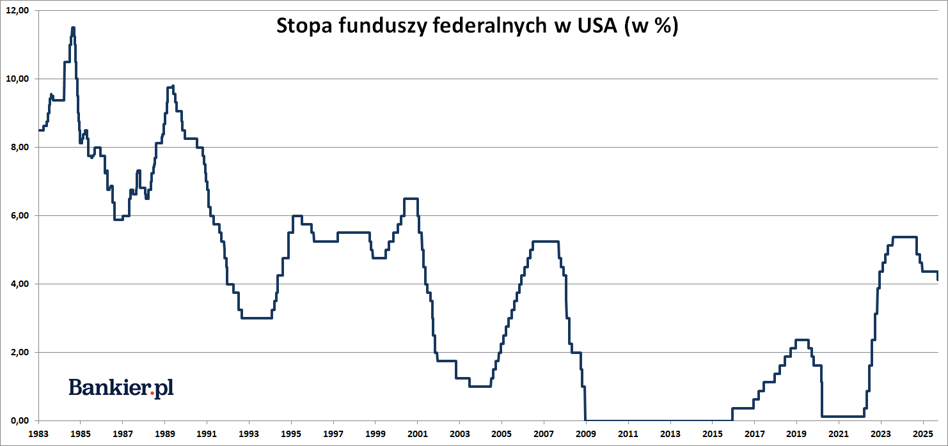
The range of federal funds was reduced by 25 base points, to 4.00-4.25% – the Federal Open Market Committee (FOMC) announced in the announcement. This is the first reduction of interest rates in the USA since December 2024. Such a decision was widely expected by economists, and the term market valued its probability at 94%. However, there were more or less official speculations with a 50-point foot reduction in Feda.
Donald Trump president demanded the resumption of the cycle of interest rate reductions in recent months. The Host of the White House did not change his words, publicly calling the chairman Powell as a “stubborn idiot” and “a real loser”. President Trump also strives to take control of the fed, nominating the Governors of “his people” to the Council of Governors and trying to appeal Lisa Cook. The term of office of chairman Jerome Powell expires in May and Donald Trump will indicate his successor.
The September decision was not made unanimously again. It is significant that Behind the reduction of the feet by 50 pb. a member of the Governors' Council – Stephen I. Miran voted freshly nominated by President Trump
End of monetary pause. The Fed starts with a reduction cycle
Almost 9 months have passed since the previous reduction in interest rates in Feda. As early as in July, Fomc decided to maintain the range of federal funds at the unchanged level, although as many as two members of the Federal Reserve Board were in favor of a reduction. They were both appointed by President Trump. It was the first such situation since 1993.
Also in June, Fomc decided not to move interest rates and then it did not surprise the financial markets. The break in the cycle of interest rates initiated in September 2024 lasted from December. The management of the Federal Reserve did not decide to reduce the costs of credit despite the strong – and often not very cultural – pressure from President Donald Trump, who would prefer to see lower feet to reduce the costs of servicing the monstrous public debt of the US.
– The committee is sensitive to risk to both sides of its double mandate and believes that the risk of deterioration of the situation on the labor market has increased – we read in the September message of the Federal Open Market Committee. The second part of this sentence is new in the communication of the Committee and the suggestion of further alleviating monetary policy.
Participants of financial markets hope that the September cut will be the beginning of a new (resumed?) Coop of loosening monetary policy. This began a year ago, when in September 2024, a nervous and unjustified cut by 50 pb. This movement chairman Powell quite clumsy explained the “rectus” of monetary policy. Another reduction in federal funds – this time after 25 PB. Each – took place in November and December. The total scale of last year's reductions was therefore 100 PB.
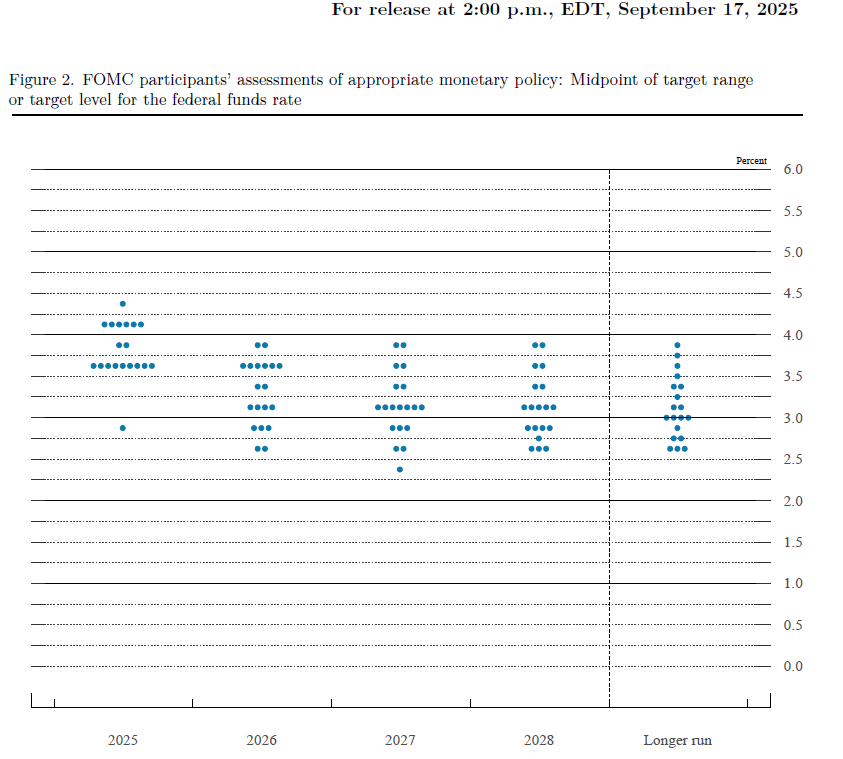
Before today's FOMC decision, the market fully valued the reduction of federal funds at 75 PB. by the end of 2025. The price also included a decrease in FFR below 3% at the end of 2026 – according to the Fedwatch Tool calculations. This scenario was supported by a dot chart published today. So -called fedocrops They indicate the existence of most decision makers ready to lower the rate of federal funds by 50 PB. by the end of this year and only at 25 pb. in 2026. In both cases, this means one 25-point reduction of more than in June assumptions.
– The Committee is strongly determined to support the fine of full employment and bring inflation back to a 2 % goal- it was recalled in the September announcement of the Federal Open Market Committee. This is probably in the event of if someone had doubts about whether it is reasonable to reduce interest rates with CPI inflation close to 3% and a 2% inflation target “in the average date”.
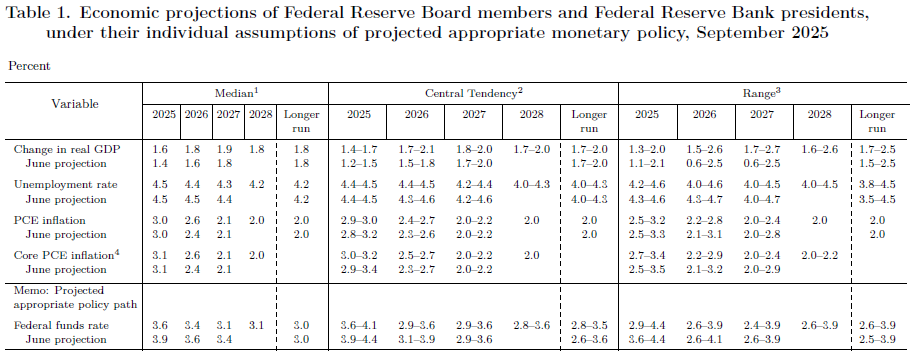
As every quarter, the members of the committee updated their macroeconomic projections. Relative to June, the median forecasts for the unemployment rate were slightly reduced (from 4.5% to 4.4% in 2026 and from 4.4% to 4.3% in 2027). The median forecasts for next year's PCE inflation, which increased from 2.4% to 2.6% (in the case of base PCE), moved up. Also in 2027 this measure of consumer inflation preferred by the Fed is to exceed a 2 % goal.
Powell: The labor market breaks down and inflation has increased
– Although the unemployment rate remains low, it twitched up, and the increase in employment slowed down and the risk of deterioration of the situation on the labor market increased. At the same time, inflation has recently increased and remains slightly increased. In the light of a change in the risk balance, the Federal Open Market Committee decided to reduce the interest rate by a quarter of a percentage point – explained the chairman of the Federal Reserve Jerome Powell.
The head of the Fed also explained that lower immigration and a decrease in professional activity indicators are responsible for part of the weakness of the labor market. But he also admitted that the demand for work probably weakened. Powell also recorded an August increase in PCE base inflation to 2.9%. The management of the US central bank considers the increase in inflation to be “transient”, but also does not exclude that price pressure will prove to be more durable.
– In a short term, the risk of higher inflation increased, and the risk of deterioration of the situation on the labor market increased – added Powell.
– I don't think our policy is no longer restrictive. During this year we maintained a restrictive attitude in monetary policy. We were able to do this because the labor market was in good condition, with a strong increase in employment – this is how the head of the federal reserve answered the journalist's question. – There was no widespread support for the 50-point foot reduction this week. In the last 5 years we have made large increases and large discounts, but now there have been times when we do not feel the need to make such quick decisions – added Powell.
The next meeting of the Federal Open Market Committee is scheduled for October 28-29. The last regular meeting of the Committee is to take place this year on December 9-10.