Brussels may have his hands tied again. Germany caused “paralysis” in the EU


On Wednesday, the European Commission will present detailed proposals regarding suspension of preferential trade conditions and imposing sanctions on “extremist” ministers and aggressive Israeli settlers.
The deadline for the announcement of this decision is crucial. It happened only 24 hours. After the UN Commission stated that Israel was committing genocide and the Israeli armed forces began large -scale land operations aimed at occupying the city of Gaza.
In recent weeks, the chairwoman of the Ursula von der Leyen committee was under growing pressure to accept harder position towards the binjamin government Netanyahu in connection with the deepening humanitarian crisis in the Gaza Strip.
According to Kai Kallas, a high representative of the Union for Foreign Affairs and Security Policy, the new package provides for the imposition of duties on over a third of the EU trade, whose value last year amounted to EUR 42.6 billion (over PLN 178 billion).
On the paper, the influence of these activities would be significant because the EU is Israel's greatest trading partner. “Certainly this step will have high costs for Israel,” Kallas said on Tuesday in an interview with Euronews.
The EU is hopelessly divided
In fact, however, this proposal has almost no chance of getting sufficient support on the part of European rule, to be implemented in a short term.
The EU's previous activities against the starving Gaza Strip from Israel have been characterized by strong words that immediately undermined poor actions.
51 days have passed since the Commission proposed what was at that time considered the mildest possible punishment for Israel in protest against mass starvation of Palestinians: suspension of part of the research cooperation program “Horizon Europe”. However, even this limited proposal did not go beyond the debate stage.
Continued article under video material
While more and more governments are taking their own actions – imposing sanctions on Israeli ministers and committing to recognizing the Palestinian state – the EU as a whole remains hopelessly divided.
“The case got stuck without a majority. We must overcome this. We cannot afford paralysis, “admitted von der Leyen last week.” Lack of ability to reach agreement “in Europe is, as she said,” painful “.
German obstacle
The most complicated situation is the economic and political power of the block: Germany.
Friedrich Merz, a new Chancellor of Germany, who comes from the same conservative political family as von der Leyen, since he was taking a position in Berlin in February, he has been openly openly criticized by the administration of Netanyahu. Last month forbade the export of German weaponswhich could be used by Israel in the Gaza Strip.
However, this caused the party's immediate response. Currently, no one in Brussels believes that Merz will succumb and the plans of von der Leyen regarding the suspension of the EU trade agreement with Israel, even if some think that Germany and other countries will support further sanctions against aggressive Israeli settlers.
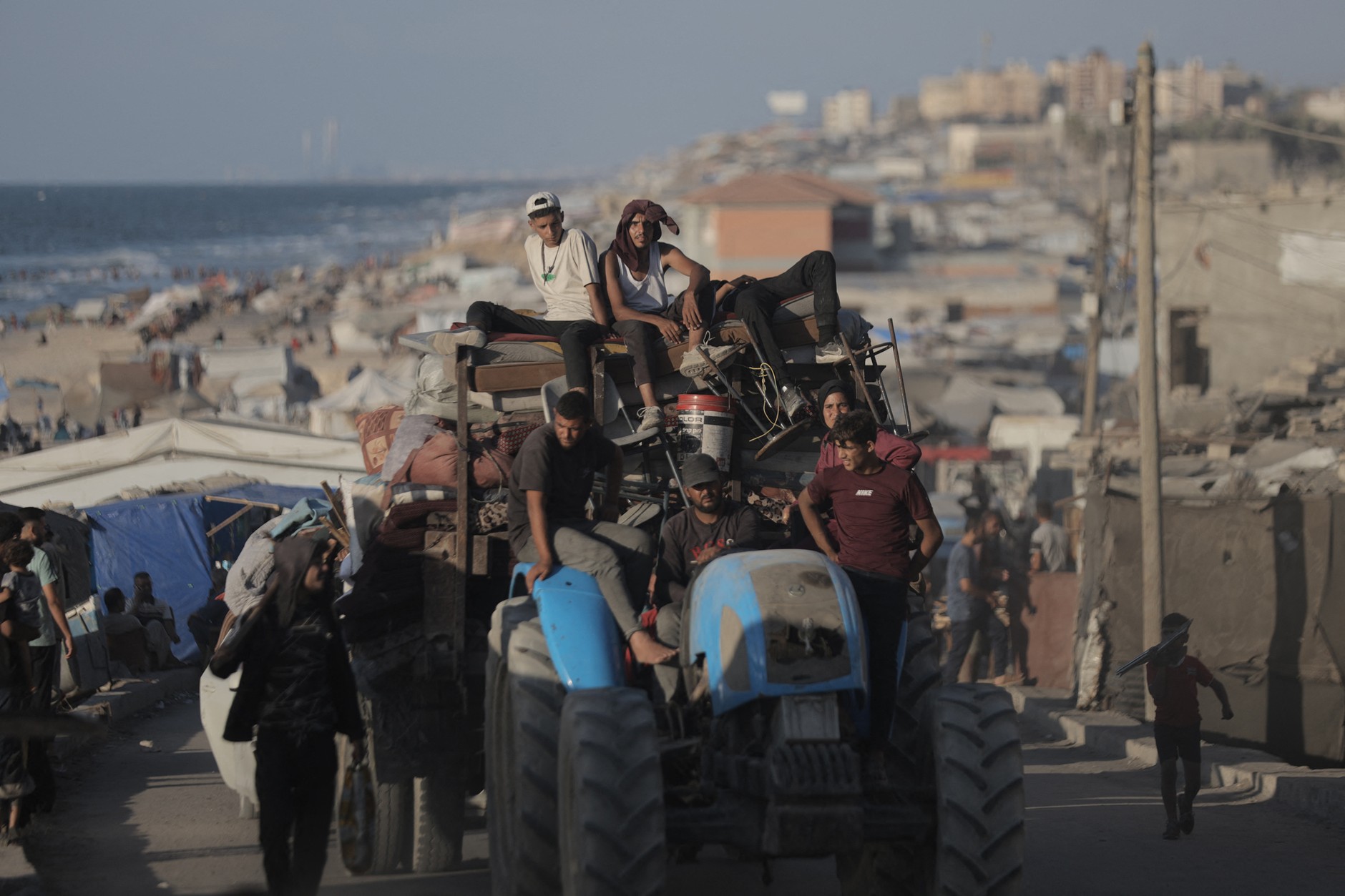
Palestinians run away from Israeli attacks on the city of Gaza, September 16, 2025.Ahmed Jihad Ibrahim al-Arini / AFP
Without the support of Germany, commercial sanctions will not obtain qualified majority of votes EU countries that are necessary to introduce them. Formal sanctions against Israeli ministers will be even more difficult, because these funds require unanimous support of all 27 EU governments to be accepted.
For a German policy, the issue of proceedings towards Israel is difficult. The heritage of Nazi extermination casts a long shadow on German politics: on Monday evening, the moved Merz fought tears during a speech in the synagogue in Munich, condemning “a new wave of anti -Semitism”.
Double -sided pressure
Countries that do not take action to stop the genocide may potentially stay considered complicit By virtue of the convention on genocide, which theoretically could lead more European rule to support the plans of EU sanctions.
Germany is not the only country. EU diplomats have noticed that several other countries, including Italy, Poland, Hungary and Austria, also refused to support measures to punish Israel.
But internal considerations They will probably prevent the Merz government from supporting the assessment that genocide is underway in Gaza, and even more difficult to take specific actions to limit trade between Israel and the EU.
Katja Hoyer, a German-British scientist and author of the book “Country behind the wall”, said that Merz's relations with her own part of Christian Democrats would probably have an impact on his way of thinking. “Surveys indicate that Merz has the support of the majority of German public opinion when it comes to a more definite position towards Israel, but the problem for him is the negative reaction of his own party,” she said.
– CDU/CSU has long been home for those who definitely support Israel. For many, this is an integral part of the party's soul. I do not know if Merz, who is already under pressure because of various broken promises and disappointment of conservative purists in many issues, will consider that he will be able to survive the change of policy in this field unscathed – she added.
As for von der Leyen, the pain associated with Europe's paralysis will probably continue.