Captain-Commandor (r) Laurențiu Buzenchi and Security expert Hari Bucur Marcu explains the decision of the Romanian pilots not to bring down the drone that entered the Romanian airspace, as opposed to the decision of the Polish colleagues.
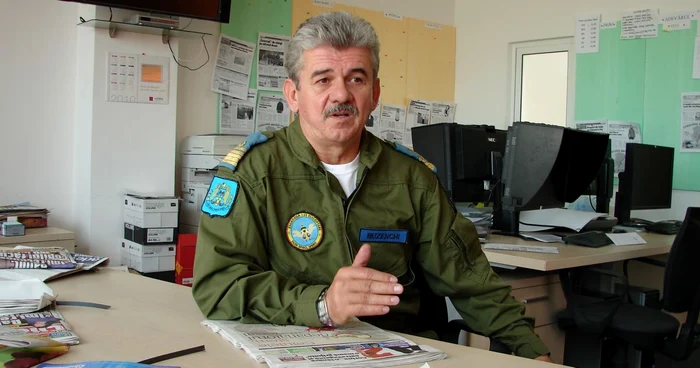
Captain-Commandor Laurențiu Buzenchi explains why the Russian drone was not destroyed. Foto: Adevărul
Why the Romanian drone was not shot down, as Polish counterparts did – it is a question that has been on the lips of many Romanians following the incidents of the last days.
The president of the Romanian Propaganda Association and the History of Aeronautics, Captain-Reserve Commander Laurenciiu Buzenchi, helicopter pilot with 3,700 hours of flight to assets, claims that: “I cannot make the decision to hit such a target when it is not very well identified. As he also gave an example, if it was a biological bomb with anthrax and spread everywhere. It could be a challenge ”.
“You use a rocket that costs from 35,000 euros to 600,000 euros”
The commander argues that the most evolved in countering the drones are the Ukrainians, who have designed “hunter drones” which are a much more effective response in the case of such incidents. “These involve relatively low prices, 10, 12, 15 thousand euros and you need to use a rocket that costs from 35,000 to 600,000 euros.” he explained. In addition, the situation would be much more complicated if they were an attack of 400-500 drones. “What do you choose?”he asks rhetorically.
Asked how dangerous the drone was breaking down, Buzenchi claimed: “I do not think it would have been dangerous. It is certain that even if the Russians say that it got out of control, it has always been under control. They try to check our vigilance and see the counterfeiting methods. Maybe even the resources we have, quite a few, in specialized ammunition, that there is an anti-air-air. It supplies for peace and does not have large ammunition stocks.
We must distinguish between peace supply and war supply, explained the specialist.
Regarding the comparison that is made with the way in Poland, the commander claims: “Because a certain degree of danger has not been demonstrated, it preferred not to be shot down. Now, the question is that there has given an example. And I did this grade fight service. This means to be at the unit, to be at the alarm cell and you have the intervention time somewhere at 10-15 minutes. to us and who stays there.
Buznechi claims that we have to think very much about this modern aspect of the war demonstrated in the conflict between Russia and Ukraine in the last year. “That is, the troops on the ground are the ones that conquer the land. To conquer the land with as small losses, this air war is practiced that before the weather was with bombers, with hunting-bombardment, with hunting aviation. Now with these small drones and with variable load, variable and in the sense of its weight, that the Ukrainians have.
Laurenciiu Buzenchi refers to the explanations of the expert in the Security Hari Bucur Marcu, who made, on Facebook, an analysis of the decisions taken by the Romanian authorities in the case of the Russian drone that overcame the country's airspace at the end of the week: “I agree with the analysis of our colleague Hari Bucur Marcu.”

Security Expert Hari Bucur Marcu explains when the drones break down. Photo: Eduard Enea
Hari Bucur Marcu: “Any object that enters the Romanian airspace must first be identified”
In the analysis referred to by Buznechi, the security expert Hari Bucur Marcu wrote: “In the concrete case from us, with a war on the border, a war that has a complex air component (in the sense that air fights are carried out and blows from the air on the land targets, with various means of hitting, with and unmanned), the supervision of the aerial space becomes almost irrelevant, from the perspective of a warning.”
Whenever it can happen that aircraft participating in air operations in the vicinity to change their mission in the air and to go, in just a few minutes, to targets in Romania. “Under these conditions, the interception can only be done with airplanes already in the air, which involves a huge resource consumption”he explains.
Any object that enters the Romanian airspace must first be identified: “Depending on this identification, the degree of hostility and danger that the object represents is established, which can take seconds, minutes or, in the case of the Chinese research ball, reached above the United States, in the mandate of the Biden Administration, a few days.”
The pilot executing the air police plays a crucial role: “Direct observation, nearby, remains one of the safest methods of identification.”
Why don't the drones immediately break down
The decision to break a drone is never automatic. “Without the correct identification and establishing the degree of danger, one cannot talk about its breakdown, even if it looks like a simple uninjured object. ”
The specialist also warns the hidden risks: “Imagine that a terrorist puts on a drone a load of biological ammunition. The destruction in the air, above a populated or agricultural area, could trigger a disaster. In such cases, the capture of the drone is much safer than its destruction.”
Not even if it is suspected that the drone would only have the mission of research or testing of the Romanian surveillance and hit systems, it is not recommended to destroy it in the air, but only to capture it, as much as possible, in order to see what research equipment had on board and possibly what information he collected and sent to the operators.
When the break -up is justified
However, there are situations in which the immediate response becomes mandatory. “The only argument for the breaking of a obviously hostile drone is whether it presents a major and imminent danger on a Romanian target. At that time, the choice of armament is made according to the value of the attacked target, not the value of the drone.”
Finally, the expert emphasizes that the aggressor's intention matters decisively: “If it is obvious that the drone was sent by a hostile actor, as recently happened in Poland, then we are talking about an attack. If not, the incident should be treated as such, and the capture of the drone is always preferable. ”