Poles prefer to suffer in silence than seek help. Here's what we think about psychological help


The report “Mental well -being in Poland” shows that at least 64 percent respondents claim that their mental state is rather good, reality turns out to be much more complex. Up to 66 percent At least, adult Poles sometimes experience chronic fatigue, and nearly 30 percent. He admits that he often misses having a loved one nearby. Every fourth person meets the criteria for possible depression.
Particularly alarming data relate to the youngest adults aged 18-24, who experience exhaustion, lack of sense and emotional overwhelming. This group lives in the shadow of the great crises of the present day.
– Our study shows that the mental condition of many Polish women and Poles is disturbing – says Marta Marchlewska, prof. Institute of Psychology of the Polish Academy of Sciences. – A particularly difficult situation applies to young adults who more and more often experience emotional overload, exhaustion and lack of sense. Their life runs in the shadow of crises: pandemic, war, information overload – emphasizes the expert.
The myth of a magic wand in psychotherapy
Despite the growing awareness of mental health problems, Poles are still reluctant to reach for professional help. Although almost half of the respondents declare that they have ever considered using psychological help, many people ultimately do not report to a specialist. The reasons are different: shame, lack of knowledge about how to start or lack of trust in therapists.
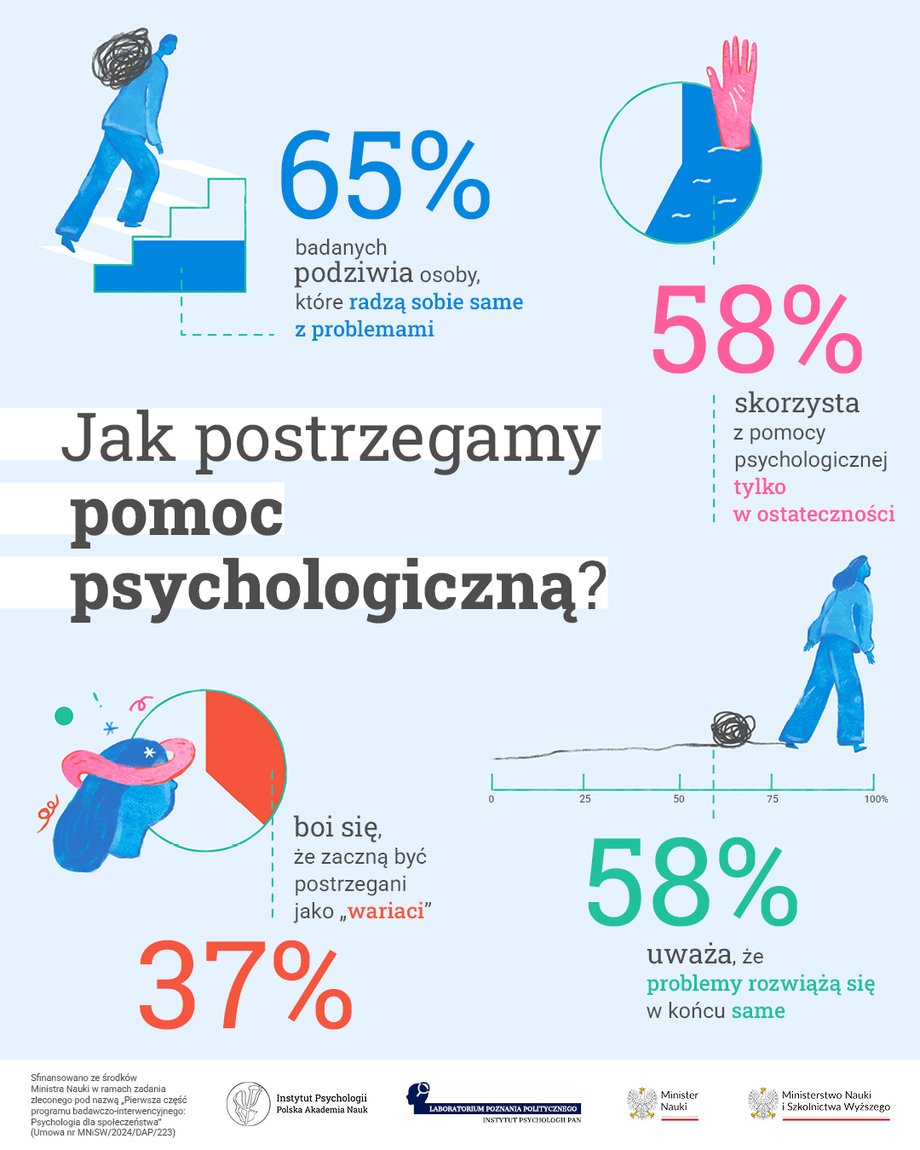
How do we perceive psychological help
|
Lord / Lord
In the heads of Poles, a psychologist should have a magic wand that will immediately solve all problems. When reality differs from these expectations, people looking for support often experience disappointment and can even abandon therapy. The Polish culture is also dominated by the belief that the need to deal with difficulties independently, and the use of professional psychological assistance is often seen as a sign of weakness.
“It is easier to go to a gynecologist than a psychologist? Yes! The pants are easier to take off than to open! Yes, talking about yourself, but about your problems is more intimate” – this is the statement of one of the respondents who took part in a study on barriers before seeking psychological help.
Fear of social assessment
Studies show that 37 percent Poles are afraid that they will be recognized as “mentally unstable” or will have to listen to the virulent comments of the family and friends. Some are also afraid that a visit to a psychologist can harm them at work.
– Polish and Poles are still easier to talk about general health than to admit fear or loneliness. Mental problems are taboo in Poland – this hinders not only conversation, but also access to help – adds prof. Marchlewska.
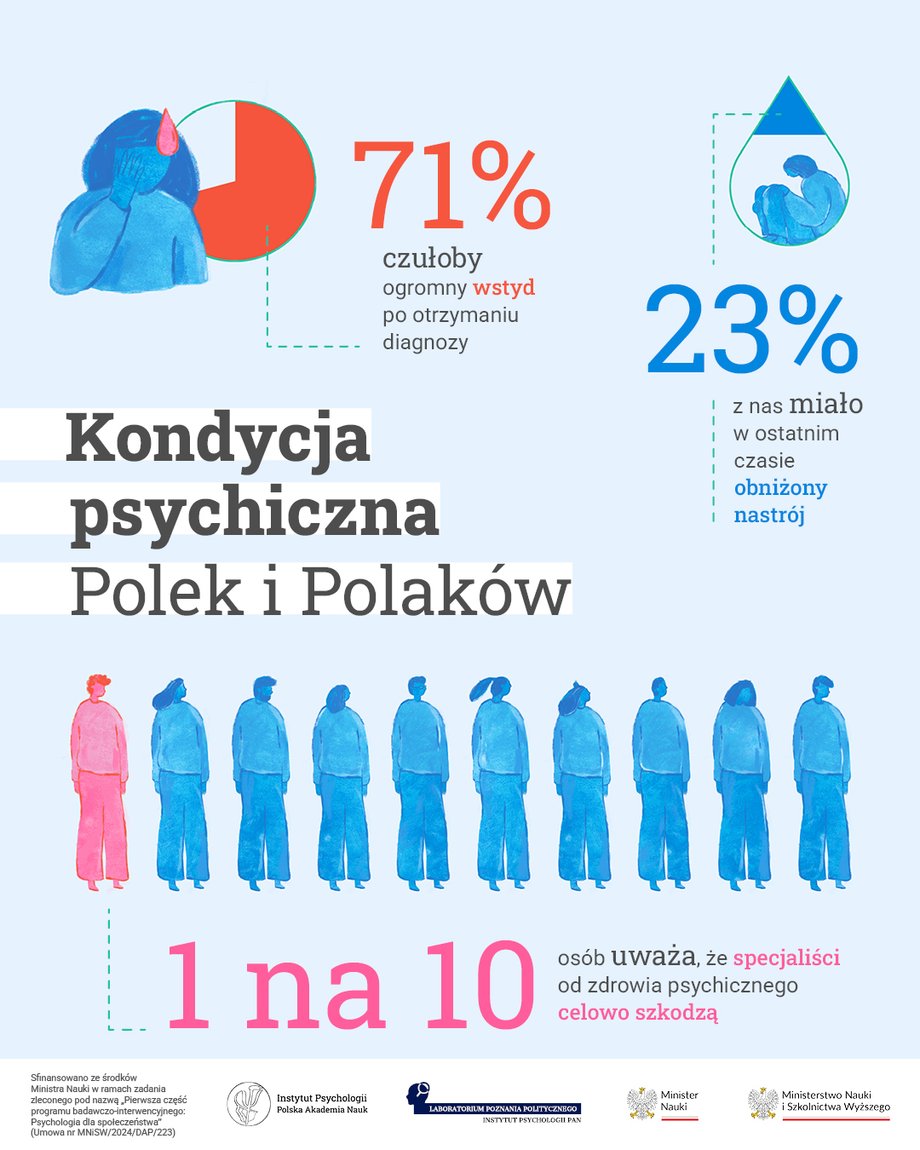
The mental state of Polish women and Poles
|
Lord / Lord
It is interesting that 71 percent People who have never received psychiatric diagnosis believe that such a “label” would be associated with shame. Meanwhile, among people who really have diagnoses, only 27 percent. He talks about a sense of shame. This shows that we are afraid of ideas, not reality.
Fragmentary knowledge of psychology
Another problem is the lack of reliable knowledge about psychology and psychotherapy. Up to 30 percent respondents do not know that the psychologist does not prescribe medications, but nearly 10 percent. He believes in conspiracy theories, according to which psychotherapy is a way to manipulate society. Most people derive knowledge from pop culture or their own guesses, not from reliable sources.
– It seems that Poles and Poles understand that therapy can be effective. However, this (still often fragmentary) knowledge does not necessarily translate into a real desire to use the therapist's services. Going to a psychologist is the last resort – those who use it are perceived by more than half of the respondents as weak people. And when we decide on therapy, it turns out that it does not look completely as we imagined. We expect a therapist to pull out a magic wand and solve all our problems. There is no understanding that therapy requires time and commitment not only from the therapist, but also the patient – says Dr. Dominika Adamczyk, a researcher from the Institute of Psychology of the Polish Academy of Sciences.
To the office only as a last resort
Research shows that to go through the door of the therapeutic office, we must usually reach the wall. We are mobilized by a serious life crisis, strong stress, uncontrolled outbursts of emotions or an unexpected event that we cannot cope with. Additionally 58 percent respondents believe that problems are finally solved by themselves, so why look for help with a specialist?
– Those who have never used psychological assistance assess it worse than those who really received it – notes dr hab. Marta Marchlewska, prof. IP PAN. – Our imaginations are often much more harsh than reality. And it is them, in the first place, to block access to support.
You need to change the social atmosphere
The authors of the reports call for a change in the social climate around mental health. They recommend the introduction of psychological education in schools, the fight against myths and system financial support, which will allow real access to help.
– Mental health cannot be a luxury, and asking for help should not be a shame. We have to start talking about it – and stop pretending that we can handle ourselves – sums up Marta Marchlewska.
Studies show that psychological barriers and internal beliefs are crucial in limiting access to psychological help. Therapy costs, long terms or distance to a specialist, although relevant, do not constitute as much an obstacle as one would expect. It is our heads full of myths about therapy and social taboos are the greatest barrier on the path to mental health.