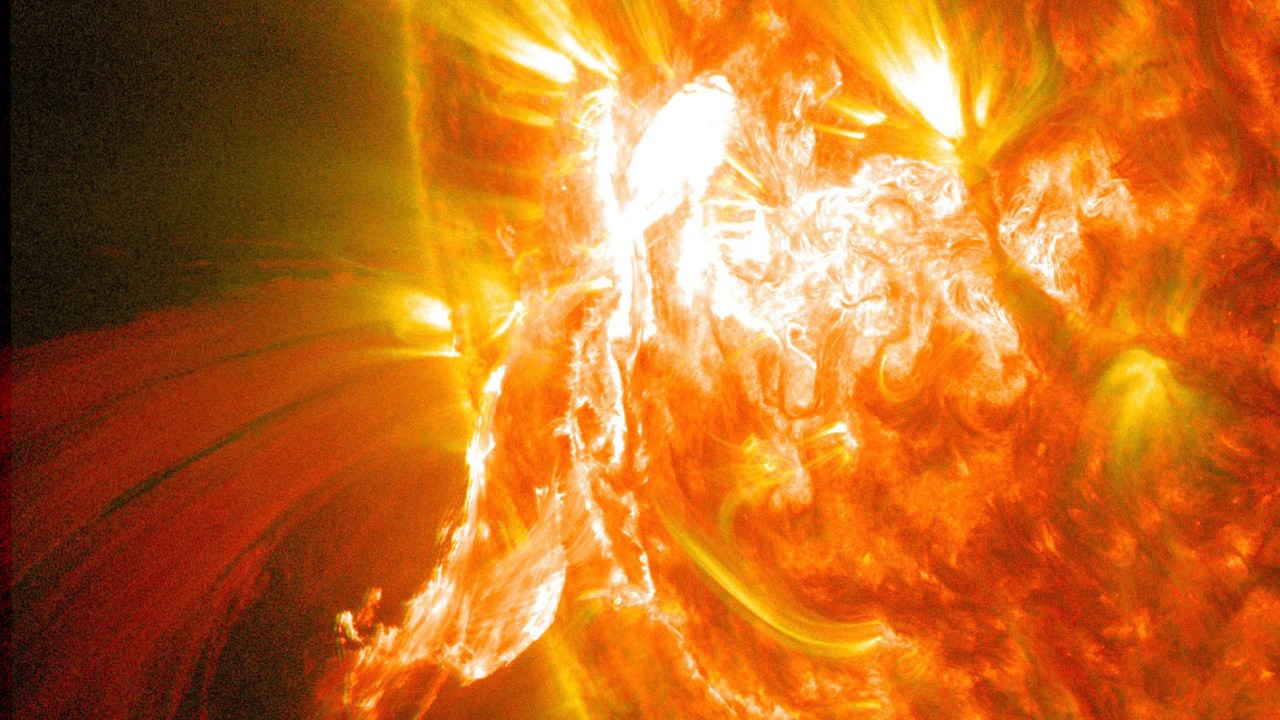
Gamma (Gamma Ray Bursts, GRB in short) are the most energetic explosions in the universe. They are the result of catastrophic events such as the death of a massive star as a result of collapsing or tearing through the black hole. They usually last from milliseconds to minutes.
Continued article under video material
However, the GRB 250702B signal lasted about one day. It is from 100 to 1000 times longer than most of this type of phenomena. What's more, gamma flashes never repeat, because they occur as the effects of catastrophic events.
Gamma GRB 250702B was registered on July 2 this year. With the help of Fermi Gamma-Ray Space Telescope, which belongs to NASA. Within a few hours, this telescope detected three flares from the same source. Later analyzes indicated that the source was active almost the day before, which was visible in the data from the Einstein Probe X -ray telescope, which is a project conducted by the Chinese Academy of Sciences in cooperation with the European Space Agency (ESA) and Max Planck Institute for extraterrestrial physics (Germany).
Otachaltic source of flash
The attitude of the observations given above was known only to the approximate location of the source of the flare in the sky, in the galactic disk in the crowded stars. It was supposed that the event had occurred in a milk way, but observations with a very large telescope (VLT), belonging to the European Southern Observatory (ESO), allowed to accurately determine the place of flash and determine that its origin is non -magical. Observations were also carried out with the help of Hubble Space Telescope and the Space Telescope James Webb.
Probably the galaxy, in which the gamma flash has taken place, there are several billion light years from us. The exact determination of this distance requires further observation. But this generally means that the Gamma GRB 250702B flare is much more powerful than originally thought.
It is not known what the nature of the event is, which led to the flash of gamma. If it is a collapsing massive star, the flare should last a few seconds. However, if we were dealing with the tearing of the star through the black hole, the flare would last about one day. However, to explain the properties of the explosion, you need a very unusual star and an even more unusual black hole.
For example, it could be a white dwarf, i.e. the final stage of the evolution of a star such as the sun and the black hole with an intermediate mass, i.e. a fairly rare and little -examined type of black holes. Black holes with indirect mass have mass from 100 to 100,000 sun masses, and most of the well -known black holes have masses much larger or smaller than this compartment.
Research results were published in The Astrophysical Journal Letters. The research was managed by Antonio Martin-Carrillo from the University College Dublin (Ireland) and Andrew Levan from Radboud University (Netherlands) and the University of Warwick (Great Britain).