What was to be the future bet of Saudi air defense, at least for now, an expensive and vulnerable experiment. Skyshield, the procured laser system in China, meant to protect the critical infrastructure from hostile drones, proves inefficiently under the harsh conditions of the desert.
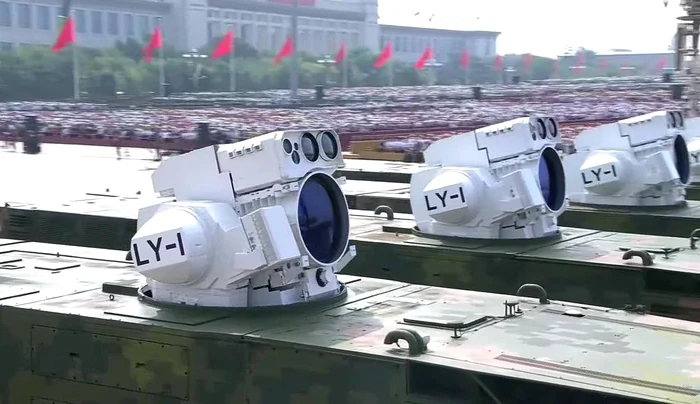
The Chinese laser system presented at the Beijing/Photo military parade: X
According to Defense Blog, an independent publication specialized in security and defense, field tests have shown that the system – promoted as a revolutionary – gives in front of dust, extreme temperatures and Saudi relief.
A technological dream defeated by reality
Saudi Arabia relied on Skyshield after the refineries at ABQAIQ and Khurais were attacked with drones in 2019, and traditional systems-including patriot batteries-proved inefficient. Skyshield promised a cheaper and faster solution: neutralization of guided energy air targets, without expensive rockets.
In practice, however, the Chinese laser Silent Hunter, the main component of the system, does not cope with the environment. The fine dust of the desert, the sand storms and the excessive heat affect the capacity for optical pursuit, reduce from the power of the beam and excessively require the cooling systems. In some cases, the neutralization of a single drone required up to 30 minutes of continuous action – an unacceptable duration in the face of fast threats.
A former Saudi officer, involved in the program, said under the protection of anonymity that “the performances in the laboratory tests were not translated into real efficiency on the battlefield.”
How Skyshield works – in theory
The Chinese system promises a stratified defense. Its components include 3D TWA radars, Aessa radar for 360 degrees, JN1101 jams and the famous Silent Hunter. Radares detect threat, jams interfere with drone communications, and laser should physically destroy them.
The problem is that, in the desert, this theory collides with physical obstacles. Silent Hunter is mounted on a mobile container, which requires significant installation time and wide spaces, rarely available in Arabic topography.
By contrast, JN1101 jamming vehicles proved to be more reliable, neutralizing most of the drones that have entered the defense area.
A complicated cooperation between RIAD and Beijing
Saudi Arabia asked China to change the system to adapt to the extreme climatic conditions in the region. For now, however, the electronic jamming remains the main defense line, while the land weapon-although spectacular in the presentation clips-remains in the operational limited experiment.
Symbolically, Skyshield confirms that, no matter how promising the new military technologies, their effectiveness remains conditioned by geography, climate and reality on the ground – a recurring lesson in the history of modern wars.