How to push our social media towards superficiality and aggression. Expert in communication: “It's like when the car appeared”


Specialist in social media and communication, Radu Delotote explains, for “Adevărul”, the mechanisms by which social media predisposes us towards superficiality and consumerism, to the detriment of a better information. From the beginning, everything starts from the algorithms of these social networks, which stimulate certain forms of behavior.

The algorithms of the social networks cultivate our superficiality. Photo: Shutterstock
The social media era has changed a whole world and habits imprinted in the memory of humanity of generations. In a hurried world, the superficiality and the desire to combat it in the online environment on the other become increasing.
A good example is a news story on “Adevărul”, but also on various social networks, about a 5 -year -old child bitten by a leiger at an illegal zoo in Suceava.
On Facebook, the article caused a real avalanche of comments, many of them acidic. Thus, instead of the information to arouse the curiosity of the Internet users, rather gave free rein to ironic comments from people who did not get tired of finding out at least what a liger is. Although in the article it is stated that the animal is a hybrid resulting from the mating of a lion with a Siberian tiger and is the only copy of this kind in Romania, many Internet users did not have the patience to read the news and rushed to go to Ironii.
More and more “hate” on social networks
The communication and social media expert Radu Delotte confirms that this is not so punctual reaction, to a certain article, but a symptom of how many of us consume information in the online environment: superficial, in the biggest rush, most of the time without traveling to the end.
“Social media is a predominantly acidic environment. That is, it is very difficult to build something or most of the time to communicate something positive with positive effects in social media due to the fact that the world has this predisposition to be attracted to everything that means derisory, chiefs and sensitive elements. In other words, more superficial things will always sell better on social media. And, obviously, he will receive in front of some rational elements ”,
says the expert.
Radu Delotes also explain what are the causes that lead to such reactions and push more and more superficiality.
Everything starts from algorithms
“This happens because this is how social media is built, this is how the networks are built, so are algorithms and this is, in fact, the system including the propagation of the message. And then, yes, it is normal, but this normal has its quilts, obviously, that the world starts to make it. You want to be present there that, I know, level of expression, or three, there is a thing about Maslow's pyramid.explains delicate.
It also matters a lot that unlike real life, where there are many more rules, there is much more permissive.
“” And there is something else, again on the construction of social media, which shows us the system of emotional representation, the fact that you have no consequences immediately on what you comment on. So you can write there, apart from the curses or other obscene words that can be forbidden by the algorithms, by the search robots, you do not have a direct consequence. you make the same person in social media?”, Says the expert.
More and more superficiality
Internet users are more tempted to read any article in diagonal or just the title. And the time we give to assimilate information or simply to read something are getting lower.
“This is how the networks are made, this is done Instagram, so is Tiktok, this is how Facebook is done, to have attention limit somewhere at two minutes, with a lot of opening, I say two minutes. So 30 seconds is the average between what I can offer for an article, for a movie, for a maximum video material 45, and for an analysis I go to the social. the media.”, Points offs.
The increasing superficiality and ability to focus and give time to a subject, a theme or simply to a reading are a direct consequence of increasingly agitated life and the fact that wherever we are, we are assaulted by information from all sides.
“We are very assaulted, in fact from here we have arrived in this situation, because we are very assaulted by a lot of information, from many different environments. And if we look, we have a lot of stimuli, we are hyperstimulated, our brain is hyperstimulated compared to the brain of a classic media, television, radio, newspaper, 20 years ago. Things are very dynamic at the moment. We have very easy access to any information everywhere. We have access to anything that happens in any corner of the globe in a few seconds. And then we arrive, in fact, instead of increasing our horizon, as it is, I know, the initial conclusion, or the primary intuition, when you say you have access to all the information, when you say that you have access to the whole globe, from the touch screen, you would say, “Mom, I will learn more.” No, in fact you are building even more. You enter a bubble. The bubble that social media, social media algorithms will grow more and more. I mean, I deepen you even more in the respective bubble ”,
Radu Delotes also shows.
There is a bubble for each
There is also an entire specialized theory that explains the situation, the so-called eco-chambers in this way.
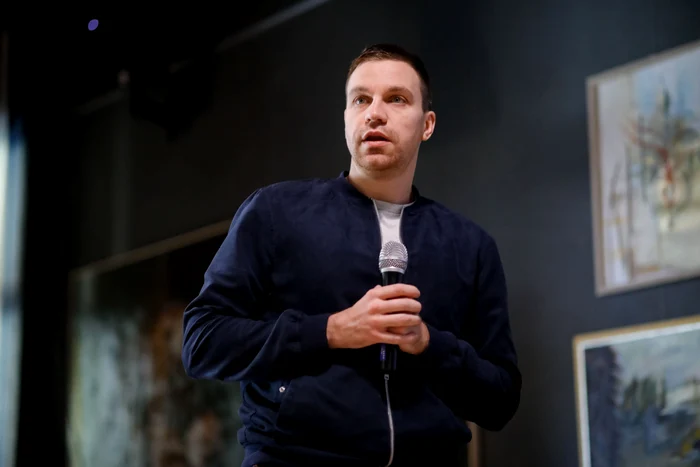
Radu delicate. Photo: personal archive
“That eco-chamber, the eco-chamber theory, that explains. People do not read anymore, they do not have the patience to understand, people do not want to have the patience to understand and reach the easiest emotional reaction, which is, as I said, that after that, the pyramid, comments and in the social representation system“He adds.
Radu Delotes also explains what does Eco-Chambers mean: “You will usually search and enter the bubbles with which you resonate, from which you draw your echo. So if it seems to me that I am interested in green cars, the social media algorithm will take me in such a way as to get where they are debated about the green cars, where people communicate about it.says Delicious.
Thus, the conclusion is not wrong that, in fact, the internets are actually pushed to become more superficial and more aggressive in expression on social networks.
“In fact, it is a mix of factors. It is not our exclusive fault, it is not the consumer. It is the work system of the algorithm. From here everything leaves? It leaves the quintessence of all social media applications, which are made to sell. This is the main goal of Facebook, of Tiktok, of Instagram. But unfortunately, people are made. Fundamental term here. Because that network will work only in the direction of Sales, or only in the direction of bringing you to win, not to inform you objectively, or to help you inform you objectively. The media consumption in which we are is a deeply emotional normality.“Adds Radu Melid.
To what we are heading for
In the future, this phenomenon will be even more accentuated. Other aspects will come to the package with this superficiality.
“The phenomenon will emphasize even more in the coming years, the trend of superficiality will be even greater. And the time allocated to read information or watch a video will decrease even more. There will be a series of changes. And we cannot say that it is necessarily something or something bad, but it is an evolution. At the same social revolution.concludes Radu Delicote.
Who is Radu Delotote
Radu Delot's social media and communication expert has a magna doctorate Cum Laudae in the study of the voting mechanism and its influencers, graduated two master's masters and commercial communication. He is an expert in Social Media, a communication strategist, consultant and analyst, being involved over time in many local, national and international campaigns. Radu Delotte is a teacher associated with SNSPA, the Faculty of Communication and Public Relations. He teaches political and electoral marketing master a course of political sociology, the political and electoral marketing seminar and the communication seminar in digital environments.
As an expert in communication, social media and political communication, Radu Delotte has been quoted in recent years by prestigious publications, international news and television stations such as New York Times, Associated Press, Washington Post, The Guardian, The Daily Courier, Euronews, The Informer, USA News Guide, Capital Bulgaria, Business Review Jazeera Balkans and chairlift.