He was already trying to find the fragments of the Titanic in 1977. This time, Ballard wanted to use the remotely controlled underwater vehicles capable of transferring videos to the research ship, but it was difficult for him to find funding to implement his idea.
Ultimately, the US Navy supported the development of Ballard technology – a deep -sea visualization system, called “Argo”. The US Navy wanted to use it to clarify the causes of the flooding of two atomic submarines “Treesher” and “Scorpio” in the Atlantic in the 1960s, as well as for the wider purposes of collecting intelligence information.
Ballard convinced the leadership of the Navy to allocate time to search for the Titanic during an expedition to examine the submarines, which ultimately served as a cover for the secret mission of the Navy.
“At that time, people, at least many, did not know that the search for” Titanic “was a cover for a super -secret military operation,” Ballard said. According to him, the United States did not want the USSR to find out where there are submarines that they examined.
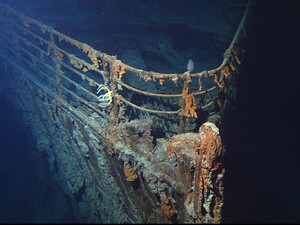
Despite the long preparation, Ballard was not sure that this time the Titanic would find. There was little time in search, and the French team of engineer Jean-Louis Michel from the Institute of Ifremer used a new complex system of on-board Sonar. The teams agreed that the French would find a ship, and Ballard would spend a week shoot there for a week. But the French team, although it was close, did not notice the wreckage, and in the end it was the “camera on the rope” by Ballard who first filmed what was left of the Titanic, the article says.
Context
The Titanic crashed on the night of April 14 to 15, 1912. The ship collided with the iceberg and sank in the Atlantic Ocean. As a result of the disaster, almost 1.5 thousand people died.
The sunken vessel was discovered in 1985 and is at a depth of 3.9 km at the bottom of the Atlantic Ocean 590 km from the coast of Newfoundland Island in Canada.