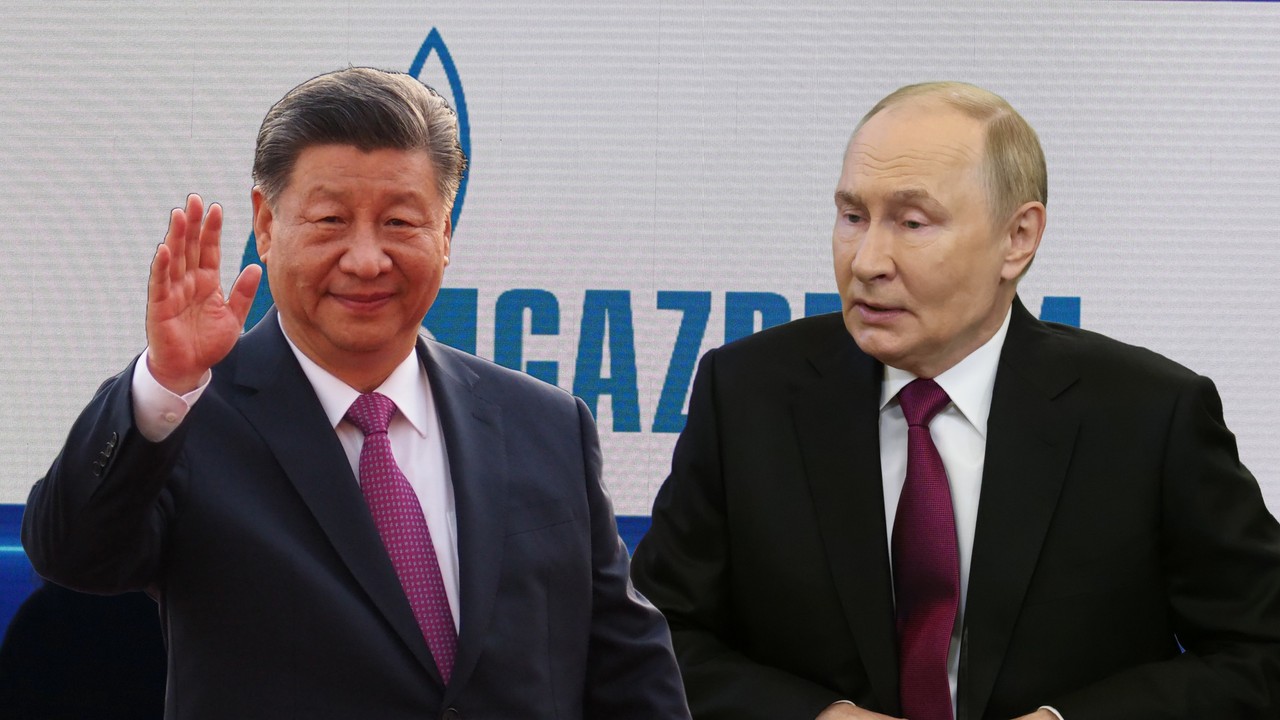
Gazprom undertook to deliver 50 billion cubic meters through the future gas pipeline. gas annually for 30 years. In addition, the Chinese agreed, starting from 2031, to take the force of Siberia, not 38, but 44 billion cubic meters. gas per year and increase the contract for an annual gas import of the Far Eastern Far -Stock route from 10 to 12 billion cubic meters.
It looks like a breakthrough in negotiations, which both Gazprom and the President of Russia were leading with the Chinese for many years – And so far they met with a blockade from China. However, this breakthrough has a second bottom, which the Russians do not seem to see.
Despite the negative attitude of Beijing, the Russians began building the gas pipeline Siberia 2-Gazprom needs deposits in the Jamal-Niencie autonomous district, To save the contract for the first thread, the strength of Siberia before the disaster.
In the current configuration, it is not able to transport through the Chinese limit of the promised amount of gas. Of the two deposits: Czajandinskoje in Yakutia and Kowietty in the Irkutsk region – a total of 42 billion cubic meters can be extracted. gas, which contains both undesirable nitrogen and valuable helium and raw materials for chemical production (ethan, propane, butane, etc.). There are exactly 38 billion cubic meters for export.
The problem is that these deposits will not be able to provide such gas values for 30 years, as the Shanghai agreement assumes. According to specialists working there (I saw the relevant documents), Gazprom conducts predatory operation of gas deposits, artificially increasing the efficiency of the wells. Despite the violations of technology, the performance of the average well in Czajanga fell from 224 thousand. Siśc. Daily up to 200,000 The annual capacity of the deposit does not exceed 21.3 billion cubic meters. Instead of planned 25.4 billion. The situation does not look better on Kowiekt.
Incorrect assessments of the potential of these deposits led to the signing of a document that was impossible to implement in advance. This caused a scandal inside Gazprom, and eventually led to extremely expensive actions to fix this error.
Continuation of the material under the video
Gazprom is not waiting for China's consent – it works in full swing. He opened the office of a subsidiary Stroytransneftegaz in Nowosibirsk, entrusted with the construction of a gas pipeline – it is to help the Russians fulfill their obligations towards the Chinese made as part of the Siberia Strength project. The second thread of this gas pipeline is to connect the deposits in the Jamal-Niencie autonomous district with Kowykta and Czajanda. There, in the north, Gazprom withdraws from many years of conservation compressors, which will be used for future supplies for the Siberia Strength project. Currently, the bandwidth of pipelines already running in this direction is being expanded.
For the benefit of China
Sources in Gazprom say that in order to build a pipeline, the strength of Siberia 2 oil giant has made the decision to buy pipes with a diameter of 1420 mm from high quality steel with a wall thickness of 38.1 mm to pump gas under increased pressure. The total cost of building a bus together with compressor stations was estimated at over 2 trillion rubles (PLN 90.8 billion).
Even before signing the memorandum, it was clear that the strength of Siberia 2 would be built – at least on the territory of Russia and Mongolia, where Gazprom's initiative was received with open arms.
There is no mention of the sources of project financing in the Memorandum. Judging by experience with the gas pipeline, Siberi's force-in 2014, Gazprom triumphantly stated that the Chinese would give $ 20-25 billion. (PLN 73 billion-91.2 billion) for its construction, but it did not happen- Gazprom will spend the money. China will cover the costs of building infrastructure on their territory.
The most important question is – what price will these additional amounts of Russian gas be delivered to China? Recently, the Financial Times wrote that the Chinese insist on selling gas at prices in Russia – and therefore lower. As Miller said, the commercial issues of transactions will be announced separately. It cannot be ruled out that Gazprom had to make concessions to the Chineseto obtain a long -awaited consent for the implementation of the project, because Putin closed the European Rynek.
It should be remembered that the Chinese pay for gas supplied with a pipeline Siberia, not $ 400. (PLN 1463) for 1000 cubic meters, as announced when signing the contract in 2014, but just over $ 200. (PLN 732). Given the huge costs of gas infrastructure and exploitation of deposits, it can be said that Russia will actually subsidize Chinese gas consumers – with a loss for itself.
I’m Ashley Davis as an editor, I’m committed to upholding the highest standards of integrity and accuracy in every piece we publish. My work is driven by curiosity, a passion for truth, and a belief that journalism plays a crucial role in shaping public discourse. I strive to tell stories that not only inform but also inspire action and conversation.