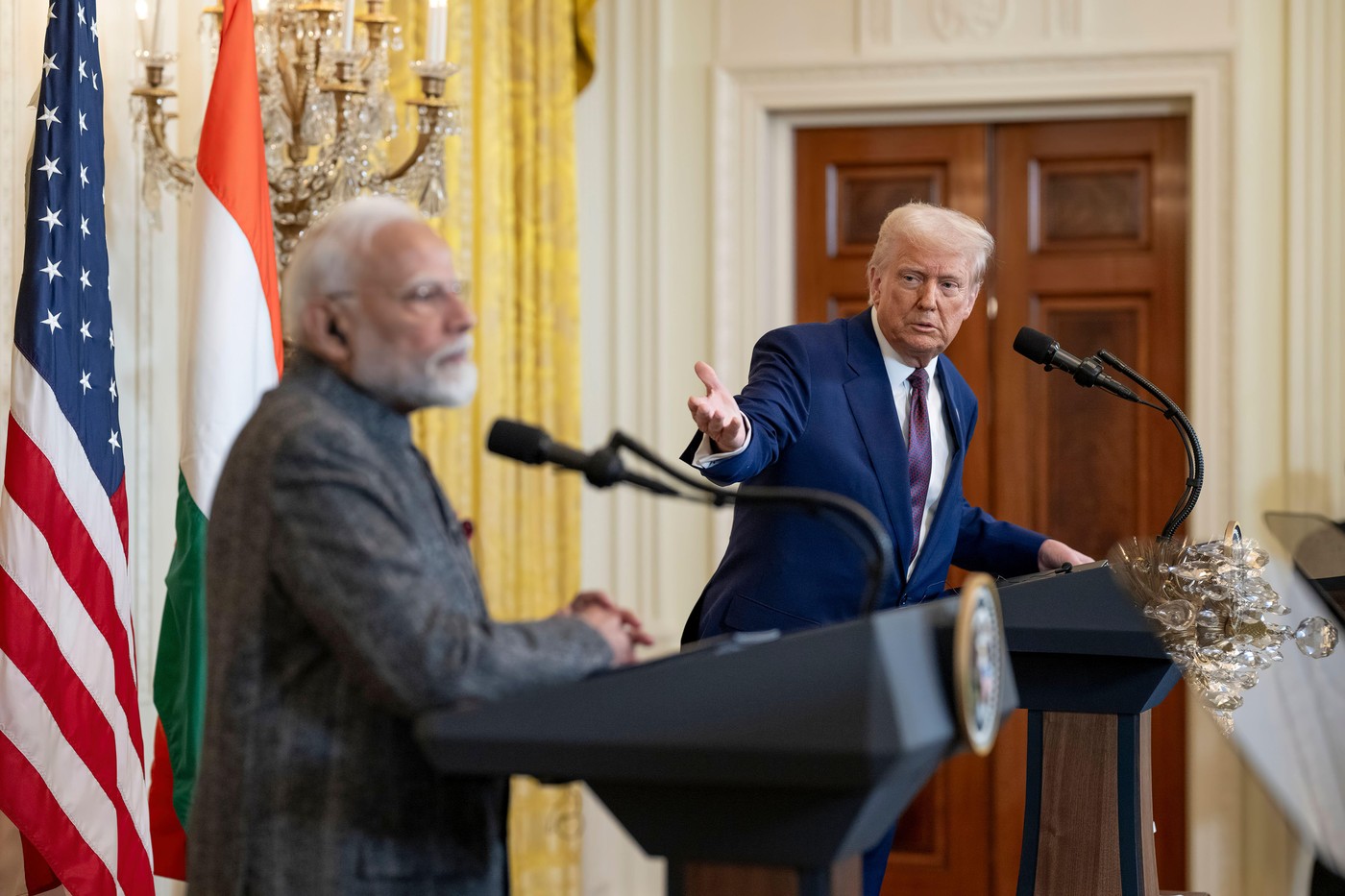
Trump's repeated statements that he would have resolved the war between India and Pakistan angered the Prime Minister of India, Narendra Modi. But this was just the beginning, writes The New York Times
The Prime Minister of India, Narendra Modi, lost his patience with President Trump. Several times, in public and exuberant, Trump said he put an end to the military conflict between India and Pakistan – a dispute dating back over 75 years and is much deeper and more complicated than Trump believed.
During a telephone conversation on June 17, Trump put the problem on the wallpaper, emphasizing how proud it is that he ended the escalation of the situation on the military plane. He said that Pakistan has to propose it for the Nobel Peace Prize-an honor for which he campaign. According to the statements of some people to the telephone call, this allusion did not want to show that Modi should do the same.
The Indian leader jumped like burnt. He told TUMP that the mix of the United States has nothing to do with the recent armistice. It was directly agreed between India and Pakistan.
In general, Trump overlooked Modi's statements, but the disagreement – and Modi's refusal to plead for the Nobel Prize – played an important role in worsening the relationships between the two leaders, some close times, who dated Trump's first term.
The dispute has occurred in the context of negotiations on extremely important commercial issues for India and the United States, and quarrels are likely to bring India closer to Beijing and Moscow's opponents. At the end of this week, Modi went to China, where he will meet President Xi Jinping and the President of Russia, Vladimir V. Putin.
This article is based on a series of interviews with over ten personalities in Washington and New Delhi, most wanting to keep their anonymity to discuss a relationship with wide implications for both sides, Trump eroding a strategic relationship, and India irritating its largest commercial partner at a time when the country is trying to maintain its economy.
Just a few weeks after the telephone call and at a time when commercial negotiations are delayed, Trump surprised India, announcing that imports from this country will be subjected to 25%customs duties. On Wednesday, he sanctioned India with taxes of another 25% because the country purchases Russian oil, all adding a 50% crushing percentage.
Modi, who said in the old days that Trump is a “true friend”, thus officially entered into bad relationships. According to the statements of some people to the President's program, after telling Modi that he would come to India during the year for a meeting of the Quadrilateral (group of Australia, India, Japan and the United States, n. Red.), Trump does not plan any visit this fall.
In some groups in India, Trump's attitude is now considered to be a humility at national level. Last week, at a festival in Maharashtra, a Trump's effigy effigy was walked on the streets with an inscription by which he was declared a traitor. The blows from the United States were so heavy that an Indian official declared them as “Gundardi”: a true violence or aggression. After the telephone conversation of June 17, the two did not speak.
Essentially, Trump's story is that between two proud and popular leaders, with strong personalities and authoritarian tendencies, and a whole network of faithful people helped the two to stay in power. But it is also the story of an American president with his eyes on the Nobel Prize, confused in a Tabu problem of Indian politics: conflict with Pakistan.
An invitation to Washington refused
In June, when Trump and Modi discussed on the phone, the event would have been a chance to resume relationships and resume negotiations on current commercial topics. Or, that didn't happen.
The conversation, which lasted 35 minutes, took place when Trump had just returned to Washington, aboard the Air Force One aircraft, after leaving the high level of the 7 industrialized state (G-7) earlier, held in Camada, attended by Modi.
Modi refused Trump's invitation to stop at Washington on the way home. His officials were scandalized, fearing that Trump might force their boss to shake hands with the head of the Pakistani army, who had also been invited to lunch at the White House about the same period. According to the statements of a high Indian official, it was a new gesture that showed that Trump does not take into account the complexity of the problems between them or their past and delicacy.
Subsequently, it was spoken of an attempt to agree on a new telephone call, for a partial commercial agreement. But, as the confidence between the two leaders had been eroded, the Indians were afraid to put Modi to talk on the phone with Trump. Indian officials have been afraid that Trump could post whatever goes on his head on the Social Truth portal, regardless of the agreements agreed during the conversation, as an Indian official said.
According to the statements of two persons up to date with the discussions, who wanted to keep their anonymity, not being authorized to make public statements, dissatisfied with the negotiations on customs duties, Trump has tried several times to contact the Modi.
The respective persons state that the Modi has not responded to these requests.
Anna Kelly, the white house spokeswoman, denied that Trump tried to get in touch.
On a last occasion, on Wednesday, before the new 25% increase in customs duties, Trump announced that he appoints Sergio Gor, a close counselor, as an ambassador to India, also receiving the special emissary in the region (Indian officials did not know how to interpret this name – Gor, but Gor was a nearby – Gor. offended by his appointment as a regional emissary, who, in their opinion, put India and Pakistan in the same pot).
A few hours before the deadline, a number of officials from the United States and India had a teleconference, which discussed several issues, from trade to defense cooperation.
But, leaving aside the fact that customs duties entered into force according to the announcement, in addition, Trump's advisers continued to make statements against India. Referring to India's attitude in commercial negotiations, someone said that the approach of India is “arrogant”, and another has arrived so far, that he called the conflict in Ukraine as “the war of Modi.”
Now, at least publicly, Modi seems to avoid talking about commercial neo -resorts. Instead, he speaks of “self-confidence” and resumes the campaign for 10 years, under the slogan “to win in India”, while continuing to rely on the home.
And during his visit to China from the end of this week – the first visit of Modi in the last seven years – it is expected to enjoy a receptive audience than some stronger and wider relationships with Beijing and Moscow.Material made with the support of Rador Radio Romania)