– German responsibility for (committed by the Germans) crimes remains, does not expire. (…) German responsibility is also ongoing, so that what happened there would never happen. Responsibility goes to the next generations of Germans that will come for us – said the Minister of State for Culture and Media Wolfram Weimer during the anniversary ceremonies in Berlin.
They were also attended by the mayor of Berlin Kai Wegner, secretary of state in the German Ministry of Foreign Affairs, Geza Andreas von Geyr and head of the Polish embassy in Germany, Jan Tombiński.
According to Weimer, the Germans devote too little attention to the suffering of Polish society during the German occupation – you need to know what the Germans did in Poland and other occupied countries during World War II.
Minister Weimer emphasized that in the face of the Russian invading war against Ukraine and the end of the post -war European order, it was time to reflect that “the European future requires a common European memory.”
A representative of the German government said that the consistent work of German crimes and the memory of the victims of the German occupation are “central” for German memory culture.
Jan Tombiński: The weakest always becomes the first victims
Tombiński referred to the air attack on Wieluń and said that “every war brings dramas and tragedies, whose first victims are always the weakest.” – For over 25 years, for the first time in history, Poles and Germans are allies. Settlement with the wounds of the past will only strengthen our ability to deal with new challenges together – said the Polish diplomat.
The ceremony took place at a temporary monument in honor of Polish victims of World War II, near the Bundestag and the Chancellor's Office. In this place during the war there was Krrolla's opera, in which Adolf Hitler on September 1, 1939 gave a propaganda speech about starting aggression on Poland.
The 30-ton boulder-“Memorial stone for Poland 1939-1945” was unveiled in mid-June and is to perform its function until the creation of the Polish-German House, combining the function of the monument, documentation and educational center and meeting place.
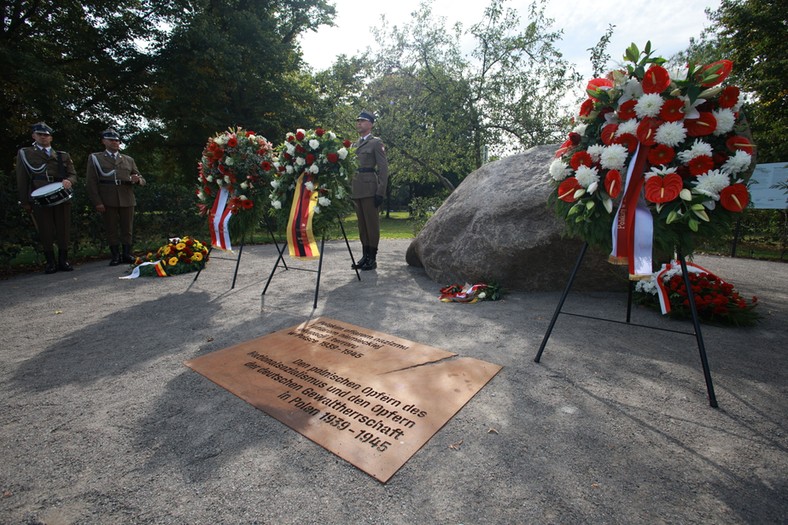
30-ton boulder-“Memorial stone for Poland 1939-1945”
On the board placed on it there is an inscription in Polish and German: “Polish victims of Nazism and the victims of German occupation and terror in Poland 1939-1945”. At the memorial site for Poland, an information board was also placed in three languages: Polish, German and English, which says, among others, that “German occupation in Poland has left unimaginable suffering and havoc.”
The German-Polish house was adopted in June 2024 by the German government. Before starting to be implemented, the Bundestag approval is still necessary.
In the evening, at the headquarters of the Berlin representation of the Pilecki Institute, there was a lecture “without the victory of the Wehrmacht there would be no Auschwitz” and a discussion of historians about the German assault on Poland as an introduction to the war for destruction. Martin Aust from the University of Bonn, John Zimmermann from the Bundeswehr Military and Social Sciences Center in Potsdam and Jerzy Kochanowski from the University of Warsaw took part.