Russia demands the teaching of the whole Donbas, Ukraine, real security guarantees. And if Ukraine will be forced to fight further, it needs more soldiers. It's just that they are increasingly difficult to find. Many of them hide in their own homes or change their address.
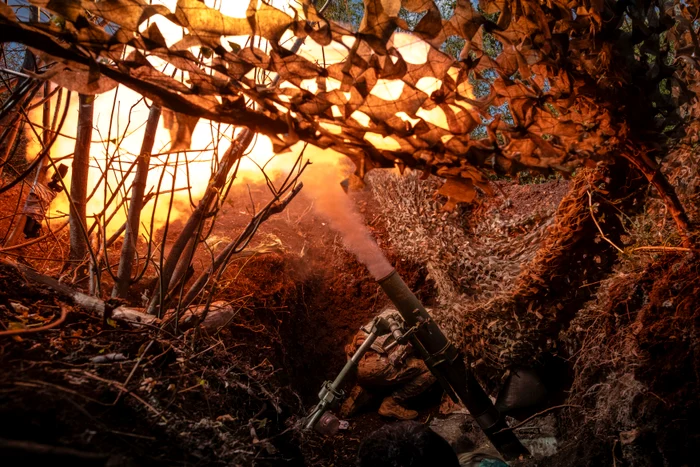
Profimedia photo
To respond to this crisis, Ukraine has taken measures to increase its recruit basin. At the same time, he protects those he already has: deserters. Some of them returned to the battlefield and are an oxygen mouth for the Ukrainian army.
In the last year and a half, Oleksandr, 36, did not set foot outside the house.
“I feel guilty,” he admits. “I am afraid to join the infantry. The deficit of men is huge and many new mobilized.”
About 800,000 Ukrainians avoid possible summons, while several thousand exploits legal exemptions, according to official figures.
Others, like Oleksandr, hope their ringtone will never call.
“I could leave the country; my family has contacts, but I refuse. I have principles,” he says.
Why the Ukrainians run off the front
The story of the deserters is a completely different one.
The brothers “Old” and “Google” are stationed on the front in the liman. There are excellent FPV drone pilots and members of the 20 K-2 regiment, one of the most successful drone units.
I smile when they remember their latest “vacation”. It is a joke between comrades and a way to describe that they left the front and returned.
30,000 soldiers have returned to the Ukrainian army since Kiev adopted a law offering amnesty to those who voluntarily return, according to official figures.
According to officers who talked to The Telegraph, many soldiers deserted due to suicidal orders or an excessively rigid control style.
150,000 soldiers have deserted in the last 18 months. But those who return are a valuable resource for exhausted units: I know what to do and do not need further training.
“We had all the equipment we needed, but the commander ordered us to destroy the cheap Russian cars instead of saving the lives of our infantry in trenches. And we did not agree with it,” says “Google”, who fought at Adviika.
The K-2 regiment, a unit set up last year, is appreciated precisely because it puts its soldiers in the first place and emphasizes technology: robotic vehicles for demination, ammunition and food, evacuation of injured soldiers. This explains that he has received thousands of applications for enrollment from former deserters.
The interest of recruits for elite brigades is increasing
The Brigade Hartiia of the National Guard, for example, is a pioneer in the adoption of three solutions to the infantry crisis: foreign fighters, women and recruits under 25 years.
“Sometimes the Ukrainians make mistakes. The army has too many civilians. We, at least, have some experience,” says Astro, a former Colombian soldier.
But neither the deserters, nor the foreign fighters are sufficient to cover over 1000 km of active front.
That is why, in Ukraine – and abroad – the calls are multiplied to reduce the recruitment age below 25.
In February, Kiev launched a voluntary campaign to recruit young people between the ages of 18 and 24 for infantry.
Terms: a one -year contract, 80 days of training, a bonus of 3,700 pounds, zero interest mortgage, free medical care, permission to travel abroad and one year without mobilization after the first 12 months of service.
In the first two months, 500 men were registered and another 1,500 were in the process of recruitment. Since then, the program has expanded.
Now, they can enroll like drone pilots, but they have to engage for two years instead of one. Even so, the number of brigades increased from six to 46.
Mala, 44, is a drone pilot in the 39th Brigade and is fighting on the Herson front.
“Our men do not want to serve and say that girls are not useful, but our women are stronger than many of them,” says Mala.
But he worries that he will not be able to leave. Theoretically, the martial law forbids them. Most contracts are concluded by the end of the war.
Uncertainty discourages many to take the step.
That is why active soldiers demand a new rotation system. But it is only possible with the resolution of the recruit crisis. It's a vicious circle.