NATO and Ukraine team in a race to introduce cheap, rapidly developed defense systems, to combat some of Russia's most challenging weapons: glitter bombs and fiber optic drones.
Several of these projects are already in different test phases, directly involved military officials said for Business Insider.
It is a counter -terror meter. The Ukraine war evolves rapidly, both camps developing new weapons and tactics. Therefore, the countermeasures must keep up.
“The rate of evolutions on the battlefield is very high,” said the Polish brigade general Wojciech Ozga, the commander of the Training and Education Center for Analysis NATO-UKRAINA (Jatec). “So you have to adapt very quickly.”
Jatec was launched in February to extract real -time lessons from the Ukraine war and inform NATO's defense planning. Based in bydgoszcz, Poland, has the mission to identify cheap solutions to the biggest threats placed by Russia on the battlefield.
The initiatives are designed to be a quick response: from concept to testing and conduct in Ukraine, while expanding NATO's defensive arsenal for potential intensity conflicts.
The relationship is mutually advantageous: NATO does not have Ukraine's experience on the battlefield, while Kiev does not have the same analysis capacity.
“So we support each other,” says Ozga.
Bombs with planar
The Ukrainian Ministry of Defense has so far requested support to find solutions to two of the greatest Russian threats. The first task was for Jatec to find solutions against plague bombs, weapons with a devastating effect that are launched from places beyond the range of air defense.
Russian aircraft constantly attacked Ukraine with these planar bombs, modified projectiles to function as precision ammunition. They are difficult to intercepted, because they have weak radar signatures, have short flight time and fly on non-ballistic trajectories.
Russia has used bombs of different sizes, even almost three tons, to target Ukrainian cities and positions. So far, the best chance of Kiev to counteract them was to attack the airplanes before starting to launch or destroy ammunition from warehouses.
Common projects
In March, the NATO Allied Command for Transformation and Jatec hosted a “challenge of innovation”, in which the companies in the Ukrainian and Western defense industry presented the ideas. In total, there were 40 proposals.
Three projects were winning: a radar that predicts the trajectory of the bomb, an autonomous interceptor drone with an explosive fossa and a drone wall.
The Ukrainian colonel Valerii Vyshnivskyi, the main representative of Kiev in Jatec and the program of implementation of the program, said that solutions can be used individually or together and have already been tested in Ukraine against Planar Bombs and Kamikaze attack drones.
Vyshnivskyi said that the defense was quite successful against Shahed drones, but improvements are needed for glitter bombs, more difficult to fight. The next step is for the new solutions to pass in the final testing phase.
Pierre Delom, a project coordinator at the Allied Command for Transformation, said NATO is now trying to estimate the costs of these defense systems, to increase production and to take them to Ukraine by the end of the year.
“We could be at war tomorrow. I hope it will not be the case, but it is not excluded,” Delom said. In such a scenario, the NATO alliance could wake up working on much more expensive defenses than the countessment threats, putting the alliance on the wrong side of the cost curve.
“So, we need a mass production of low -cost solutions,” he said. “This is the key.”
Drones that cannot be bruised
The second request for support from the Ukrainian Ministry of Defense is aimed at fiber optic drones.
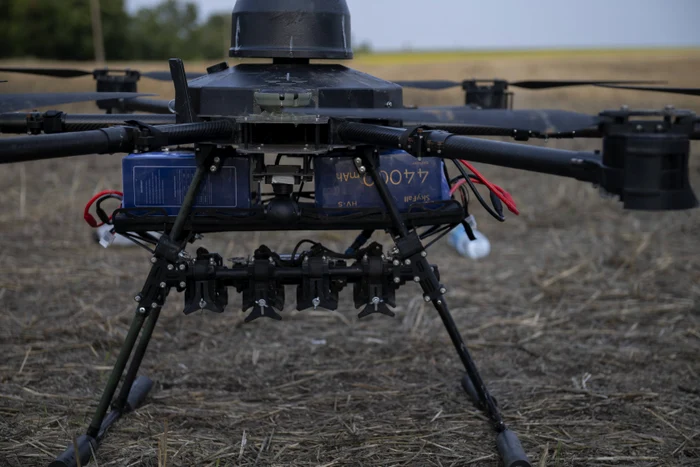
Fiber optical drones have become a redoubtable threat on the battlefield in the last year. These are ordinary FPV – small, cheap and available quadcopters – except that, instead of a radio connection between drone and operator, they are equipped with long and thin cables.
The fiber optic cables allow a constant reliable connection between the drone and its pilot, practically making them immune to the electronic war tactics. They are particularly dangerous, as they are essentially highly maneuverable precision weapons.
At this time, there is no reliable defense against fiber optic drones. A defensive option for soldiers is to shoot them. It's a lottery, but I'm a chance to get them out of battle. These drones cost only a few hundred dollars, but have the ability to carry an explosive load large enough to damage or destroy a tank of several million dollars.
In June, Allied Command Transformation and Jatec hosted a new competition of potentially innovative projects. This time, the Ukrainian and Western defense companies presented 162 solutions. Again three winning projects were chosen.
Criteria: The ability to work day and night, at any time, has a 500 -meter detection ray and have a profitable design, according to NATO standards. According to Delom, the winning solutions of Innovation Challenge consisted of a radar and two autonomous tours.
According to Vyshnivskyi, the next step is the field tests on NATO.
Currently, Jatec only works on solutions against fiber optical drones and pillar bombs. Vyshnivskyi has identified the third major threat on the battlefield, more recent: the small infantry assault groups. These Russian units are extremely mobile, lethal, and do not bear a signature as visible as the armored formations, having a great flexibility to infiltrate the Ukrainian positions.
The Ukrainian Ministry of Defense has not yet requested Jatec support to deal with this danger. However, it is not excluded to be the next challenge for innovative projects. Meanwhile, as NATO continues to extract conflict lessons, one of the biggest obstacles is the rapid reaction, so that the solutions do not lose any relevance.
“We must adapt in the fastest way using the experience that our partners in Ukraine have at this time,” said Ozga, the Polish commander.