“You are as journalists in the middle of a continuous threat“-reports on Monday morning the presenter of the Egyptian television station Al-Ghad during live broadcasts with Chan Junus. Several journalists and rescuers stand in one of the rooms of the bombarded Nasser hospital in the Gaza Strip.
From the studio in Cairo, the presenter asks about the coordination of the press's actions with the Israeli army. Before the correspondent managed to finish his answer – “There is no immunity,” the second explosion interrupted. Employees of the medical service and five journalists died in the attack. Mariam Abu Dagga was among the victims, who worked, among others for the AP news agency, and cameraman of the Reuters Hussam Al-Masri agency.
International criticism of Israeli attacks has a huge scale. Even the German government said that it was “appalled” by the death of journalists. In the afternoon, the office of the Israeli Prime Minister Binjamin Netanyahu claimed that “Israel deeply regrets this tragic accident.” The army (IDF) announced the investigation and assured that it did not intentionally attack journalists.
At the beginning of August, IDF informed differently about the killing of Al-Jazera journalist Anas Ash-Szarif. “Hit” – it was written in a post on platform X, adding an emoji shotgun with an arrow in the middle. Israel called the 28-year-old “Terrorist Hamas, who claimed to be al-Jazery journalist.”
Over 200 journalists
Both events took place in the context of the announcement by Israel's intention to seize the city of Gaza. Until the occupation of the largest city on the coast, up to 130,000 are to be mobilized. reservists. Ok 1 million civilians will be resettled. This project met with international condemnation and even in the Israeli army you can hear voices of doubts as to the need for this operation.
Continued article under video material
Already after the raid on Anas Ash-Szarif at the beginning of the month several countries demanded explanations and better protection of journalists. “Since the beginning of the war, as a result of the attacks of the Israeli army, over 200 journalists and 200 media employees were killed in the Gaza Strip,” said Steffen Meyer, spokesman for the Ministry of Foreign Affairs of Germany. “Such a high number of fatalities is absolutely unacceptable“.
The Israeli army tried to present several documents to confirm the journalist's belonging to Hamas. These documents have not yet been independently verified.
– We believe that these alleged connections and statements they are not a sufficient basisto recognize Anas Ash-Szarif as a veteran within the meaning of international law, which you can simply kill-says Christopher Resch, spokesman for the Middle Eastern Department of Organization. Reporters without borders.
Since the outbreak of war Independent reporting of events from the coastal belt has become even more difficult. Foreign journalists can enter the Gaza Strip “with the Israeli army, but they see only selected places and are subject censorship military in issues related to security, like other media operating in this country. Enabling reporters to access the enclave would be “a preventing agent so universal around the world and many false messages” – believes Resch.
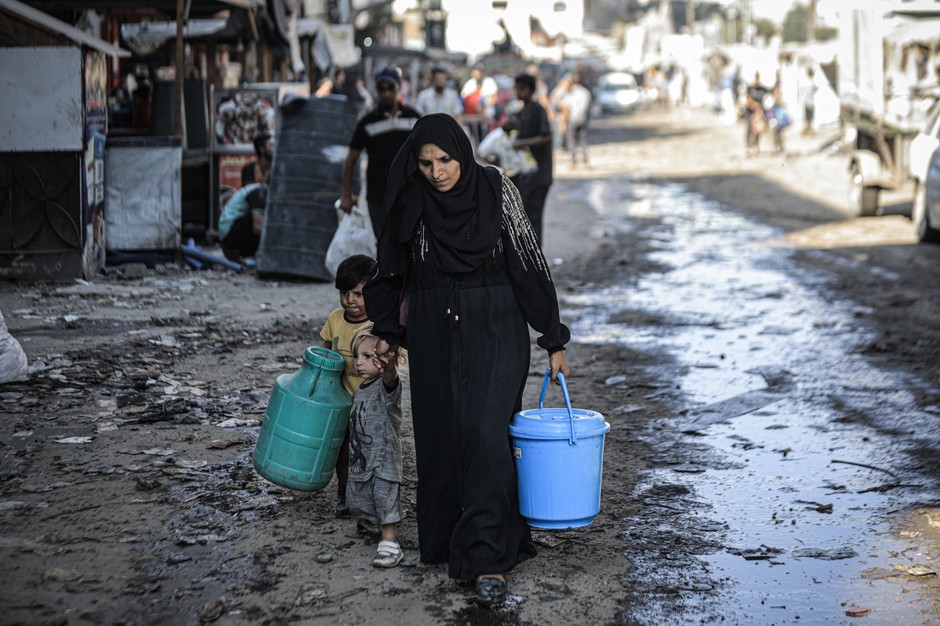
Humanitarian disaster in the Gaza Strip, August 26, 2025.Ahmed Jihad Ibrahim al-Arini / Anadol Via Getty Images / Contributor / AFP
“Hell”
For the local population, reporting of events is not only difficult, but also dangerous. The war, which began with the attack of Hamas on Israel on October 7, 2023, has been going on for almost two years. A significant part of 2.1 million Palestinians living in a closed coastal area was displaced many times.
In the destroyed enclave, both reporters and all people are exposed to the dangers of Israeli bombings and violence. The effects of war, such as escape and lack of access to food, clean water and medical care, also affect the few reporters on the spot – and affect everyday life.
As such circumstances specifically affect Palestinian reporters, he describes Ghada Alkurd, who works as a correspondent for international media, such as “Spiegel”, in a closed Gaza Zone. At the beginning of the war, a divorced mother escaped south of the enclave, while her two daughters, aged 10 and 12, remained with her father in the north.
“I didn't see my daughters for a year and five months. It was hell,” writes Alkurd.
In the war zone, a sense of security was erosion, especially among women. “I am still in a state of readiness, I give my girls instructions on how to speak, laugh, look” – adds the journalist.
In addition to Israel's policy, it turns out that Hamas is not the only entity in the Gaza Strip that is trying to impose his will. Along with its weakness, armed clans spread in the enclave. By attacking journalists, they want to intimidate reporters. As Hamas' critics from the Gaza Zone regularly inform, many of these seizures have radical Islamists on their conscience.
Often, brutal retaliation is a reaction to critical statements in social media or against foreign media. Hamas and other groups “do not tolerate critical relationships,” says Resch. At the end of July, the Palestinian Association of Journalists condemned one of the attacks in the city of Chan Junus and indicated as perpetrators special branches of Hamas.
I’m Ashley Davis as an editor, I’m committed to upholding the highest standards of integrity and accuracy in every piece we publish. My work is driven by curiosity, a passion for truth, and a belief that journalism plays a crucial role in shaping public discourse. I strive to tell stories that not only inform but also inspire action and conversation.