
The most spectacular constructions in Romania for recent years. The engineering challenges of the great infrastructure works


The most complex works of road and railway infrastructure in Romania are still in the site, but in the last decade, some of these large projects have offered reasons for pride to their builders.
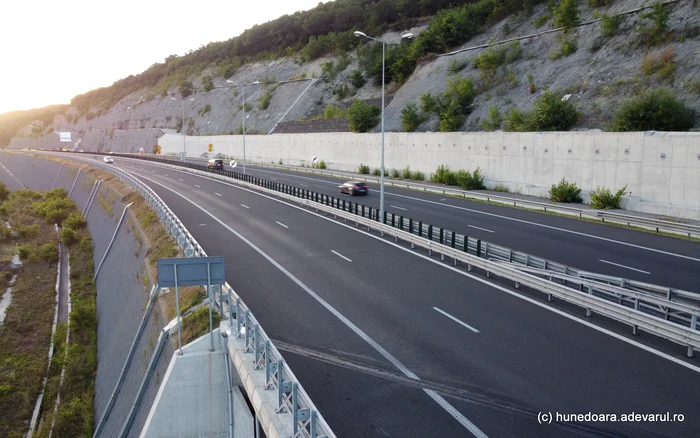
Liliecilor Hill. Photo: Daniel Guță. TRUTH
Romania entered the 21st century with just over 110 kilometers of highway, built with great efforts in the years of communism. In recent years, the situation of the road infrastructure network has improved considerably. Some spectacular art works, recently inaugurated, gave pride in both the builders and the authorities.
The Aciliu Viaduct – the highest in the country
Several spectacular viaducts are currently in the site on future highways Sibiu – Pitești (A1) and Transylvania (A3) Cluj – Oradea.
The longest of them, located in the town of Suplacu de Barcău, has a length of almost two kilometers. However, for now, the Aciliu Viaduct, on the A1 motorway, is considered one of the most complex works of this type.
The Aciliu Viaduct, located in the vicinity of Sibiu, was inaugurated in the autumn of 2014, after an investment of over 600 million lei. It has a length of over one kilometer and a maximum height of 78 meters.
At Aciliu, the highway was raised on 12 pairs of concrete pillars, implanted 40 meters deep in the sandy soil in the valley. One of the pillars reaches almost 80 meters high. In the vicinity of the viaduct, on the hill of Săcel, a tunnel with a length of 340 meters was built.
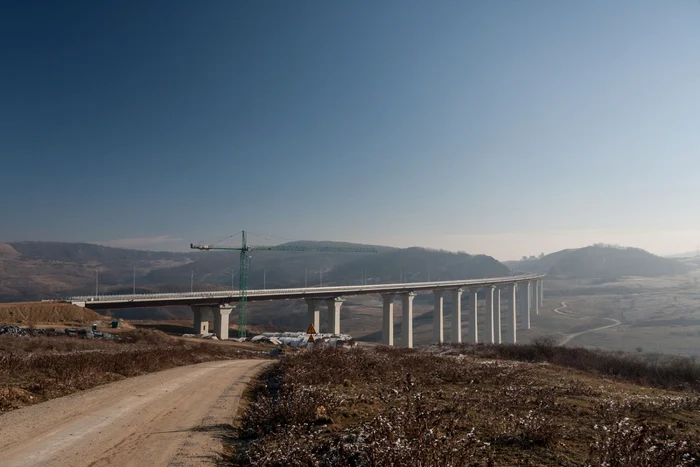
Aciliu viaduct in the construction site in 2013. Photo: Sorin Vasilescu
During the construction of the Deva – Sibiu highway, but also after the completion of the works, the clay land in the area generated many problems.
The viaduct and its adjacent area were affected by surface landslides, and to remedy the defects, a segment of the highway was demolished and rebuilt shortly after the traffic opening.
Turdaș tunnel dug into a hill
Over 200 railway tunnels have been built in Romania since the middle of the 19th century, with the realization of the first railways, and until now.
After 1990, only five tunnels and two poles (wall tunnels), with a total length of about four kilometers, were completed. The last of these, 650 meters long, was built in Bătuța, Arad county, on the new Simeria – Arad bus, part of the European IV corridor.
Other tunnels are in the site on the same bus, on the Mureș Valley, in Hunedoara county, and in Brașov county. Homorod tunnel galleries will have a total length of 6.9 kilometers, and those from Ormeniș include two tunnels with a length of 5.1 kilometers each.
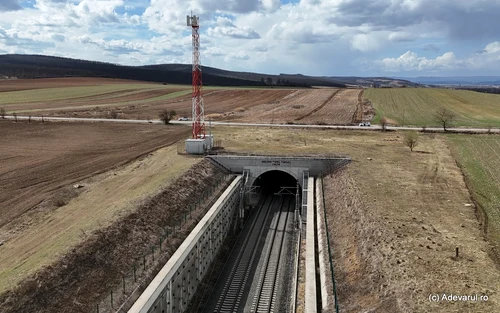
Image 1/8:
Tunnel Turdaș Photo Daniel Guță Adevărul (13) JPG
One of the most complex railway tunnels built in recent years in Romania is located in Turdaș (Hunedoara county), on the Arad – Simeria – Alba Iulia route, from the Pan -European corridor.
It has an underground length of almost 800 meters and is completed with two uncoated sectors, which, together with the tunnel, measures almost 2,500 meters. The Turdaș tunnel, completed in 2019, was built in the curve on a length of 605 meters, followed by an 80 meter connection curve and a 95 meter alignment. In the longitudinal plane, the tunnel has a slope of 5 per thousand.
Its construction was necessary to allow the railway to pass through a soft and unstable area. Without it, the new railway should have followed a difficult and risky route due to soil nature.
“The Turdaș tunnel has a major technological importance, being the first in Romania built in full by the construction method in open trenches, in land with large swelling. This type of soil represents a technical challenge, because it can cause structural movements and instability. shows the Institute of Studies and Designs Railway (ISPCF).
Liliecilor Hill, excavated to make room for the highway
On the right bank of the Mureș River, a large -scale infrastructure work, known as “Liliecilor Hill”, remained one of the most complex constructions inaugurated in the last decade in Romania.
The name comes from a cave in the area that housed a colony of bats. The hill was excavated to make room for a section of about two kilometers in the A1 Lugoj – Deva highway, in the area of the Şoimuș road node, Hunedoara County.
The route of the highway passed directly through the massif, and the solution chosen to maintain the direction and slope designed was the excavation of the slope and the removal of hundreds of thousands of cubic meters of rock.
Both during the works and after their completion, there were landslides and boulders. In order to reduce the risks, the builders have installed protective nets on the rock wall, support metal elements and anchor systems for the consolidation of the slope.
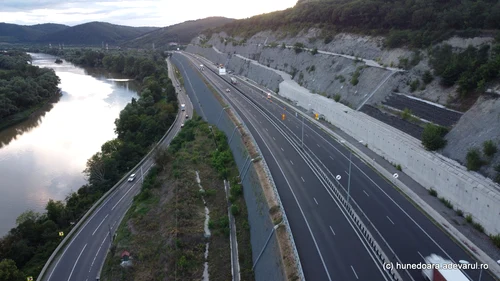
Image 1/12:
Lugoj Deva highway, Liliecilor Hill again in photo site Daniel Guță Adevărul (33) JPG
The construction of the highway segment, inaugurated in 2019, was complicated not only by the instability of the land, but also by the presence of the bats.
The works were delayed more than a year after the existence of a small colony was reported in a cave in the hill. They were monitored for a year, then relocated, and the slope excavation could start in 2017.
Bridges over the Danube
Two bridges over the Danube complete the string of the most spectacular infrastructure works completed in recent years in Romania. The bridge “New Europe” Calafat – Vidin was built between 2007 and 2013 and cost over 225 million euros, Bulgaria funding most of the investment.
The road and railway bridge, with a length of over two kilometers, has in the meantime became one of the most important links between Romania and Bulgaria, but also between the European Union and the Balkan Peninsula, being crossed by over 11 million cars.
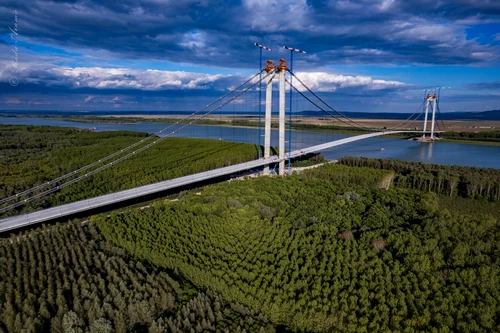
Image 1/4:
Bridge suspended over the Danube, from Braila Photo: Radu Arama
In 2023, Romania inaugurated a new bridge over the Danube, at least as spectacular. The new road bridge from Brăila, suspended, has a total length of almost two kilometers, with a central opening of 1,120 meters and two side openings of 490 and 365 meters.
The bridge was open to traffic in July 2023, but the works on the connecting roads of the suspended bridge were completed only this year.


