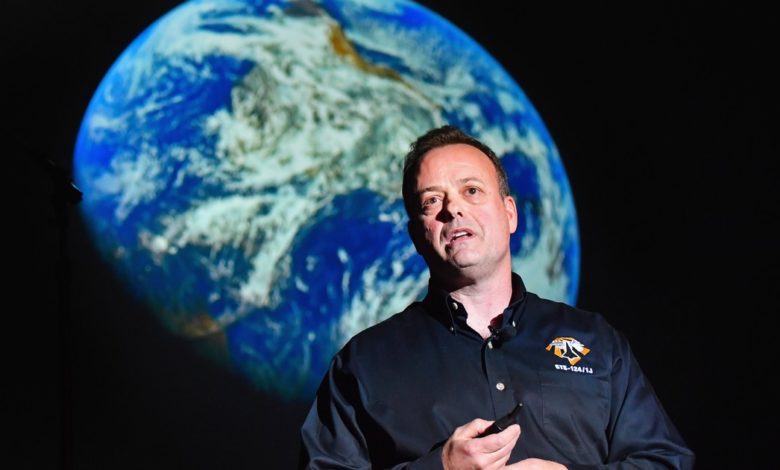
Astronaut Ronald GARAN watched Earth from a height of 250 miles (about 402 km) from the NASA space probe. He claims that he not only saw continents and oceans. He also thought about the beauty and fragility of the earth, but also about the lie, which – in his opinion – rules our perception of the world.
– From space, it is clearly seen how human systems treat earth biosystems: as facilities for the global economy – he said.
After 178 days spent in orbit, as part of two missions, he experienced the “moment of inspiration” – and caused a debate on how our society should be organized and why change is necessary.
Garaan did not come to his conclusions suddenly, and gradually during long hours spent at an international space station. The most caught his attention not so much the image as the thin atmosphere of the earth – a luminous, blue arc, which Garan called “the artery of life for all living beings.” Storms, polar auroras and changes in weather systems – all this, in its perception, took place in harmony, which confirmed how much all these phenomena are related to each other.
This fragile beauty is difficult to see from the ground, but it is impossible to ignore it from space. “You see how everything is connected, but also how much our systems on Earth are separated from this reality,” he said in an interview with Big Think magazine.
“Lie” that rules modern life
His view concerned not only climate change, but also a lack of balance at the level of civilization. For Garan, the problem is not technical or scientific, but philosophical – people have created a global system in which economy dominates society and nature, instead of serving them. “We live in a lie,” he says directly.
This lie is the idea that the driving force to make all decisions must be growth and profit, even if it will harm life support systems on earth. – The economy is not the basis, the basis is Earth. There is no economy without her – says Garaan.
Continuation of the material under the video
His words reflect the growing fears of climatologists, economists and political scientists. In 2021, specialists from Stockholm Resilience Center conducted a study in which they determined the “planetary boundaries” of safe human activity. It showed that many borders – including those concerning, among others biological diversity or geochemical cycles – has already been exceeded, mainly due to economic factors.
The message of Ronald Garan is clear – the current model is not balanced, and astronauts are one of the few who see it.
“Earth is one system, one house”
Garaan often refers to the famous photo of the land taken from the orbit of the moon during the Apollo 8 mission in 1968. It changed the awareness of millions of people, because it showed the planet not as a map, but as the only, beautiful and lonely system floating in space.
“This made us realize that the land is one system, one house,” says Garaan.
Over half a century later, astronauts talk about similar emotions. Scientists call this “the effect of comprehensive vision” – a cognitive change that occurs during space flights and changes the human view of Earth.
I’m Ashley Davis as an editor, I’m committed to upholding the highest standards of integrity and accuracy in every piece we publish. My work is driven by curiosity, a passion for truth, and a belief that journalism plays a crucial role in shaping public discourse. I strive to tell stories that not only inform but also inspire action and conversation.