Lindenfeld, the missing village of the Germans, with disturbing stories. “From the Bohemian forest, the ghost had come here with people”

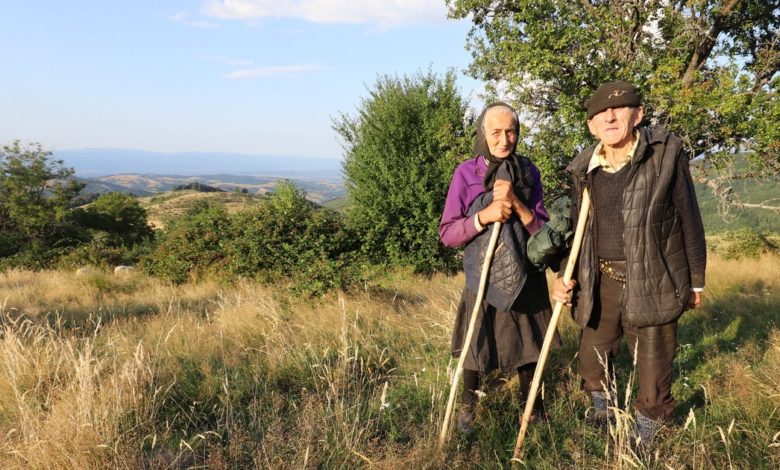
Lindenfeld, a village left in Banat Montan, hides a lot of disturbing stories. The community of bohemi who lived a series of dramas, and eventually wasted. In recent years, the settlement has been resumed by tourists from Via Transilvanica.
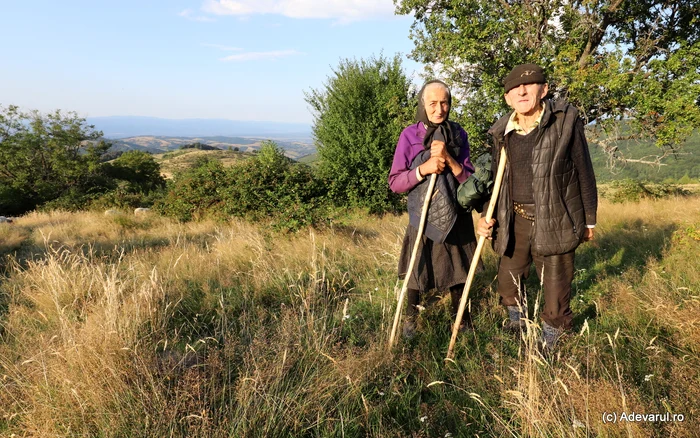
Maria and Vicheni, the only people who live, temporarily, at Lindenfeld. Photo: Daniel Guță
Since the 1990s, no one has lived permanently in the village of Lindenfeld (Caraș-Severin county) in Banat Montan, after his last inhabitant, Paul Schwirzenbeck, died at the age of 85.
The only villagers who remain in Lindenfeld
The elder, with Germanic origins, like most locals in Lindenfeld, with ancestors from the Bohemian region, died in a circumstance that became anecdotal for those who knew it.
“Paul did not want to leave his village, but he had, from time to time. Last time, in 1998, he had descended to Caransebeș to lift his pension and, walking and drinking, as it happened, he was hit by a car and died. Since then, no one lives with Lindenf. Here, ” tells Vicheni Jurchița, an 85 -year -old shepherd from the Poiana nearby village, which during the summer “shepherds” the desert settlement.
In Lindenfeld, also called the Tei Field, a Roman Catholic church in comparison and the ruins of several houses along the land of land remind of “the village of Germans”. This is what the locals from Poiana, the village of Vale, said about five to six kilometers.
The road between Poiana, a locality about 15 kilometers from Caransebeș, and Lindenfeld has never been modernized, so that it can be used by cars.
In the past, a wider path climbed steeply through the forest, linking the Romanian village to that of the Bilts, the followers of the German colonists brought here by the Habsburg monarchy at the beginning of the eighteenth century.
The village reanimated by Via Transilvanica
The path was transformed over time into forest road, which cars cannot climb due to the ditches and the state of erosion, accentuated with every rain.
“Although it was depopulated after the 1989 revolution and only the family of shepherds in the village of Jos, Poiana, we live here, we are very pleased that in recent years, Lindenfeld has become a landmark of the Transylvanian via route. More and more tourists go up here, starting from Caransebeș, through Poiana, New ”, says Constantin, a teacher of physical education in Caransebeș, who often runs on the spectacular route to Lindenfeld.
The teacher organized trips with the students in the left village, and they were able to discover here the old church, still standing, but also the ruins of the former school, where in the late 1960s they learned about 40 children.

Image 1/10:
Lindenfeld Photo History of Banat WordPress (7) JPG
“” There was a small business to be done here in the area, but it did not go too. Here, in these bars, someone tried to rebuild their parental house, but had to interrupt the works and did not resume them. He wanted to move here. But the place is very good for relaxation, and not far from him, known as tourist destinations ”, Constantin tells.
The last bohemians, appreciated by Romanians
The locals from Poiana remember with the nostalgia of their neighbors in the hill, even though, apart from the few, they have climbed Lindenfeld, curious to see what was left of the “village of Germans”.
“I was born in Poiana and I often came here, with the pets, with the animals. They were very households and, often, they were not in us, as they were fed here. They also had water drawn in each house and stable, from a basin on the top of the hill. You were holding in the palms ”, He remembers the shepherd.
Nicolae Todorescu, another local from Poiana, was also impressed in the past by the solidarity of the small community in Lindenfeld.
“Being a child, I was climbing to Lindenfeld. I often remember, one day, how, after the job, the whole community had gone on to work on the construction of an agricultural road of the village. It was only an old man in the village. It was a real heaven there. And now it is, unfortunately the houses that were destroyed after the Germans,”says the elder.
In the middle of the 20th century, almost 90 houses were inhabited in Lindenfeld. Immediately after the Second World War, the exodus began, and in the 1970s, in the absence of the road, most locals had already moved to Caransebeș or in more accessible villages.
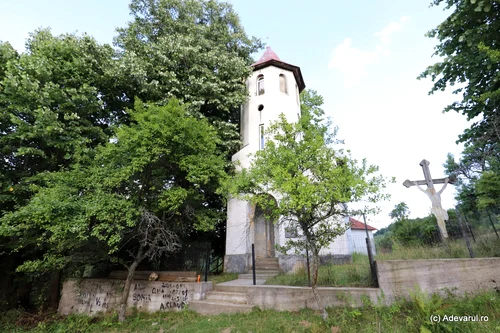
Image 1/20:
Lindenfeld, Caraș Severin Photo Daniel Guță Adevărul (15) JPG
The communist regime no longer wanted to invest in the settlements considered “unviable” mountain, with few inhabitants, so that the road expected by the locals was no longer built. The village remained more and more deserted, isolated from steep slopes and forests, with a few old people who were stubborn not to leave it, remaining to extinguish here, with the village.
How did the bohemia arrive in Banat Montan
The story of the village of Lindenfeld began two centuries ago, with that of three other villages: Gărâna, Brebu Nou and Wolfswiesen, the last disappeared after only a few years. In 1826, as Professor Helga Weber shows, the authorities of the military border in southern Banat requested the population of some regions of Banat Montan.
Immigrants were promised arable land and hay, tax exemption for five years, firewood and free construction, pastures for cattle, as well as other facilities. Instead, men, after ten years of military service exemption, were to serve all their lives as “border guards” within the community.
“The unfavorable political and economic conditions of the time, which mainly affected the without land, determined many servants, small farmers and craftsmen from Bohemia to leave their country. In the spring of 1827, our ancestors around the cities of Klattau, Pissek and Ellbogen, as well as in Bavaria. Last year, 56 German-Boeme families arrived in Slatina-Timiș. Weidenheim, but has not been populated anymore ”noted Dr. Helga Weber, in 1978.
As it was too late to climb to the new localities, the German-Boemi immigrants were hosted in winter in the houses of the Romanian inhabitants of Slatina-Timiș. German historians have noticed the hospitality of these simple people.
“They have successfully tried, To teach the new ones to come the most necessary notions of Romanian language, having a lot of patience and skill. A mockery or even a smile on a clumsy pronunciation you will never see at a Romanian. For him, this would be a sign of non -professional, rudeness … “wrote the historian Peter Grassl.
In that winter, the first friends between the Romanians from Slatina and the German-Boemi colonists, connections transmitted to the following generations were linked. Even today there is no resident of Brebu Nou who does not have a “Pretschin” (friend) at Slatina-Timiș or in other Romanian villages, the historian note.
The villages of Bohemilor built in the heart of the mountains
In the spring of 1828, over 50 families of colonists raised their needy shelters in the middle of a beech forest. At the same time, other families left the southwest of Bohemia to settle in the four new localities.
“The seeds brought from home were cultivated on the only unpaid surface, Raida Hill on the Brebului Crack. The colonists cleaned the land and weed, calling this work 'Raida'. The climate was particularly harsh. The cereals did not catch, but the potatoes were well. A house in the beams, the deforestation of the forests began. Professor Helga Weber report.
In a short time, all four villages remained abandoned. The German-Boemi were scattered in the Banat Plain, in the communes of Moritzfeld, Nițchidorf, Buziaș, Grădiștea, Bacova, Darova, but also in other localities in the plains.
“I climbed the hill, I endured hunger – that's why I left; otherwise I would have stayed in Weidenthal”, They were the lyrics of an old Bohemian song.
The unfamiliar climate, the intermittent fever made their lives here, suffering a lot in the summer months. Gradually, the colonists began to return to the mountain villages, except Wolfswiesen, the highest of them, with a too harsh climate, where no one returned.
“On June 9, 1872, the Banat military border was abolished. At that time, the German-Boeme villages each had a school (in Brebu Nou, founded in 1834), with a single class. On average, about 100 students were trained by a single teacher. Banatul Montan was attached to Romania, returning to teaching in the mother tongue ”the researcher said.
The ghost from Lindenfeld
In World War II, many locals died on the front. Others, returning home, found their families devastated by hunger, disease, poverty and heavy winters.
The village cemetery, today covered by Jnepeniș, with numerous tombs of young people, keeps the drama lived by the inhabitants in the years of the war.
Other old legends, kept from the elderly, also offer gloomy perspectives on Lindenfeld.
“A shepherd of horses had 36 horses. When he went out with them-he wasn't exactly whole-he was always counting and every time they were only 35. So one was missing. And when he told the people of the village that he was missing a horse, he does not know where he is … They said, 'Well, you must replace the horse. And, for fear that a horse was missing, the man was hanged. They were terrified. reported a local.
The great lime
After the war, the difficulties continued for many locals. Some were deported to Siberia to work at the “USSR reconstruction”. They didn't come back. Others had a choice between remains in the isolation of the small German community, increasingly broken by the rest of the world, and leaving for Caransebeș or Resita. Some of the departed took with them, as a memory of the native place, the symbol of the settlement.
“At Lindenfeld, which was founded on the saddle called Teiului Crack, the great tree was in the middle of the village. This is how the people in Lindenfeld call it:” This was the ancestor tree, “says Lorenz Tremmel, a mountain peasant who still lives in the village and thinks that Lindenfel has a great future, when he has a great future. Girgl planted two young linden in the middle of the village, so that Lindenfeld does not be lost ”, He wrote the newspaper Neuer Weg, in 1978.
Several lime trees can be seen today among the ruins of the former households in the village.
“Down, in Caransebeș, where most of the former inhabitants of Lindenfeld have been established in recent years, is in front of the teacher of teacher Friedrich Bartolf a lime that comes from the one planted with a root brought from the old lindenfeld lime”, Wrote the newspaper Neuer Weg, in 1978.
Since the 1970s, the Bohemians began to leave Gărâna, Brebu Nou and Lindenfeld, and until the 1990s they became almost desolate. In the first two villages, more accessible and more popular, some families have returned. In Lindenfeld, the peace that covered the windows of the former houses is still disturbed from time to time by the bell moved by the wind and by the ATVs of some tourists.