On the golf course of Donald Trump on the outskirts of the small Scottish town of Turnberry turned out to be how Europe is desperate. A week ago, the US president negotiated new duties there with Ursula von der Leyen. In an elegant club house – among stucco, chandeliers, thick rugs – the head of the European Commission agreed to an agreement, which by many was later described as an act of surrender: reduction of almost all European duties to zero, raising American duties to 15 percent.
It was a bizarre evening. During the performance with von der, Leyen Trump lost himself in monologues. He rebuked Europe (“they prohibit us from selling cars”), wind turbines (“they drive whales crazy and throw them to the coast”) and its predecessor Joe Biden (“America was dead under his rule”). None of this was true, but von der Leyen listened patientlysmiled from time to time and even praised Trump as “an honest dealmaker”.
Ultimately, the head of the most powerful European institution buckled under all his demands. Even the British-ridiculed by many commission officials, when they accepted the 10 % tariff in spring-they are now in a better situation than the EU. Why did von der Leyen agree to something like that? One of the main reasons is rarely discussed in public. He has little to do with trade and much in common with fear of war.
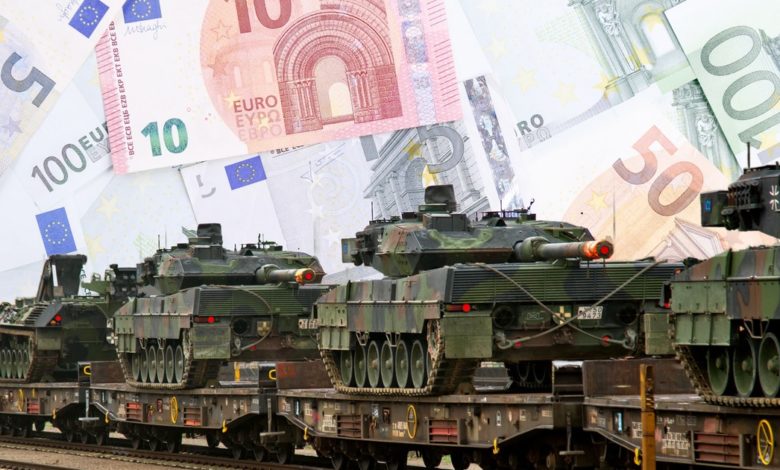
Brussels officials speak behind closed doors that if Trump does not receive what he wants, he can leave Europe alone in the case of a Russian attack. The continent can hardly defend itself and is still dependent on Washington's helpaircraft, bombs and “made in usa”. Economists and politicians therefore propose something new: a defensive bank. A large joint financial institution that will finance the development and purchase of weapons. So that the disgrace with Turnberry does not happen again.
“It is clear that Europe has to be reached, but so far there is no money for it,” says German economist Said Werner. He is a project consultant and conducts research at the MIT Sloan School of Management, Massachusetts. Explains that Such a bank could probably be launched within 20 months And like the World Bank, it could receive members from around the world, including EU countries, Great Britain, Canada, Australia, South Korea and Japan. “Everyone,” says Werner, “who shares our values.”
Continuation of the material under the video
The question is how Europe can finance security and sovereignty. The continent wants to argue on a possible war with Russia and strives for greater independence from America. The EU is slowly transforming from the market and free trade zone into a military union. And for this you have to pay somehow.
Questions without simple answers
However, none of the currently discussed options seems realistic. EuroBLigations, or common debt? Germany is against this for fear of having to take responsibility for economically weaker statessuch as Italy or Greece. Higher national military expenses? This is impossible in times of tense public budgets.
It also exists EU program called Safeshort for “Security Action for Europe”. The idea of the program consists in the fact that the Commission takes loans and transfers them to European governments at favorable rates. This week, 18 countries expressed interest in the program. However, the program budget is only EUR 150 billion [ok. 550 mld zł]which, according to many experts, is too small.
According to an analysis carried out by the Brussels Think Tank Bruegel and the Kiloan Institute of World Economy, In order for the EU to be able to defend itself against Russia without US support, an additional EUR 250 billion would be needed every year [ok. 1,7 bln zł]. According to experts, it would be necessary to place 50 brigades of 300,000 soldiers and 3,400 new tanks, which would exceed the current supplies of all main armed forces on the continent.
Is the world defense bank a solution? Many see it. This vision acquires a political momentum, although it is still largely unnoticed by public opinion. Experts talk about the DSR bank, i.e. Defense, Security and Resilience [obrona, bezpieczeństwo i odporność]. Its originator is Rob Murray, a former British officer and a high -ranking NATO official.
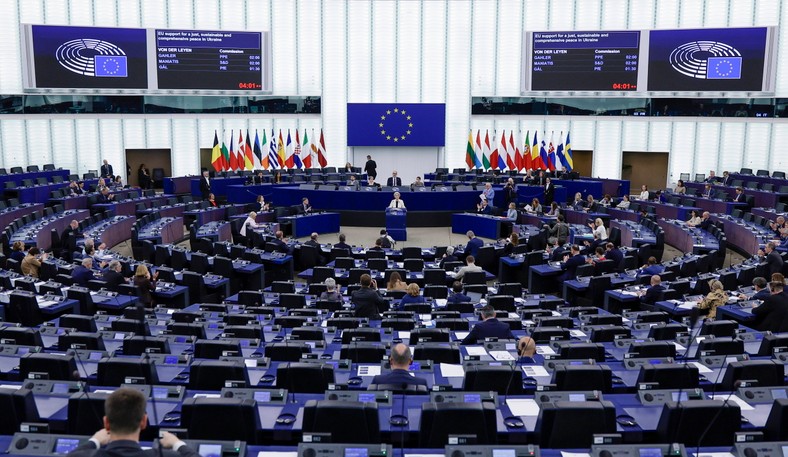
MEPs have recently discussed this concept and adopted an opinion about it. “European Parliament”, we read in it, “calls Member States to support the establishment of a defense bank, security and immunity.” It should act as a “multilateral financial institution and grant long -term loans with a favorable interest rate to support key national security priorities. “
Ronald Wittek / PAP
Session of the European Parliament in Strasbourg
Task group in Great Britain under the leadership of the Secretary of Defense John Healey and the Treasury Chancellor Rachel Reeves also recommended the creation of a DSR bank. This group wrote in the report that London should play a central role and become a “leading global location for defense investments”. Luke Charters MP MP MP said: – The global defense bank could be the most significant means for our collective security for almost 80 years.
This idea was to be discussed several times at meetings of officials and ministers from 27 EU Member States. If it succeeds, a new global financial organization will be created. There are already many others, such as the World Bank, which is fighting poverty, the European Investment Bank, which finances climate protection and infrastructure, and the International Monetary Fund, which helps governments in a difficult financial situation. An institution with DSR acrony.
Will it be possible to erect above particular interests?
How exactly will the bank work? Its members – such as Germany, Great Britain and Italy – transfer money. The bank uses these deposits to raise capital after favorable interest rates using the financial lever. In this way a large pool is formed. It can be used to grant loans to countries that would normally have to pay high interestbecause their credit rating is considered weak. An important thing is that each country only serves its own debts, no one is responsible for others. “Europe's financial force,” says Werner, “can be combined without excessive burden on national budgets or hassleing.
Existing EU instruments – such as Safe – are intended for crisis situations. Brussels must coordinate them with 27 rule and usually creates them in a hurry. On the other hand, DSR Bank is intended for constant financing of defense. Without constant political disputes and regardless of the summer attitude of the economy. Only in this way, supporters say, armies can plan long -term.
Although the idea sounds good, it raises questions. Ethical, political and economic. Can Bank DSR run a spiral of arms and tempt you to neglect other areas, such as education, climate protection or digitization? And who decides which weapon is bought where? According to experts, the whole will only work if orders take place without national preferences. Is it real?
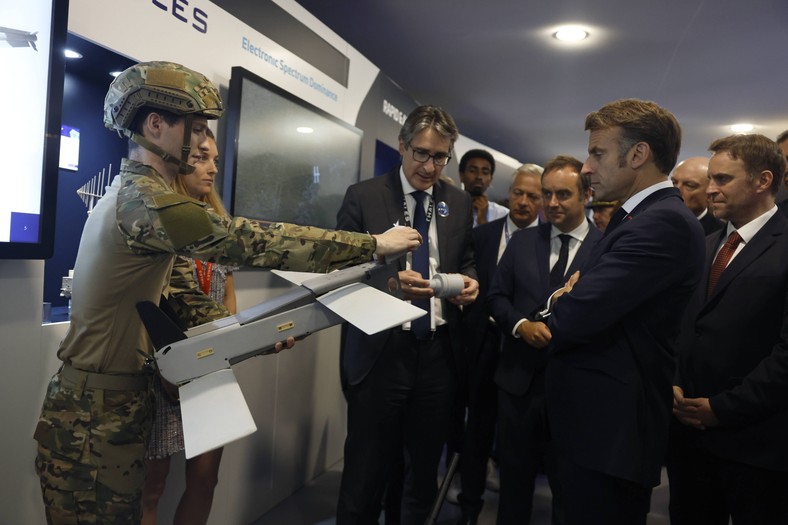
“The abandonment of defense protectionism would be desirable, but it seems unlikely,” says Paul Taylor from the Brussels Think Tank European Policy Center. He believes that countries with a large defense industry are unlikely to be inclined to such a step. For example, France always insists that Member States buy weapons in Europe – preferably from Dassault, Thales or Nexter.
Mohammed Badra / Pool / PAP
French President Emmanuel Macron and CEO of Thales Group Patrice Caine during the 55th edition of the International Air Salon in Paris, June 20, 2025.
What's more, not all countries will be enthusiastically focused on the bank of weapons. The governments of Austria and Ireland pursue the policy of neutrality and express backstage reservations. It will also be difficult to convince Hungary. Prime Minister Viktor Orban has repeatedly spoke against funds that could harm Russia.
What now? After the summer break, the heads of European states and rule want to discuss what funds they can take achieve a recently agreed new NATO goal, which is to allocate 5 percent. GDP for defense. According to the interlocutors, in EU circles the topic of the defense bank will probably play in this important role.
I’m Ashley Davis as an editor, I’m committed to upholding the highest standards of integrity and accuracy in every piece we publish. My work is driven by curiosity, a passion for truth, and a belief that journalism plays a crucial role in shaping public discourse. I strive to tell stories that not only inform but also inspire action and conversation.