Kremlin TV. The Ukrainians from the occupied territories are obliged to follow the propaganda “Russi Mir”, but why the plan gives failures

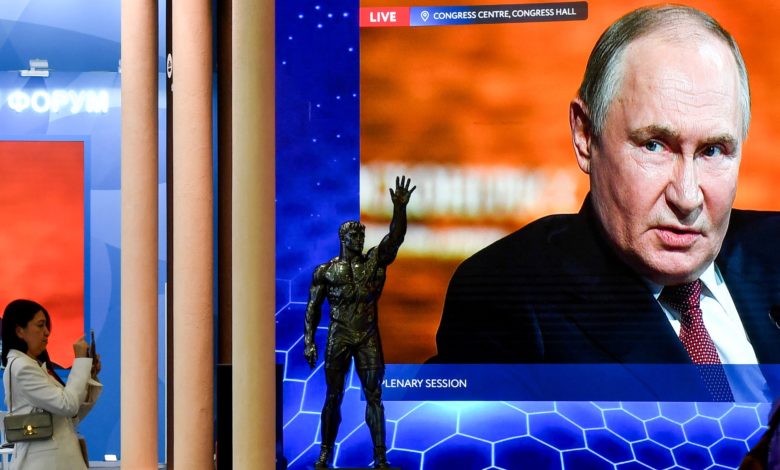
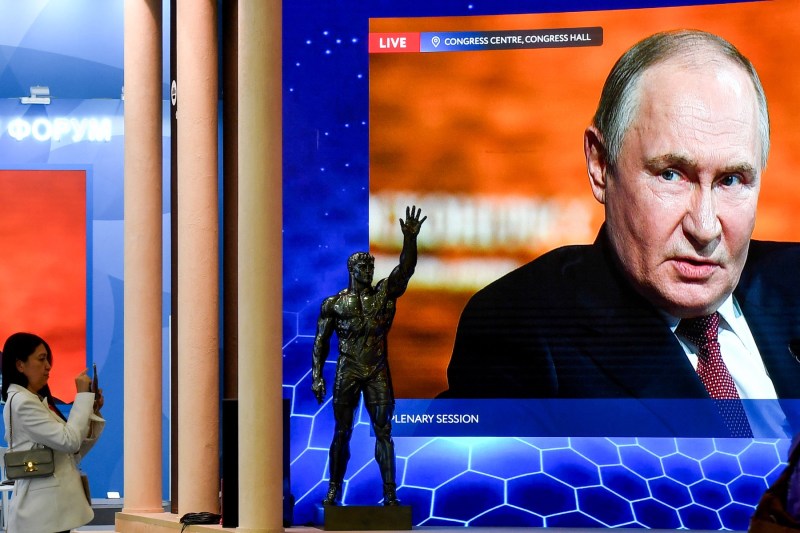
Russian President Vladimir Putin, on the huge screens at the Center for Expoforum Convention and Exhibitions, while participating in the plenary session of the International Economic Forum in St. Petersburg (Spief), Russia, on June 20, 2025. Photo: Olga Maltseva / AFP / Profimedia
Russia's attempts to spread the propaganda of the Kremlin in the occupied territories of Ukraine, by replacing the parabolic antennas with others that receive only transmissions of the Russian TV channels, have been hit by the resistance of the inhabitants, the reports of the Ukrainian center (UCC) show.
Television, media and social networks are key tools used to spread Russian propaganda and to Russian the inhabitants of occupied Ukrainian areas. In just one week, over 1,000 equipment that allow access to Ukrainian televisions have been confiscated, the SCR announced on July 21.
“The purpose is to” completely clean “the information space,” writes in a UCC report, which adds that Ukrainian TV antennae “Horynych” are replaced with Russian versions called “Russi Mir” (“Russian world”), according to The Kyiv Independent.
The “Russi Mir” satellite project was launched in December 2022, in order to provide “citizens from the new territories” access to Russian television. The project was implemented by the political coalition that supports Russian President Vladimir Putin, the People's Front of Russia.
The official website of the project states that it was created especially for the regions of Luhansk, Doneșk, Herson, Zaporojie and the Crimea Peninsula.
Russia occupied Crimea and partially occupied the regions of Luhansk and Donetsk in 2014. After the beginning of the warm, Moscow's troops also occupied the Herson and Zaporojie regions. Moscow annexed the four regions (Luhansk, Donetsk, Herson and Zaporojie) in September 2022, following some referemdums not recognized by the international community, despite not fully controlling them.
The “Russi Mir” package and the local resistance
The “Russi Mir” channel package includes 20 Kremlin state television stations, 10 regional television channels from the four occupied regions and 11 “entertainment channels”, including children's stations.
On May 7, 2024, the American think tank Institute for War Study (ISW) said in a report that “the installation of” Russi Mir “satellites in occupied Ukraine allows the Russian government to directly control the news and media consumed by the inhabitants, thus strengthening the information on information space and promoting the propaganda of Kremlin.”
But the inhabitants of the occupied territories boycotted the replacement of the antennas, refusing to pass voluntarily at “Russkiy Mir”, the UCC said on July 27.
According to the UNC report, this resistance “irritates” the local occupation authorities, and Moscow is dissatisfied with the rhythm of the project.
The transmissions of Ukrainian television, forbidden by decree
The head of Herson region, installed by Moscow, Volodimir Saldo, said on June 23 that the inhabitants of the Herson region can replace the TV equipment for free from July 1 to November 30.
Previously, on February 11, Saldo issued a decree by which Ukrainian TV satellites were designated as “enemy propaganda” tools and forbid them.
On March 31, the activists of the “yellow ribbon” resistance movement announced that the locals were warned of systematic inspections in the occupied part of the Herson region, being threatened with fines and forced confiscation of parabolic antennas capable of receiving Ukrainian positions. In addition, the owners of private houses were obliged to dismantle any “suspicious” equipment.
Local authorities said that 25,000 “Russi Mir” satellites were installed in the Herson region between 2023-2024.
The resistance in the territories controlled by the Russian army is dangerous – anyone who is considered to defy occupation authorities are facing the real possibility of being incarcerated and tortured, notes the publication in Kiev.
In the peace negotiations, President Volodimir Zelenski said on March 12, that Ukraine will not recognize any territory occupied as part of Russia. And because the negotiations have proven inefficient, the problem of occupation has gradually passed in the second plane, writes the source.