The Constitutional Tribunal reflects the Sejm ball. “The Act on the Constitutional Tribunal are unconstitutional”

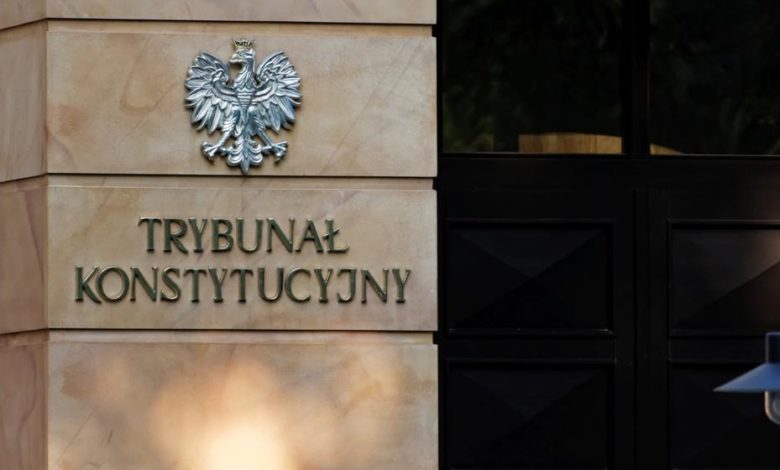
On Tuesday, the Constitutional Tribunal recognized the unconstitutionality of both reforming laws of the Constitutional Tribunal. The assumption of the alleged defect in the selection of the tribunal's judges is not in the applicable legal status or in reality – the justification was emphasized.

The rapporteur, judge Bartłomiej Sochański emphasized that the Sejm has no legal basis to assess whether the judge of the Constitutional Tribunal is or is not an authorized person to adjudicate.
President Andrzej Duda referred two laws reforming the Tribunal in the CT in preventive control in October last year. The provisions contained in them provide, among others, that the judgments of the Constitutional Tribunal issued in recent years with the participation of “unauthorized persons” would be “invalid and no effective effects”. According to the president, changes agree to the legal security of citizens and may deprive them of many of their acquired rights as a result of the case -law of the Tribunal.
The case at the Tribunal has already been defined several times. To hear the positions of representatives of the Chancellery of the President and the National Council of the Judiciary, the Constitutional Tribunal allocated a meeting on April 2 this year. Both then and on Tuesday during the announcement of the Tribunal's decision, no one appeared to the meeting on behalf of the Sejm and the Prosecutor General.
The result of the judgment is the recognition of both acts as unconstitutional. The President of the Republic of Poland is obliged to refuse to sign both these controlled laws – said the rapporteur of the Tuesday judgment of the Tribunal Judge Bartłomiej Sochański. In the case, he adjudicated the full composition chaired by the president of the Tribunal Bogdan Święczkowski.
Sochański emphasized in the justification that although the Sejm chooses members of the Constitutional Tribunal, “He has no grounds to make a legal effect on whether the tribunal judge is or is not an authorized person to adjudicate'
According to the Constitutional Tribunal, the contested solutions “ruin the foundations of the constitutional structure of the Tribunal as an independent judicial authority and constitute” unacceptable interference of legislative power in the minimum competence of judicial power. “
– The legislator's creation of a special category of judges, called “unauthorized persons” is a de facto attempt to retroactive abolition of the judge investment (…), the status of the judge imposed and depriving the judge of his material and social rights – said Sochański.
He emphasized that “the assumption of the legislator on the alleged defect in the election of judges is not based in the applicable legal status or in reality.” – Contrary to the applicant's claims, the status of any of the judges referred to as persons “unauthorized to adjudicate” has been effectively challenged in any ruling of the Constitutional Tribunal – said Sochański.
On the other hand, just taking away from a judge of the Constitutional Tribunal, according to the Tribunal, “irreversible effects”. – The possibility of exercising the office is secured by a constitutionally defined term and other provisions providing guarantees of independence and irremovability – he added.
The unconstitutionality of the Constitutional Tribunal also found in relation to certain provisions of the amendment to the Act on the Constitutional Tribunal. The Tribunal decided to recognize the entire act as unconstitutional, because the challenged provisions are “inseparably related to all controlled legislation.”
The challenged regulations included Those regarding the procedure of appointing new judges of the Tribunal. According to the challenged amendment, the judges of the TK Sejm chooses individually by a 3/5 majority. However, the Constitutional Tribunal's doubts raised a provision according to which the Judge of the Constitutional Tribunal performs its function until the Sejm appointed his successor. – The lack of a deadline when the successor of the Depational Office must be established, creates an opportunity to manipulate the length of the term – noted Sochański.
The unconstitutionality of the Tribunal also accused the provisions entrusting the General Assembly of the Constitutional Tribunal to designate the adjudicating warehouses of the Tribunal. According to the justification, the proposed solution “does not take into account the realities of the functioning of the General Assembly.” Therefore, after the entry into force of the novella, the General Assembly “would not be able to perform the competence to create adjudicating warehouses”, and this “is a trap for the Tribunal itself.”
Judges Jakub Stelina, Wojciech Sych and Andrzej Zielonacki made a separate sentence from the judgment.
The Sejm adopted both laws on July 24 last year, and on July 31 amendments reported to them the vast majority of Senate amendments The Sejm adopted on September 13 last year and both laws went to the president's desk.
According to the ruling coalition, both adopted laws were to be a recipe for the “healing” of the Constitutional Tribunal. Together with the resolution of the Sejm adopted in March and a proposal to change the constitution, they constitute a package – presented over a year ago by the then head of MS Adam Bodnar and politicians of the ruling coalition – a comprehensive reform of the Constitutional Tribunal.
The new Act on the Constitutional Tribunal assumes that the judges of the Tribunal will be elected by the Sejm by a 3/5 majority in the presence of at least half of the statutory number of deputies. Candidates are to be from 40 to 70 years old and in the 4-year period preceding the election they cannot hold the mandate of a deputy, senator or deputy to the European Parliament, to be a member of the Council of Ministers or political parties. The regulation also sets a 14-day date for the President's President's oath, calculated from the date of election by the Sejm.
The provisions introducing the Act on the Constitutional Tribunal contain transitional regulations, adapting and repealing the current laws relating to the functioning of the Tribunal. At the same time – as planned – the judgments of the Constitutional Tribunal issued in recent years with the participation of “unauthorized persons” would be “invalid and no effective effects”. With regard to the current judges of the Constitutional Tribunal, it was foreseen that after the new regulations came into force, they could make statements that they were retiring. This possibility would not concern – as the Act says – “unauthorized person to adjudicate”.
The latter issues are one of the arguments of the appeal. The regulations of the act containing the introductory provisions – according to the president – lead to the cause of “political chaos and on a scale that is not possible to predict today.”
In turn, the new Act on the Constitutional Tribunal, according to President Duda, contains regulations, which They are “inconsistent with the political position of the President of the Republic of Poland and the principle of efficiency and reliability of public institutions and the principle of proportionality resulting from the preamble to the constitution.” (PAP)
nl/ par/ lm/