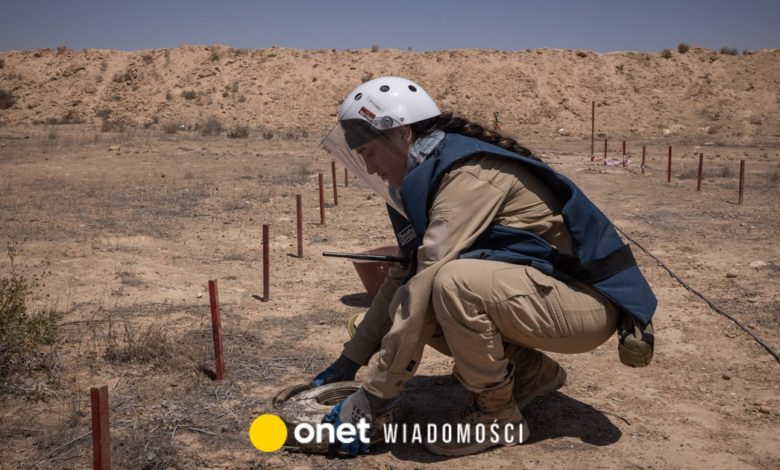
After the fall of the Bashar regime, Syrian refugees return to their homes, unaware of the danger of underground. According to UN estimates Syria is one of the most mined countries in the world. Roads, fields and residential districts are full of explosive residues, which hinders the safe return of millions of people.
It is particularly perfidious that many mines were not distributed by the army, but intentionally used to terrorize the civilian population. Improvised explosives are hidden in drawers, in playgrounds or in the entrance door. Since Assad's fall, over 1,000 people were killed or mutilated by land mines and unexploded bombs. At the same time, there is no national demining campaign coordinated on a national scale.
Therefore, in June, the Syrian organization of civil law protection “White Helmets” turned to the Geneva Humanitarian Massage Center (GichD). On Saturday, a group of experts from Geneva came to Damascus to help create the National Missing Center.
“Nobody knows exactly how minted Syria is,” notes Tobias Privitella, director of Gichd. His employees' tasks will include help in preparing endangered zones. The center is supported by 18 countries, the organization of the United Nations and several private foundations, with Switzerland financing half a budget of 20 million francs (PLN 91 million). Creating structures for professional mining removal is one of the basic competences of the organization. Gichd has already proved it in Ukraine.
Continued article under video material
The Geneva Center was supported by the Wołodymyr Zełent government in creating a new anti -mine program. Privitella sits on the Advisory Council of the State Ukrainian Missing Center. At least 135 thousand KM Ukraine is mined with Russian mines and other explosives – it is more than three times the surface of Switzerland.
Anti -personnel faces are particularly cruel: they are to hurt enemies, not kill – to give concerts resources and slow down the attack. However, civilians fall most often victims. In 2024, more than a third of the victims of mines were children, and 85 percent They are civilians. Therefore, the Ottawa Convention from 1997 prohibits the use of anti -personnel mines. 166 countries are signatories to this agreement.
“Politics for good times”
However, this ban loses its importance: Russia, the United States and China have never signed it. Ukraine also does not want to use it anymore. “Land faces are often an irreplaceable means of defense of the country,” said Zelenski recently. Estonia, Latvia, Lithuania, Poland and Finland have already announced that in the face of Moscow's threat they will again start using anti -personnel mines. [W czwartek, 24 lipca prezydent Andrzej Duda podpisał ustawę o wypowiedzeniu konwencji przegłosowaną pod koniec czerwca przez Sejm]. There is talk of a giant NATO min belt.
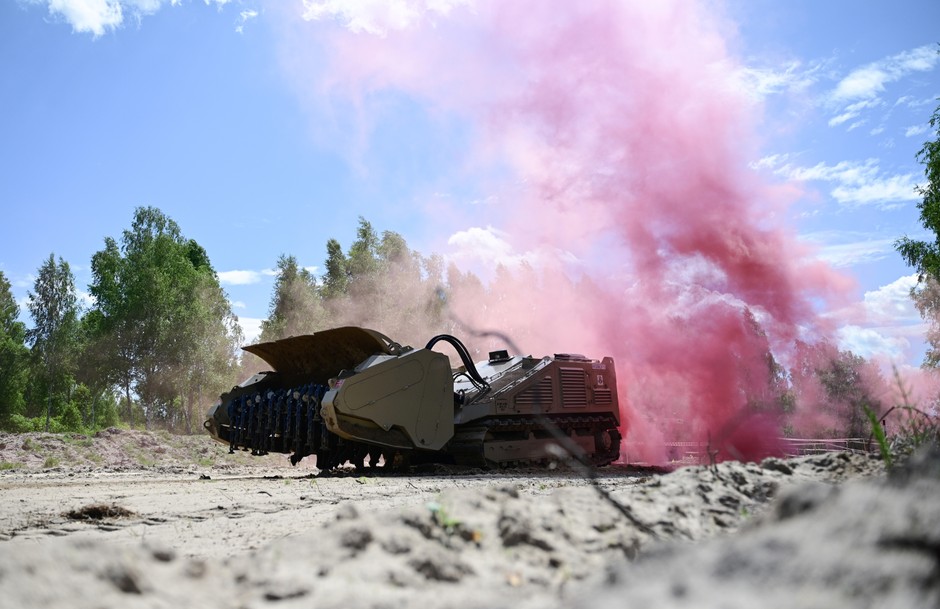
– The Ottawska Convention is unfortunately a policy for good times – everyone is against the minles until they are threatened themselves – indicates Hansjorg Eberle, general director of Fontation Suisse de Déminage (FSD). The Swiss Foundation is one of the leading organizations in the world in the field of relaxation. He operates in Ukraine, where he deals with education on threats, provides vehicles for demining and sends special teams that search the rubble in search of ammunition residues. The Swiss government supports the FSD in this respect with the amount of 40 million francs (PLN 182 million) by 2027.
Testing of equipment for mockery in the Lviv region of Wukrain, June 25, 2025.Ukrinform / Nurphoto via Getty Images / Getty Images
FSD experts are also ready to act in Syria, but they are forced to wait. – In three months we can train 200 to 300 locals who will close the areas – says Eberle. However, the unstable situation under the rule of new authorities now scares off many donors.
The needs are growing, support is decreasing
However, financial difficulties do not only apply to Syria. Interest in miming decreases despite the growing needs. The principle applies everywhere: safety before disarmament. “There is money for Ukraine, but often at the expense of other regions,” says Eberle. The US withdrawal has particularly dramatic consequences.
Until Trump's second term They radically limited the funds. France, Italy and Great Britain also reduced their support. Currently, your own security considerations are coming to the fore. FSD lost one third of its budget. “We had to withdraw from Afghanistan and slow down 170 local sappers,” says Eberle.
Strongly mined regions, such as the Middle East with Afghanistan and Iraq, Cambodia, West Africa and the Sahel region are neglected. Tobias Privitelli from the Geneva Most Recrimatal Center also senses the decreasing readiness to finance projects – especially in Africa. After all, the trend is not only negative: thanks to the Ottawa convention, 50 million anti -personnel mines were destroyed. Although the number of victims is growing again, it was even higher in the 1990s.
The Swiss Ministry of Foreign Affairs emphasizes the importance of humanitarian involvement: there is no reconstruction without demining. Switzerland regrets the withdrawal of some countries from the Ottawa Convention and encourages them to change his position.
In 2024, Switzerland invested 44 million francs (over PLN 200 million) in demining, which places it among the ten largest donors in the world. In 2024, 16 countries, including Syria, benefited from the involvement of Switzerland. There, Swiss experts conducted information on threats and helping victims.
I’m Ashley Davis as an editor, I’m committed to upholding the highest standards of integrity and accuracy in every piece we publish. My work is driven by curiosity, a passion for truth, and a belief that journalism plays a crucial role in shaping public discourse. I strive to tell stories that not only inform but also inspire action and conversation.