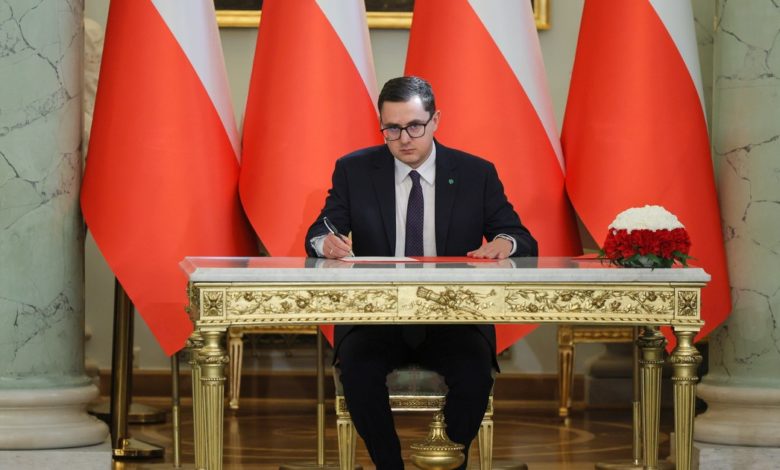
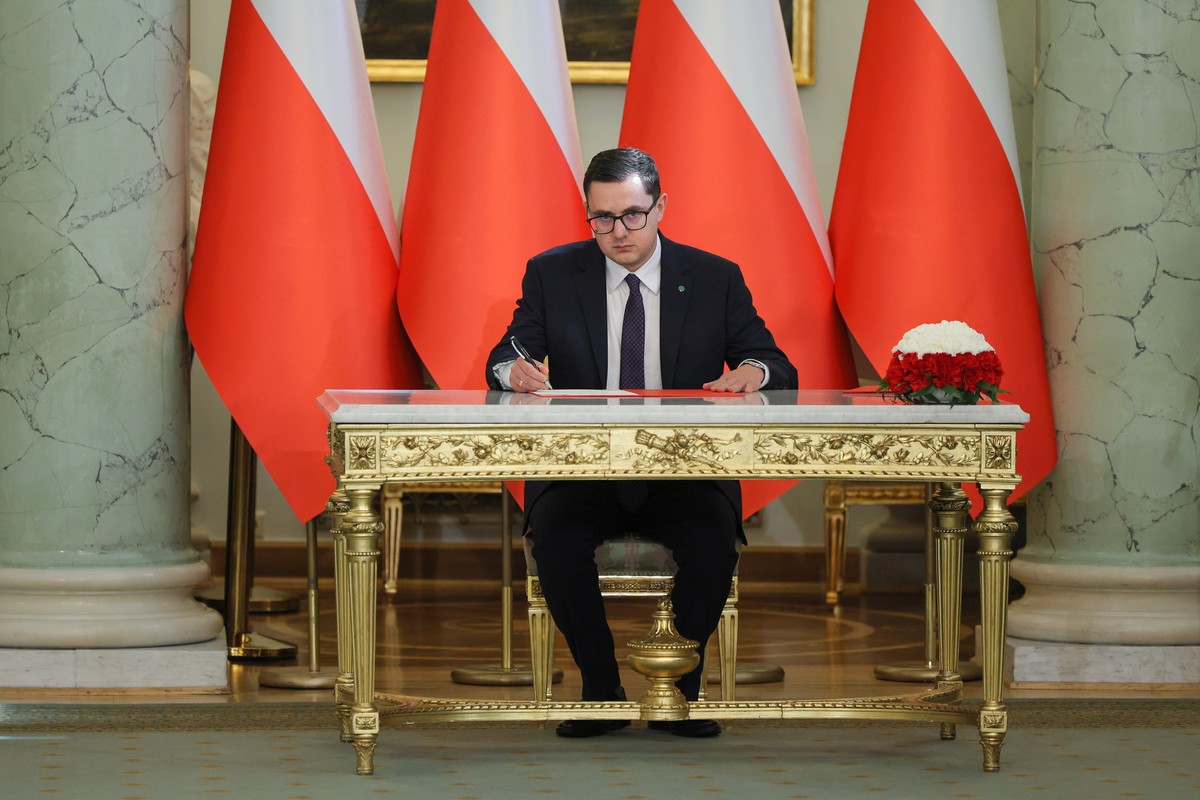
As expected, the long announced reconstruction of Donald Tusk's government resulted in, among others The creation of the Ministry of Energy (the ministry with the same name operated in 2015-2019). The rudders of the new institution were covered by Miłosz Motyk, a politician of the Polish People's Party and the current deputy minister of climate and the environment responsible for energy issues.
The ministry, previously announced as the so -called Superresort, is to focus in one hand all the issues related to the energy sector, which until now were the responsibility of several different ministers. Did the declarations turn into reality?
Read also: Great shuffling in energy ministries. Coal in new hands
“Incomplete decision -making”
The consistent opinion of a number of commentators confirms that not. Under the supervision of Motyka, there will be network infrastructure management, supervision of the energy market, the power market or system balancing (all these areas belong to the competence of the Department of Electrical Engineering, which previously located within the structures of the Ministry of Climate and Environment), and the liquidation of the Ministry of the Industry will transfer nuclear, oil, gas and mining to the new ministry. The heating sector awaits the same fate. So what will be missing?
In addition to supervision over key companies that will remain in the Ministry of State Asset – the key and fastest growing energy segment, i.e. renewable energy. Department of Renewable Energy Sources, responsible, among others For the development of a draft distance act or regulations for the offshore industry, it will remain in the Ministry of the Climate and Environment (MKIŚ).
Considering the dynamics of market growth and the fact that, according to government forecasts from the project of updating the ambitious scenario of the national plan in the field of energy and climate in five years RES are to be responsible for 56 percent. energy mixit's an important gap. Paulina Grądzik, deputy director of the Energy Department and Climate Change in the Lewiatan Confederation, explains her with the requirements of the Act on government administration departments.
– According to the Act, renewable energy belongs to the climate department that remains the responsibility of the Ministry of Culture and National Heritage. The shift of this area to the Energia department, belonging to the new ministry, requires amendment of the law, which requires, first of all, to overcome the amendment, and secondly the president's signature – he explains.
– RES should not be separated from other parts of the energy sector. For example, the issue of issuing connection conditions for new installations, but also non -relief editing is directly related to network themes, and these topics (network – editor's note) have just been transferred from the Ministry of Finance under the authority of the Minister of Energy. It is good that other areas have been integrated with each other, without renewable sources the decision -making of the Ministry of Energy will be incomplete. In this case, we are counting on good communication of the new department with the Ministry of Middle Education. From one place, managing the entire complicated system would be easier and gave a full picture of the energy sector – adds an expert.
In the long run, the shift of renewable energy from the “CLIMATE” section to the “Renewable energy” section, which would allow the new ministry to take over this topic, is not excluded, but the position of Karol Nawrocki will be crucial here and whether he would decide to sign the amendment to the act.
Read also: The first leaks from the government after reconstruction. What about apartments, energy and companies?
Who to call on transformation?
The Ministry of Energy will correspond to, among others For the proceedings before the European Commission on public aid for nuclear energy, or notification of a social agreement with the hard coal mining industry, which assumes the termination of the mine by 2049 Paweł Wiejski, a senior analyst for public policies at the Reform Institute, positively assesses the liquidation of those who had been the current of these issues of the Ministry of Industry.
– It's good that this experiment has ended. The Ministry of Industry created in the government of Donald Tusk last year turned out to be ineffective and too weak, and at the same time too focused on defending the status quo in mining instead of developing a system approach to the sector transformation. There are many challenges ahead of Minister Motyka, but his tools are limited – he assesses.
The expert means not only leaving renewable energy in the Ministry of Culture and National Heritage, but also leaving under the supervision of the Ministry of Paulina Hennig-Kloski National Fund for Environmental Protection and Water Management. The fund has significant money and manages many programs that finance not only the development of prosumer and distributed energy, but also, for example, investments in a distribution network.
– Responsibility for certain elements of more widely understood green transformation, e.g. in the building sector, will still be dispersed between several centers. In addition to the Ministry of Energy and the Ministry of Climate and the Environment, the Ministry of Finance and Economy also inherited them from the liquidated development department and technology. Arranging relationships between them and coordination of tasks will not be easy. Energy fragmentation between various ministries was not de facto ended, but rearranged. The question arises – who to call on energy transformation in Poland? – asks the rural.
He adds that the new ministry will also be developed by one of the key strategic documents, i.e. Poland's new energy policy until 2040, whose last version from four years ago is no longer available.
Energy is not everything
Our interlocutor reminds about the postulate raised for a long time by various expert circles or business, i.e. the creation of the “brain” of transformation – a government agency that would be an analytical facilities for decision -makers and would help in setting strategic directions.
– The National Center for such facilities is currently played by the National Center for Balancing and Emission Management. However, its thematic scope is too narrow today. He also lacks tools to influence processes. Of course, the establishment of one institute, attached, e.g. under the supervision of the Ministry of Energy, would not solve all problems, but would certainly improve the coordination of activities. Examples can be derived from abroad – e.g. in Great Britain, the government's Climate Change Committee plays a similar role. However, the premise for Polish government reconstruction are primarily political considerations, not the actual desire to improve the functioning of the state – says rural.
The name of the British government think-tank directly refers to climate issue. Will the symbolic separation between climate and energy, despite remaining renewable energy in the department of Paulina Hennig-Kloski, do not distract attention from the pursuit of zero-emission system?
– This is a meaningful sign of the times – the climate did not appear at all in the prime minister's speech about the new shape of the government. As a result, thinking about energy transformation can narrow down significantly – says Paweł Wiejski.
As he mentions, in addition to energy, Poland must also think about decarbonization of industries such as transport or industry. – The transformation of these sectors is necessary not only for climate reasons, but above all for reasons of energy security and independence. After all, we cannot rely on the import of fossil fuels and be under the pressure of price fluctuations on international raw materials markets – he puts.
“Potentially functional division”
About the complex, but “potentially functional division of responsibility in the area of energy, climate and industrial policy” as a result of the reconstruction of the government in a commentary for our editorial office, says Bartłomiej Kupiec, advisor to energy policy at Clean Air Task Force.
– The key importance for the fulfillment of obligations towards EU policy and industry decarbonization will be effective coordinating actions between ministries – especially in the field of renewable energy, hydrogen and long -term climate planning – he indicates.
In addition to strategy for nuclear energy and a new hydrogen strategy, among important tasks to undertake several ministries, the buyer mentions the development of a strategy for the development of technology for capturing and storage of carbon dioxide (CCS); The stake is to be a fair and competitive industry transformation.
– Transparent inter -ministerial communication and coherent planning frames will be necessary for efficient implementation of these priorities, with extensive involvement of stakeholders – he adds. However, not all experts are convinced that the new system will change a lot after reconstruction. As we hear from one person, “Tea is not getting sweeter from mixing “.