
publication
2025-07-24 14:15
According to the forecasts of most economists, EBC left interest rates at an unchanged level. This is the first such decision since the start of the current cycle. The open question is whether it means its end or just a break before the next reductions.

The deposit rate, which is the basic interest rate in EBC, remained at 2 percent. The basic rate of refinancing operations was not changed, which is 2.15 percent. as well as a loan rate of 2.40 percent It was the first decision to lack feet after eight reductions in a row as part of the cycle of loosening monetary policy in 2024.
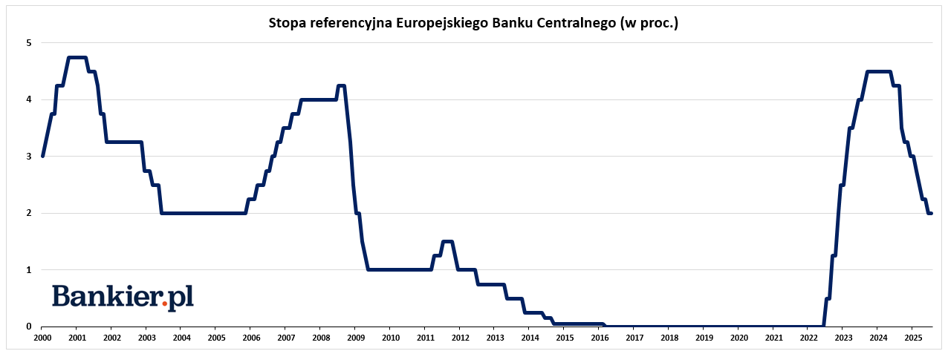
In June last year, a decision was made about the first reduction in interest rates in the euro area since 2019. Earlier, for nine months, EBC feet were kept at the highest levels since 2001. The total scale of these reductions was already 200 PB. in the case of deposit foot and 235 PB. in the case of refinancing operations.
Advertisement
Previous reduction of credit costs at EBC took place in June. Earlier, EBC cut his feet at meetings in April, March and at the end of January. In mid -December, the Presidents' Council reduced the costs of the loan by also 25 PB. In October, EBC decided to cut the feet by 25 pb, and in September he lowered the deposit foot also by 25 pb, while reducing the reference foot by as much as 60 pb.
It is worth noting that HICP inflation in the euro area the second month in a row remained for an ECB for 2 percent. In June, price increases amounted to 2 percent. compared to 1.9 percent recorded in May, when he was the lowest since September last year. Forecasts, however, say that in the following months of this year it will fall even below this level.
It's just a pause or the end of the cycle
The basic question remains whether the July decision means the end of the cycle or just a pause? As Philip Lane, chief economist of ECB, said at the beginning of July in an interview with CNBC, the ECB intervention period in monetary policy aimed at mastering inflation was “completed”. However, the topic of the influence of US customs policy, with which the EU has no contract yet, remains open. High duties will probably cause a decrease in the low economic growth.
Therefore, markets and a large part of economists still bet that at least one more reduction will occur, perhaps in September (no decision -making meeting in August) or closer to the end of the year. “For us, September remains the month in which another reduction of interest rates may take place, regardless of the potential escalation of commercial dispute,” said Ulrike Kastens, an economist for Europe in DWS in an interview with Morningstar.
In turn, economists from Deutsche Bank Research expect that there will be two more discounts by 0.25 percentage point by December, which will lead to a decrease in the deposit rate to 1.5 percent. “In the short term, the commercial conflict with the United States is the greatest risk for the euro zone economy. In the long run, the pressure will be moved to fiscal policy. The new Limit of NATO expenditure will be a challenge for some EU Member States,” they comment.
“Stronger euros and re -threats of introducing customs clearly increase disinflastic pressure in the euro area and the risk that inflation in the future will be lower than the purpose of the central bank, thus increasing the probability of subsequent EBC interest rates,” said Carsten Brzeski, global macroeconomics director at ING.
The risk that inflation falls too low appears more and more often in the comments of analysts, especially in collision with weak other macroeconomic data. The eurozone's economy is barely growing and although pre -emptive indicators suggest that it may be better, there is no shortage of risk, especially from the US policy. The increasingly stronger euro reduces the competitiveness of European exports and contributes to a decrease in inflation. EBC assumes that price increases will be below its 2 %. purpose over the next 18 months. At the end of this year it can be about 1.6 percent, so bankers have something to think about.
Another meeting of the CEOs Council is scheduled for September 10-11. This year, the ECB will meet on October 29-30 and December 17-18 at the planned decision-making meetings on interest rates.
Michał Kubicki