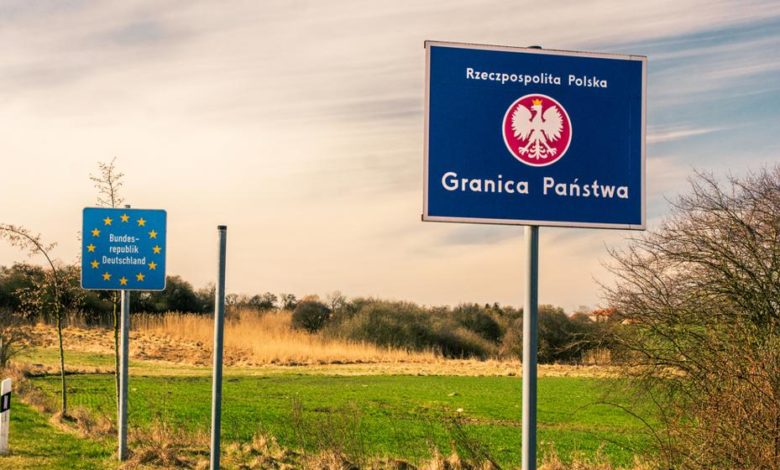
On the border with Germany, 52 places of border control were selected, and permanent inspections will be carried out in 16 places. At the border with Lithuania, 13 places of control were selected, of which permanent inspections will be carried out in two places – the head of the Border Guard Gen. Robert Bagan.
On Thursday, a press conference was held at the interior and administration department on the temporary restoration of border controls at the borders with Germany and Lithuania, at which the head of the SG announced that 52 places of border control were selected on the border with Germany, and permanent inspections would be conducted in 16 places. In turn, 13 places of control were selected on the border with Lithuania, of which permanent inspections will be carried out in two places.
Gen. Robert Bagan reported that it is about road, rail, pedestrian and bicycle and river crossings. He noted that permanent inspections would be conducted by border guard officers. On the border with Germany – in 16 places, and on the border with Lithuania in two – in the old border crossings of Budzisko and gardeners.
“In addition, the track tract crossing, through which the train -Kraków relationship train passes,” he noted.
He added that in the case of Germany, permanent inspections will be carried out in the following voivodships: Lower Silesia, Lubuskie and West Pomeranian. “These are the most frequented roads running from Poland to Germany and Germany to Poland,” he said.
He noted that controls at permanent points will be carried out using special containers and the so -called Schengen-Bus. “In other places, an ad hoc control will be carried out, carried out by border guard officers with the support of soldiers of the Territorial Defense Forces, as well as with the support of military gendarmerie soldiers” – he noted. Similarly, inspections are to be carried out on the border with Lithuania. He said that the inspections would be selective and the vehicles will be previously selected.
The deputy head of the Ministry of Interior and Administration Czesław Mroczek emphasized that the key issue in the whole operation is that the inspections take place smoothly. “The overarching goal of restoring temporary control for 30 days – at the moment we assume that it will be extended – is primarily to control the migration movement on the border with Germany and with Lithuania” – said Mroczek. He added that the migration trail leading from east to west runs through Poland, and thus on the western border migrants will not appear if they are stopped in the east of the country.
“Our activities on the border with Belarus are of key importance, but it turned out (…) that out of about 800 migrants who were not allowed to Germany, and crossed the border with Belarus, nearly half are migrants who crossed the Latvian, Lithuanian border, and then through Poland to the western border,” said Mroczek. “Therefore, it is also crucial for us to master illegal migration that flows to us from Lithuania,” he added.
Mroczek also referred to the question whether the border guard and the police are intervening with the so -called civic patrols. “We will not allow impersonation under the officers of the Border Guard or the Police to all those who want to take over the rights of these formations. We will not allow public officials to be obstructed and their insult” – he noted. He said that obstructing the work of the fire brigade and the police is an action to the detriment of the country's security.
The Ministry of Interior and Administration invites those willing to WOT
The deputy head of the Ministry of Interior and Administration appealed to all people who want to act for the security of Poland to join the service in the Territorial Defense Forces. The head of the SG also encouraged people who want to defend boundaries to join the Border Guard. “We have free full -time jobs,” he said.
Deputy Minister of Infrastructure Stanisław Bukowiec said that when it comes to rail traffic, the inspections will be carried out as far as possible without bringing trains to delay, as well as without having to stop. “The Railway Protection Guard is prepared for activities related to stations on the western wall and near the border crossing with Lithuania. If illegal immigrants appear at the stations, it will react. Preparations have been made in this matter” – emphasized the deputy minister.
The head of GDDKiA Paweł Woźniak assured that a special traffic organization will be introduced at border crossings with Germany and Lithuania. As Woźniak pointed out, GDDKiA manages border crossings within the national road network in Poland. On the borders with Germany and Lithuania there are a total of 14 of them. He explained that the temporary organization of traffic would consist in narrowing of traffic on dual carriageway to one lane. He added that information about narrows will be transmitted earlier, using signaling and characters. In addition – as he said – “the whole stream of movement” will be directed to specially designated travelers service places, where Border Guard officers will selectively choose vehicles for control.
On Wednesday, a draft ordinance was published on the website of the Government Legislation Center regarding the restoration of border control temporarily. Its authors pointed out that he is a response to a serious threat of illegal immigration on the Polish-German and the Polish-Lithuanian section of the state border.
Pursuant to the Schengen Border Code, when a serious threat to public order or internal security in a Member State is impossible to predict and requires immediate action, the Member State may exceptionally restore border control at the internal borders.
Increased government's actions were demanded by opposition politicians. On some sections of the Polish-German border, people associated with the so-called By the borders' defense movement, appointed by Robert Bąkiewicz. Members of this movement declare that “they are guarding the border with people trying to cross it illegally.”
According to the project, controls at the borders with Germany and Lithuania will be restored for 30 days – from July 7 to August 5. (PAP)
MCHOM/ MAS/ MBL/ KNO/ AGZ/ LM/