Iran made preparations for the mining of the Ormuz Strait, a last resort measure in the war against Israel

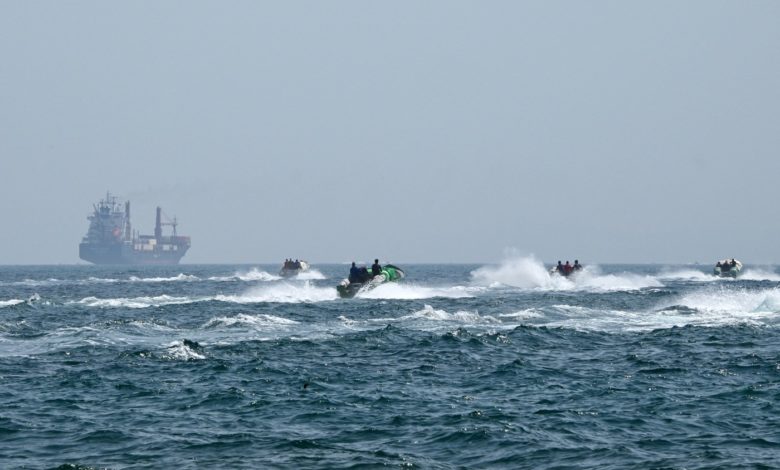
The Iranian armed forces loaded me naval on the Persian Gulf last month, a move that amplified Washington's concerns that Tehran was preparing to block the Ormuz Strait following the attacks of Israel, two American officials told Reuters.
Officials, who have requested the protection of anonymity in order to discuss sensitive issues from information services reports, say that these preparations, which have not been publicly reported so far and have been detected by US relevant agencies, took place after Israel launched the first rocket attack on Iran on June 13.
The loading of the mines, which were not finally carried out in the straits, suggests that Iran even took into account the closure of one of the busiest maritime routes in the world, a movement that would have escalated a conflict already in full and would have severely affected world trade.
About one -fifth of global oil and natural gas transport goes through the Ormuz Strait, and a blocking of it would most likely lead to a sudden increase in world energy prices.
However, oil reference prices have decreased by over 10% globally from American attacks on Iranian nuclear installations, against a sense of relief that this conflict has not triggered major disturbances in oil trade.
Iran never closed the Ormuz Strait despite repeated threats
On June 22, shortly after the US bombarded three of the main nuclear sites of Iran, in an attempt to paralyze the Nuclear program of Tehran, the Iranian Parliament supported a resolution to block the Ormuz straits.
However, that decision was not mandatory, and the final decision regarding the closing of the Strait belonged to the Supreme National Security Council in Tehran. Finally, an armistice between Israel and Iran entered into force on June 24, two days after the resolution adopted by the Iranian legislature.
Over the years, Iran has repeatedly threatened that it would close the strait, but has never completed that threat.
The Reuters agency failed to determine when exactly, during the confrontation between Israel and Iran, the Tehran loaded the mines, which – if they were placed – would have practically stop the circulation of ships through this essential maritime route. It is also clear whether the mines have been downloaded in the meantime.
The sources did not reveal how the United States learned that the mines were loaded on Iranian ships, but such information is usually obtained by satellite images, from agents that operate clandestin or by a combination of these sources.
Asked about the preparations of Iran, a White House official said: “Due to the president of the Midnight Hammer operation, the successful campaign against the rebels Houthi (no from Yemen) and the maximum pressure campaign, the Ormuz Strait remains open, the freedom of navigation was restored,” Iran was restored.
The US Defense Department did not respond immediately to the comment requests. The mission of Iran to the UN did not respond to the commentary requests.
Mining of the Ormuz Strait, a diversion of Tehran?
The two officials who spoke to Reuters said that the US government does not exclude the possibility of loading the mines was a diversion. According to them, the Iranians could have prepared the mines to convince Washington that they are serious about closing the strait, but without the real intention to do it.
Also, the Iranian army could have been limited to making the necessary preparations in the event that the Iranian leaders had given the order.
The Ormuz Strait is between Oman and Iran and connects the Persian Gulf to the Gulf of Oman, and further on the Sea of Arabia.
It has a width of 21 miles (34 km) at the narrowest point, and the navigation corridors are only 2 miles wide on each direction.
Even Iran would be strongly affected by the closure of the Ormuz Strait
OPEC – Saudi Arabia members, United Arab Emirates, Kuwait and Iraq – exports most of their crude oil through Asia. Qatar, one of the largest exporters of liquefied natural gas in the world, sends almost all its quantity of GNL through the straits.
And Iran also exports most of his crude oil through this route, which, theoretically, limits Tehran's appetite to block the Strait. In fact, almost all the specialists in the energy sector consulted by the CNBC financial television during the 12 -day conflict between Israel and Iran said it is unlikely that the Tehran would close the Strait.
They argued, among other things, that such a move would directly affect not only Iran and China. The second largest economy in the world is both the largest Iranian oil buyer and Tehran's largest trading partner.
However, Iran has invested considerable resources over the years to ensure that it can block the strait, if necessary.
Iran has thousands of me that can place in the Ormuz Strait
Analysts estimate that Iran has held over 5,000 naval mines since 2019, which could be located shortly after the order is issued, with the help of small and fast boats.
The fifth fleet of the US, which is based on Bahrain, has the mission to protect trade in the region. The American navy has typically retained four ships specialized in countering mines (MCM) in Bahrain, although these ships are being replaced by another type of ship called the “coastal fighter” (LCS), which also has anti-miracle capabilities.
All anti-miracle vessels have been temporarily withdrawn from Bahrain on the days of US attacks on Iran, in anticipation of a possible reprisal attack on the fifth fleet headquarters.
Finally, the immediate reprisals of Iran have been limited to a missile attack on a nearby US military base.