Over 40 Palestinians were killed in the city of Gaza, after Israel bombed a cafe. Intense aerial attacks in the north

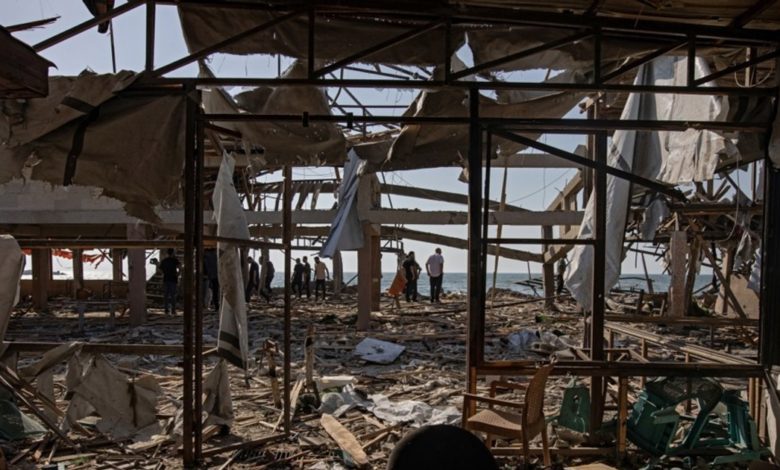
Israel has intensified its offensive in the Gaza strip on Monday, issuing new displays for tens of thousands of people in the northern territory, while about 60 Palestinians were killed in bombings, according to local officials and medical staff, The Guardian reports. More than 40 people were killed in a Israeli air attack that hit a cafe near the port, in the city of Gaza, according to the director of the largest hospital in the territory.
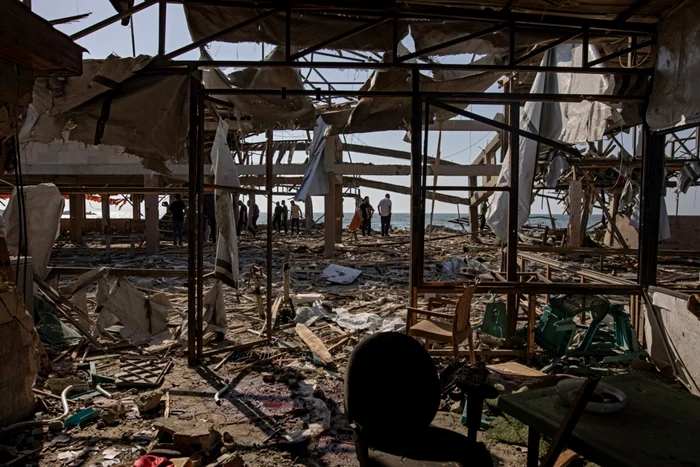
Al-Baqa cafe, bombed by Israel PHOTO EPA-EFE
Mohammad Abu Silmiya, the director of Al-Shifa Hospital, said on Monday night in an update of the bile that at least 41 people were killed and another 75 injured.
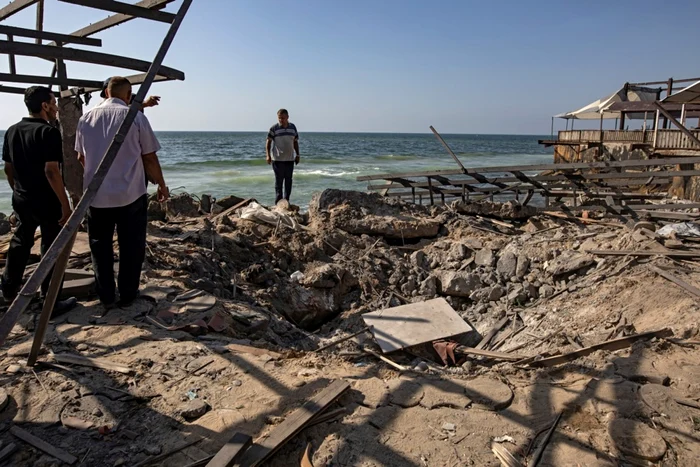
CNN geolocalized videos show thick smoke rising from the place of attack as well as extended damage to the cafe and surrounding area.
Israel's defense forces told CNN that the incident is “in examination”. “Earlier today (Monday), IDF has attacked several Hamas terrorists in the north of Gaza strip. Before the attack, measures were taken to reduce the risk of injuring civilians through air surveillance. ”
Al-Baqa cafe was a popular place among students, journalists and remote workers, because it offered internet access on the Mediterranean coast.
One of the victims is Sama Abu Namous, 17, who was in the cafe to study. The schools were suspended in Gaza, but she was preparing for a possible resumption of exams, her family said.
“He studied for the high school exam and was going to come home afterwards. I received the news that she was killed … Children die every day. What are we negotiating? The blood of our children?”, Said the aunt of the teenager.
Silmiya told CNN that “most victims are women and children,” including many students who were at the cafe to have access to the Internet.
The doctor also said that the hospital lacks beds and anesthetics to treat the victims. The number of deaths increased Monday night, after some of the wounded died due to serious wounds.
“We treat the wounded on the hospital floor, because there are no hospital rooms and beds,” added the hospital director.
Among the killed were an independent journalist, Ismail Abu Hatab, according to other journalists on the spot.
The Government Press Office, controlled by Hamas, said that his death increased to 228 the number of journalists killed by Israeli military actions in October 2023.
Attacks before possible negotiations for an armistice
The new air attacks take place in the context in which a counselor of Israeli Prime Minister Benjamin Netanyahu was expected to arrive in Washington for discussions on the conclusion of an armistice, one day after Donald Trump, in a post on social networks, to an agreement to the war and release the 50.
Ron Dermer, the Minister of Strategic Affairs and a close relative of Netanyahu, are about to meet high American officials to discuss indirect negotiations with Hamas, the consequences of Israel's war and the possibility of regional diplomatic agreements.
A spokesman for the Israeli government told reporters on Monday that Netanyahu is making efforts to end the war in Gaza “as soon as possible” and to release the rest of the hostages from which it is believed that more than half are dead. An American official said Netanyahu will travel to the US on July 7 to meet Donald Trump.
A source familiar with the discussions told CNN that Israel has not yet made a decision after two consecutive days between Netanyahu and his most important councilors and ministers. However, the source said Netanyahu is interested in an armistice, CNN reports.
Ben Gvir, the leader of the Jewish power party, insisted that a “decisive movement” should be made in Gaza and expressed frustration that Israel loses time and opportunities with each passing day, the source said.
Netanyahu is trying to make a decision before his trip to Washington, DC, to meet Trump, the source said, adding that he may have to make a decision this week.
On Sunday, Netanyahu said that “many opportunities” were opened “following Israel's military operations, including the possibility of bringing home to the hostages in Gaza.
New evacuation orders in the Gaza strip
The defense forces of Israel (IDF) issued new “exhaust orders” before imminent attacks around the city of Gaza, densely populated, asking Palestinians to evacuate south, to the already overcrowded coastal areas, where there are few limited facilities and resources of water. About 80% of Gaza is now targeted by such evacuation orders or controlled by Israel's defense forces (IDF).
The orders also stated that IDF plans to advance in the center of Gaza to against the Hamas militants who were there.
On Monday, Israeli tanks and infantry entered the Zeitoun neighborhood, on the eastern edge of the city of Gaza, and opened the fire on several areas in the north, while the planes bombarded at least four schools after ordering the hundreds of families who were sheltering in, the inhabitants said.
“The explosions have never stopped; they bombed schools and houses. They were like earthquakes,” said Salah, 60 years old, from Gaza. “In the news we hear that an armistice is approaching; on the ground we see death and hear explosions.”
In the afternoon, an aerial attack hit a busy cafe in Gaza, killing at least 22 people, including women, children and a local journalist.
IDF said he has attacked militant targets in the north of the gas, including command and control centers, after taking measures to mitigate the risk of injuring civilians.
Analysts have detected changes in the rhetoric of high Israeli officials in recent days, which could suggest a new armistice.
During the conflict, Israeli attacks intensified at important moments of negotiations. Israeli officials said that one of the goals of the Israel's offensive, launched in May, after the breakup of a two -month armistice in March, was to conquer the territories that could be negotiated.
On Friday, Eyal Zamir, the chief of the IDF General Staff, said that the offensive is very close to achieving his goals.
Following an armistice in Gaza?
However, officials close to the negotiations said that an agreement remains difficult, both Israel and Hamas maintaining the previous incompatible positions.
Hamas asks Israel to accept the definitive cessation of war and refuses to disarm. Israel refuses the Hamas requirements to completely withdraw from Gaza and declares that he will complete his campaign only when the militant organization will give up weapons, and his leaders will have agreed to leave the territory.
Yair Lapid, the leader of the Israeli opposition, joined the voice of those in Israel asking for the cessation of the war in Gaza.
“The State of Israel has no benefit from the continuation of the war in Gaza. Only damages at security, political and economic level,” Lapid told a meeting of the parliamentarians. “The army has no objectives in Gaza.”
A public opinion poll published the day after the armistice with Iran, concluded on Tuesday, by the public radio station Kan, showed that almost two thirds of the respondents want the end of the war in Gaza. The result is in accordance with dozens of similar surveys of recent months. The Israeli army suffered significant losses this month, which increased public pressure to reach an agreement.
Nasser Hospital in Khan Younis announced on Monday that he had received the bodies of 11 people who were shot while returning from a helping center associated with the Humanitarian Fund for Gaza, supported by Israel and the US, in the south of Gaza. Another ten were killed in a warehouse to help the United Nations northern Gaza, according to the Ministry of Health.
The Israeli army acknowledged on Monday that Palestinian civilians were injured while waiting for food from the distribution centers in Gaza and other locations, reasoning that instructions were issued after “Lessons learned”.
Foods, fuel and other basic goods are insufficient in Gaza, and the distributions made by GHF are not far enough to meet the needs of 2.3 million people.
Israel claims that Hamas was stealing aid to finance military and other operations. The group rejects this accusation, while humanitarian agencies say their monitoring systems are robust.
Over 56,500 Palestinians have been killed since the beginning of the Israel-Hamas war, most of the civilians, almost the entire population of 2.3 million inhabitants being relocated, and most of the territory has been reduced to ruins.