Work in the sulfur mine in the volcano Ijen. Toxic fumes, heavy loads and dramatic conditions

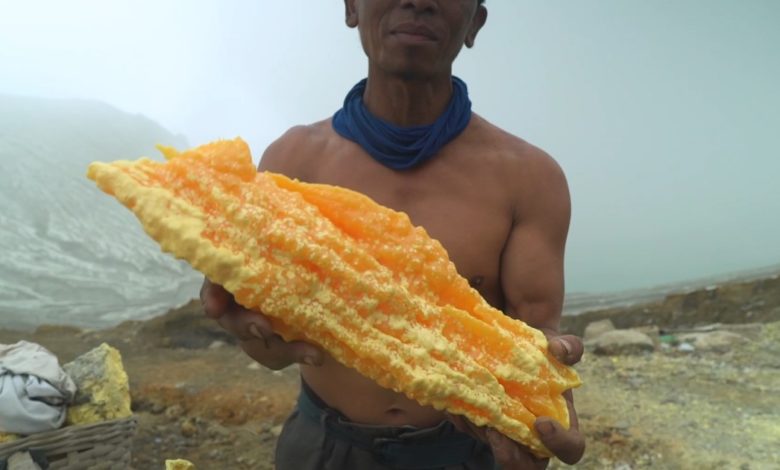
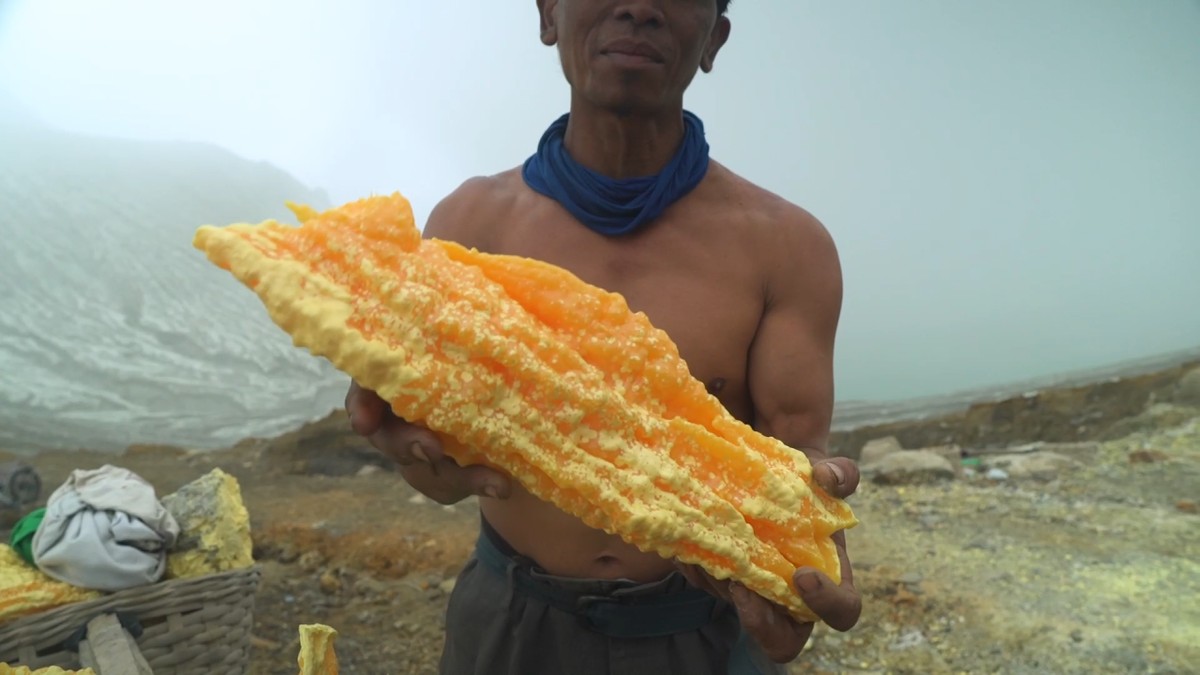
Narrator: Hundreds of miners work inside an active volcano in Indonesia, fighting with toxic fumes throughout the day. They bring out a sulfur, which the locals call “the gold of the devil”. Working conditions are so dangerous here that many miners are not lived to be 50 years old.
Mistar, Górnik: My name is Mistar. I bring sulfur in the Ijen volcano complex.
Narrator: Miners like Mistar carry on their backs up to 90 kg of sulfur up and down these steep cliffs. Mistar has been doing this for 30 years.
Mistar: Swollen arms after a whole day of wearing sulfur is a normal matter.
Why is sulfur coming out?
Narrator: Sulfur is used in everything – from matches and rubber to cosmetic products. It is thanks to her that the sugar is white.
Mistar: It's good sulfur because there is no sand. It is natural.
Narrator: Most of the world sulfur comes from oil and gas refining, which makes the mines in volcanoes, such as the one, are considered outdated. Miners, however, still work there, earning from $ 12 to $ 17. daily.
This is because in this distant part of Indonesia it is one of the better paid works.
Mistar: It is dangerous, but we prefer it than to starve.
Narrator: So why is this sulfur still extracted in this way and why is this work so dangerous?
Mistar: I wake up at 1 or 2 at night. For breakfast I eat rice with fern leaves. There has been a lot of raining lately, which caused landslides around the crater.
Narrator: At this point, Mistar must stop the motorcycle. There is no way to the crater, so he must cover the rest of the road on foot.
He covers 3 km to reach the top of the Ijen volcano. He only takes his basket and crowbar to a 300 m deep crater.
Mistar: We are accompanied by ghosts guarding this place.
Miners must face extreme conditions
Narrator: Mistar must face the extreme conditions in the volcano. The temperature reaches 38 ° C.
Mistar works near one of the most toxic volcanic lakes in the world.
Mistar: Its pH is equal to the acidity of battery acid, which is dangerous. If our lips or teeth have contact with him, then teeth can fall out. If it goes to our stomach, it will end in death.
Narrator: Added to this is smoke.
Mistar: The smell of smoke is very strong. It is sour, sometimes it smells like a fried egg. He is extremely suffocating.
Narrator: Mistar is struggling with two types of smoke. The first comes from the depths of the volcano and goes to these pipes.
Mistar: If the smoke gets into our respiratory tract, we will feel bad.
Instead of gas masks, they use wipes or wet towels
Narrator: The mining company PT Candi NGrimbi has a license to run a mine, but miners are independent contractors, so they have to pay for their own equipment. Many of them cannot afford gas masks. Instead, they use handkerchiefs or wet towels so that the sulfur does not stick.
The second type of smoke is even more dangerous. It comes from volcanic gases under the sour lake and can be fatal.
If miners see large clouds of thin, white smoke coming out of the lake, they must evacuate.
Mistar: We must save our lives immediately. We run away as soon as the smoke comes out.
Narrator: That is why Mistar starts working so early. The winds increase during the day, pulling more white smoke towards miners. Both types of smoke have a lasting effect on health.
Mistar: Some miners are sick. Sometimes their bellies hurt during work. It is also easy to fall over and break your leg.
Why smoke from the inside of the volcano is important
Narrator: However, smoke from the inside of the volcano is crucial for sulfur production. Here's how it works.
When very hot smoke collides with cooler air outside, a liquid condenses, which drips from the pipe.
Mistar: When dripping, the liquid is red and cannot be touched. If it touches your skin and start rubbing it, you will break the skin.
Narrator: When the liquid hardens and cools down, sulfur turns yellow, and miners will be able to start the blocks. It is because of these two colors of sulfur is called the devil's gold. Miners carry blocks with bare hands.
Although frequent touching of the constant sulfur can cause rashes and blisters, Mistar says that when it is cool and yellow, it can be touched.
Mistar: We start from below from below, then press the crowbar into the gaps and lift like a lever. If the block does not break down, we hit from above.
Narrator: Before Pandemia, the miners extracted up to 25 tons a day, but from 2020 they work in two shifts to keep a distance. This reduced the extraction of a single miner to just 10 tons of sulfur a day.
Miners carry a heavy load on their backs
After filling the baskets, Mistar places them on his shoulder and sets off. However, sulfur is not a light load.
Mistar: I can lift 70 kg maximum. Of course I feel back pain.
Narrator: Some younger miners can lift 90 kg.
Mistar: Our arms are overloaded, prints and spots appear. This is typical for people who use arms for work.
Narrator: Miners carry sulfur on the steep walls of the crater.
Mistar: We climb slowly because you can easily fall.
Narrator: Some have this treacherous journey in flip -flops.
Mistar: After work, I am tired and I only think about reaching the top quickly and safely.
Narrator: After reaching the edge of the crater, Mistar moves sulfur to his pram and goes back. Today he is traveling for the second time.
Mistar: We put the sulfur by weight. We count how much we get for it, and then move it to the car.
Where sulfur goes after the miners throw it out of her back
Narrator: The mining company PT Candi NGrimbi is also the owner of this weighing station and the factory to which sulfur goes. At the factory, employees cook sulfur and let it through a series of filters. They must remove any impurities, such as sand or dirt.
Then they pour it out to the floor of the factory to cool. Sulfur is loaded into bags and goes to nearby sugar factory.
It is processed into sulfuric acid – the most commonly used chemical in the world. It is used in everything – from matches, fireworks and gunpowder to detergents, paper and batteries. It is thanks to him that the sugar is white.
It is also an essential ingredient in rubber products and even in wine production. 98 percent However, world sulfur comes from refining oil and gas. It is a side product of refining, and oil companies are obliged by the right to process it in a safe way.
In this way, a lot of pure sulfur is created, which is necessary to produce products such as fertilizer. Currently, the industry associated with sulfur from crude oil and natural gas is worth almost $ 13 billion. And it is expected to continue to grow.
Natural mines and volcanoes are no longer needed, especially since the extracted sulfur is not so clean. It can be sour or contain sand.
Ijen is one of the last places in the world where people still bring sulfur in this way. So why do they do it, knowing that it is dangerous?
Miners can count on “fast” money
For a mining company, it is easier and cheaper to extract sulfur from this place. Miners, in turn, earn much more than, for example, in agriculture.
Mistar: If I went to the construction site, I would have to wait a week for payment. Working on the plantation, I would wait two weeks. Working on a volcano is a challenge and danger, but I get money quickly.
Narrator: The mining company pays depending on the weight of the load. Miners get about 9 cents per kilo. Mistar can get $ 17 for two loads. daily.
The mining company did not respond to our request to comment why miners receive such a low salary for one of the most dangerous works in the world.
What could be another reason why this mine is still open? Tourism. At night, tourists come here to see blue sulfur flames.
During the day, tourists go upstairs to admire the views. They are protected by gas masks and observe the work of miners who do not have such masks.
Some miners work as guides or produce souvenirs from sulfur, but most work in a classic way.
Mistar: Sometimes local tourists give us some money. They ask for joint photos for which they pay us. It makes us happy.
Our work is hard, but we don't feel it that way. For foreign tourists, working as a miner in a sulfur mine is not something. They even feel sorry for us.
According to them, this is a very dangerous job. But what can I do? It's just my job.
Narrator: At the end of the day, Mistar returns home to eat dinner with his family and rest. Ijen dominates them and is a symbol of how Mistar provides his family's life while he slowly loses his own.
This is a heavy burden that Mistar carries on his shoulders.
Note from the publisher: The material was first published in October 2022.
Crowd: Piotr Nazek