Forecasts of the Kiloan Institute of World Economy and the IFO Institute are not a complete surprise, considering that The new German government has recently committed to significant increase in expenses. However, they are a nice change after years of stagnation and shrinking of the economy caused by subsequent shocks, such as Pandemia and the invasion of Ukraine.
“It looks like a reflection from the bottom,” comments Stephan Koths, head of the forecast department at the Kiloan Institute of World Economy (IFW).
Koths adds that after two difficult years, consumption in the private sector and enterprise investments begin to grow. IFW has revised its growth forecast from zero to 0.3 percent This year Is 1.5 percent up to 1.6 percent in 2026
These data largely coincide with the new estimates of the Munich IFO Institute, which raised its forecast at 2026 by 0.7 pp from 0.8 to 1.5 percent. Initially, he looked more carefully at next year, partly due to the potential risk caused by the tariff plans of the US President Donald Trump. Germany is by far the largest exporter in Europe and the main goal of American tariffs.
Continuation of the material under the video
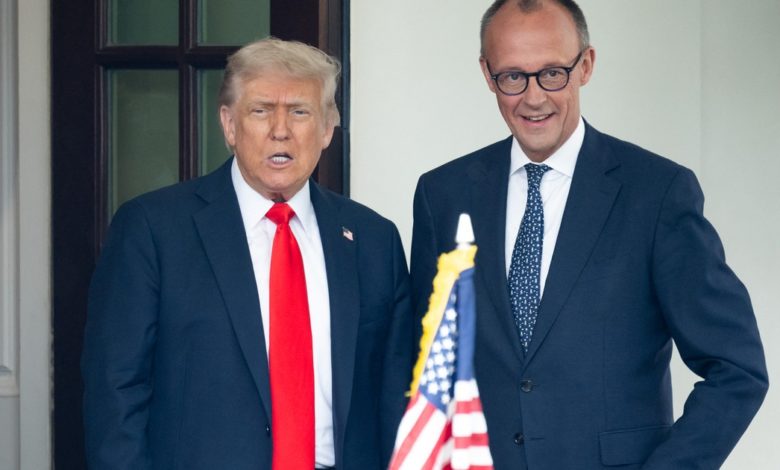
Timo Wollmershauser, economic director at IFO, explains that this positive forecast is partly caused by the fiscal means announced by the new government of Chancellor Friedrich Merz I Hope “to reach an agreement in a commercial dispute with the USA”.
The new IFO forecasts are based on the estimates of new stimulants worth EUR 10 billion [ok. 42 mld 700 mln zł] in 2025 and EUR 57 billion [ok. 243 mld 500 mln zł według obecnego kursu] in 2026
The specter of the customs war unexpectedly accelerated export
Injection of money into the national economy is particularly important because analysts say that better than an increase of 0.4 percent was expected. In the first quarter of 2025 it was probably one -off, driven mainly by companies accelerating exports to the USA to avoid expected duties.
This factor will probably be reversed over the next few quarters, reducing the growth rate in the near future. The Institute warns, however, that if trade problems with the USA are again intensified, it may balance positive impulses and re -drive Europe's largest economy into recession.
The president of IFW, Moritz Schularick, clearly stated that the risk associated with trade policy remains “significant” and the “inconsistent” United States tariff policy It continues to fuel uncertainty in German foreign trade.
– We need to find good solutions for all pages because We see that all participants suffer from uncertainty related to commercial conflicts – said the Minister of Economy Katharina Reiche, hosting a delegation of the organization of economic cooperation and development in Berlin.
OECD appeals: less administrative burdens and regulations
OECD itself also becomes more optimistic about the short -term prospects for the economic growth of Germany, By forecasting GDP growth by 0.4 percent This year and 1.2 percent in 2026
The new OECD report on Germany was satisfied with recent reforms of fiscal principles that will increase the expenditure on the reconstruction of the defense potential, while dealing with large infrastructure arrears. The Parisian organization also calls on Mierz's government not to stop covering his problems with money, but above all introduced a number of structural reforms. Her proposals include increasing expenditure efficiency, their realocation and expanding the tax base.
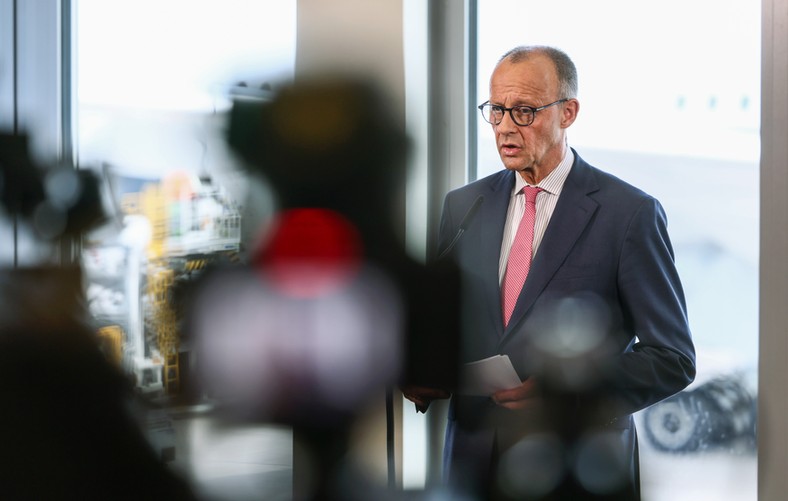
PAP/EPA/HANNIBAL HANSCHKE
Conference of the German Chancellor Friedrich Merz before Flight to Canada to the top of G7. Schoenefeld, June 15, 2025
OECD also called Berlin to reduction of administrative loads and regulatory barriers For competition to revive business dynamics, innovation and increase in productivity.
Various measures were also proposed to support the labor market in a crisis caused by the aging of society. They include Strengthening incentives for women to return to the labor market and for low -paid and older employees. They are also in favor of further reduction of barriers for the migration of qualified employees, as well as improving policy in the field of education, training and adult education.
I’m Ashley Davis as an editor, I’m committed to upholding the highest standards of integrity and accuracy in every piece we publish. My work is driven by curiosity, a passion for truth, and a belief that journalism plays a crucial role in shaping public discourse. I strive to tell stories that not only inform but also inspire action and conversation.