The railway is the Achilles heel of Europe in the event of Putin's attack. “There is a break in Suwałki”

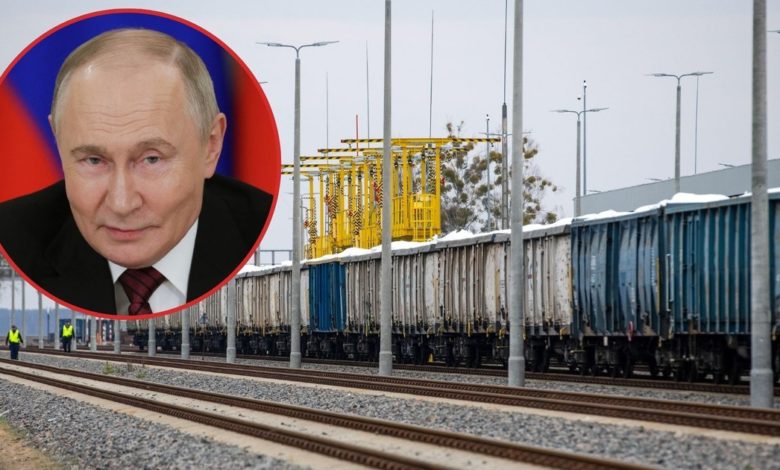
Since the taking of the office by President Donald Trump, who weakens transatlantic bonds, many of the European countries have committed to increasing defense expenditure. The largest European economy, Germany, has abolished debt restrictions for this purpose, and a few days ago the European Union leaders approved the creation of a new EU SAFE financial instrument, thanks to which Member States will jointly buy military equipment and take loans for defense purposes – in total up to EUR 150 billion [641 mld zł].
The challenge they are currently facing is not only the purchase and production of weapons, but also the issue of its transport. Trade trains play a key role. Some countries are aware of this – for example, in the Netherlands, the government decided to buy its own wagons so as not to have to borrow them for a fee from private entities. The Czech Republic has their own company transporting commodity, which has almost half the share in the entire rail transport in our country – CD Cargo. However, the company struggles with serious problems, and a similar situation occurs in Germany. However, the defense of Europe cannot do without freight trains.
In December and January, the Logistic Command of the Dutch Ministry of Defense bought 75 new freight wagons. In total, this section of the Dutch ministry has almost 450 freight wagons that are intended for the transport of military equipment. Two hundred of them are platform wagons that can be transported even by heavy vehicles, including Leopard 2 tanks or armored vehicles.
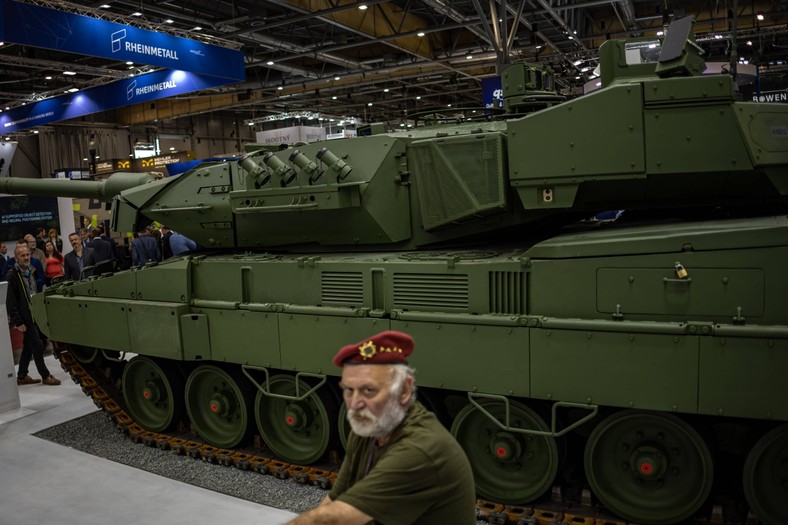
KNDS Leopard 2 A8 tank at the International Defense Technology and Safety Fair in Brno in the Czech Republic, May 28, 2025.
Newly purchased wagons are containerrowers – this form of transport of military equipment has become a common practice as part of the North Atlantic Alliance. The Dutch ministry explains the purchase by the fact that the state tries to be less dependent on the market: having freight wagons allows it to act quickly and transport equipment quickly and as soon as possible where it is needed – for example, to the east wing of NATO (i.e. to Poland).
The head of the logistics section of the Dutch Ministry of Defense Merlijn Heiligers explained to Defense News that A military -based train can be loaded and sent in one day. In the case of renting from a commercial carrier, this process may take up to several days.
In Europe, however, this is rather an exception – in addition to the Netherlands, for example, the German and French army have their own trains. Other countries usually rent them from the German company DB Cargo or the Swiss company Transwaggon. Some countries, including the Czech Republic, have their own enterprises dealing with rail transport, whose services are used by armies – in our country it is CD Cargo, which is owned by the Czech Republic. However, in recent months and years the company is struggling with serious financial problems.
Last year, the subsidiary of the State Czech Railways suffered a loss of almost a billion [koron czeskich, czyli około 172 mln zł]releases employees and sells older locomotives and freight wagons – including platforms that would be suitable for transporting heavy military equipment or tankers that could be used to transport fuels. In addition, when sales, it often turns out that the wagons are not in the right condition: they are all functional, but they lack confirmation of the inspection, so you may need to repair.
Since last year, CD Cargo has 520 freight wagons, and this year is still falling. The head of the company Tomas Toth said in an April interview for Seznam ZPravy that at least 1,400 will disappear from the current fleet of 22,000. “I say openly that CD Cargo is not doing well now and it is not enough to say that in other countries the situation is much worse. The situation is bad, but not hopeless, which is why I introduced crisis management in the company,” he said.

President of the Management Board of CD CARGO Tomas Toth during a press conference, Prague, Czech Republic, April 25, 2024.
More favorable and more ecological
CD CARGO was previously the flagship source of Drah's profits [największego przewoźnika kolejowego w Czechach]. Recently, the company has achieved a positive result in passenger transport, while freight transport records decreases. According to Toth, the cause is to reduce coal and wood transport due to the bark beetle destruction. Prices also increase high energy costs.
Executive director of the Trade Union of the Czech Republic of the Czech Republic (ZESNAD) of the Oldrich Sladek Purchases also sees the problem in trading in the entitlement to issue. Most of the goods in our country are transported by electric locomotives by rail, but they also pay for emissions – they obtain energy from power plants that produce it from fossil fuels. And they must buy permissions.
Car transport does not have to buy permissions – it applies to “only” exhaust emission limit in accordance with the European Directive Euro 7. Most of the freight transport in the Czech Republic is therefore carried out by trucks – the army also uses car transport rather. However, rail transport has many advantages that, along with growing pressure on reinforcements, will be of key importance to all European countries. In addition, it is much more environmentally friendly – Last year, rail transport constituted one -fifth of transport in our country, but its participation in emissions was only two percent.
CD Cargo tries to solve problems, but the mood among the heads of companies providing rail transport (e.g. Metrans or IDS Cargo private companies) are not very optimistic. According to Sladka, there is no talk about the sale of CD Cargo – there is no political will and it will not even be in case after the election to the government entered the party [Andreja Babisza] WELL. However, the company could be interested in, for example, Czech weapons producers, who would then rent wagons to the Czech state for the transport of goods they produce.
Break in Suwałki
– Although you can quickly transport, for example, an armored vehicle on the battlefield by plane or ship. But if you have to quickly transport tens of thousands of soldiers, hundreds of tanks and armored vehicles over really long distances, the railway is still the best means of transport – he describes its advantages of Davis Ellison, an analyst from the Hague Center for Strategic Studies. – It is the fastest and the most economical. You can load the entire unit to one train that will reach the place in the set – he adds.
According to him it is This is absolutely necessary for a sudden attack. – The use of the armed forces in the case of conflict is not something that can be planned, always occurs suddenly. That is why it is necessary to have a certain minimal ability to be able to take action – says the Dutch commander Merlijn Heiligers.
The problem, however, is not only that few European armies have its own wagons, let alone locomotives. The Netherlands has already adapted its tracks to heavy loads transported by military trains. However, this is not a rule in all NATO Member States.
– The further to the east of the continent, the heavier tanks and armored vehicles are. At the same time, the existing infrastructure is able to bear them less and less. We are not talking here only about the tracks – it is also about the size of the tunnels, the strength of the bridges. The passability is also a big challenge – In fact, it is impossible to travel by train through all the Baltic States because of a break in the tracks in Suwałki between Poland and Lithuania – adds Ellison.
The same problem occurs in southeastern Europe. The displacement of a large number of soldiers, e.g. from Poland to Croatia, would be very difficult according to Ellison. – Polish and Baltic connections are old Soviet railway lines. They are unreliable – says. – And there are practically no railway lines in the Balkans – he adds.
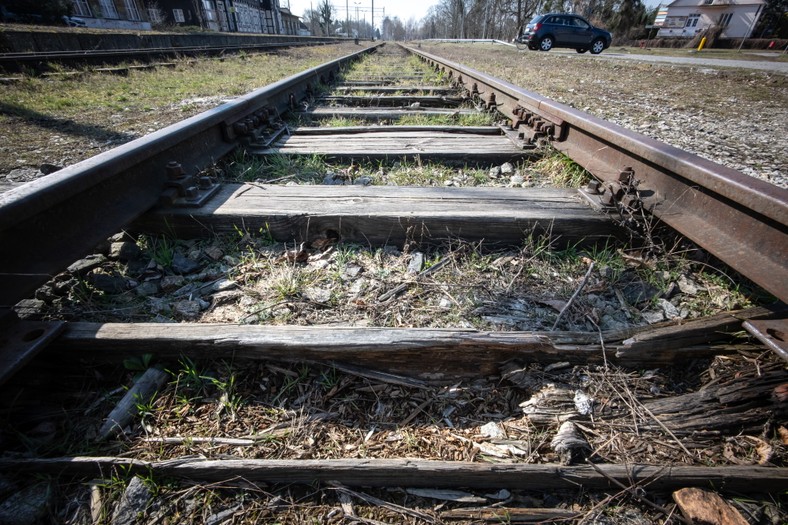
Destroyed railway tracks in Ciechocinek, March 21, 2025 (illustrative photo)
Also for this purpose, Member States will now be able to raise funds from the European SAFE instrument – under which The European Commission even recognized the railway as one of the key priorities of defense logistics, requiring urgent investments. The Netherlands already mentioned for several years has been conducting a Military Mobility project as part of the EU, which aims to simplify the transport of military equipment and staff through the borders.
– For many years, NATO was a big problem that when the train with military equipment went, for example, from Hungary to Romania, he had to stop on the Romanian border, where customs officers entered the train and controlled all passengers – says Ellison, adding that such controls significantly delayed the transport of key equipment. Initiatives such as Military Mobility are aimed at removing these obstacles.
Soldiers from Canada, Great Britain, Turkey and the United States also take part in NATO exercises. They are not EU citizens, so they can undergo control at the border, and thus all passengers checked. According to the analyst, these are obstacles that are forgotten and which cause further problems.
The European Union and NATO do not provide specific tips to the countries on how to provide transport – whether to buy their own wagons or not. For now, the Czech Republic must rely mainly on CD Cargo and focus on repairing railway infrastructure – they are lying in the center of Europe, and if necessary, a large number of freight trains with soldiers and weapons would pass through their territory. The Czech defense minister has not yet answered the question of how he intends to proceed in the case of improving transport capabilities in accordance with new security challenges.