A medical emergency appeared in full car examination, in the capital, brings to the fore a legislative void that can make the difference between life and death. Currently, car examiners in Romania do not have the legal obligation to take a first aid course, although they are directly facing situations in which candidates can have serious health problems at the wheel.

Auto examiners are not required to meet first-aid elements photo shutterstock
An incident, spent on Monday in Bucharest, shows us a major gap of the examination system to obtain the car permit: the examiners are not obliged by law to be trained in granting the first aid.
The case on Veseliei Street, from Sector 5 of the Capital, in which a 55-year-old man suffered a cardiac event during the practical test, could have had a tragic end, if the ambulance did not reach a record time.
The incident that could become tragedy
During the exam for category B, the candidate began to breathe hard, and the examiner took control of the car and stopped on the right.
Chief Commissioner Marius Petrache, head of secretariat service and public relations-DGPCI, explained the succession of events for the truth:
“Regarding the exact situation today, when the 55-year-old person began to show signs that he would suffocate, our colleague asked if it was good, he took the command of the vehicle, stopped on the right, the candidate had begun to recover and collaborate. Our colleague told him to calm, he had to calm down, Open the door to take air.
Meanwhile, in the rear school car was the candidate's instructor. He got down with the phone in his hand, and when the examiner learned that the person had heart problems, he called 112.
“This is how he writes in any manual, before you start doing something, call the rescuers. “continued Marius Petrache.
The car with the person concerned would have stopped right in front of a store, the place where the ambulance was requested. He would have received a bottle of water, and from that store would have come two other men who would have gotten directly into the car and tried to give them first aid.
The commissioner claims that the examiner was constantly near the candidate and called several times to 112, to inform about each change in his health.
“The third time, everyone panicked, on the grounds that the gentlemen who gave him first aid did not feel his pulse anymore. The 112 operator said to take him out of the car, to extend the road to perform resuscitation maneuvers. Our colleague says: Let's get it out, at which time the siren and the paramedic, come on the motorcycle ”,
supports the chief commissioner.
A happy case
The chief commissioner DRPCIV claims that, in this situation, the examiner would have done everything he held. Fortunately, the ambulance has arrived in record time, with no need for the examiner or other witnesses to intervene. Currently, the patient is in a stable condition.
“It's a happy ending situation ”concluded Marius Petrache.
At such unforeseen situations, we can expect at any time, since it is not a singular one. The alarm signal would consist in the fact that, at present, there is no obligation of car examiners to know elements of first aid.
An essential goal in the law: Examiners are not trained in the first aid
According to Order 260/2011, the attestation of car examiners does not include the preparation in granting the first aid. Chief Commissioner Petrache confirms:
“The first aid course is not provided. I did not necessarily consider it necessary, as all the candidates who are presented at the car exam are, for the first time, evaluated at the medical clinic. The doctor must declare if the person is capable or specify the conditions he suffers.”
The European Directive in terms of permits would change since October.
Unofficially, Marius Petrache says that a change in legislation is taken into account, especially after this incident.
All the more so as the first aid courses can be accessed, by any citizen, for free.
“Any major citizen should know how to provide first aid.”
The general manager of Sabif, Alice Grasu, also draws attention to the importance of this knowledge. Not only in the case of car examiners but of any responsible citizen:
“In my opinion, any major citizen should know how to give first aid in the case of a cardio-respiratory stop. All people should have this knowledge, they are very important at a certain time.”
She recalls that there are numerous accessible courses, and the Ambulance Service has already organized, in the past, large -scale training:
“There are several bodies that organize such first-aid courses. The Ambulance Service had such courses, organized on the stadium in 2011 and 2015, where thousands of people learned life-saving maneuvers.”
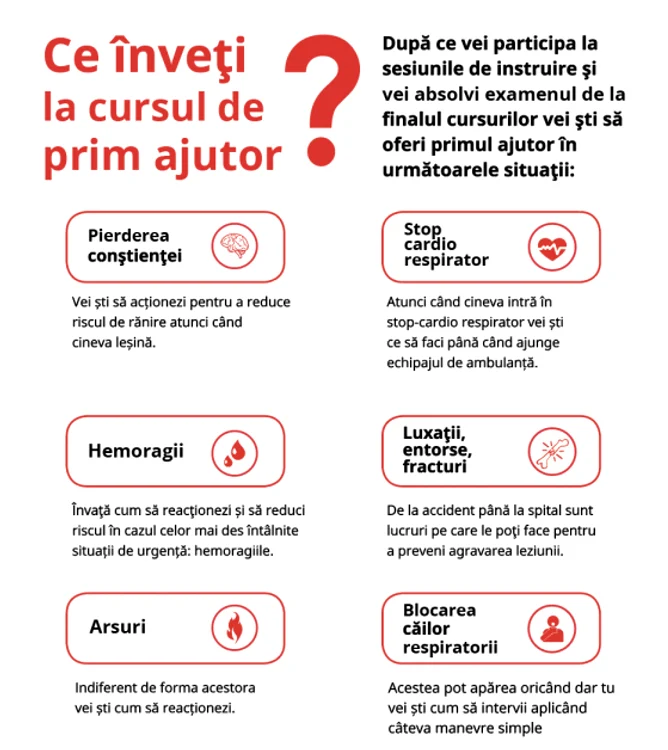
Where we can learn to save a life
Public organizations and institutions offer first aid courses accessible to anyone:
- The Red Cross – Basic first aid course, 12 hours, accredited by the Global Reference Center in first aid (GFARC) and recognized at international level.
- Smurd – workshops through the program “Life rescue” and the Caravan “Be prepared” of IGSU.
- Ambulance service -Occasional public campaigns and training, available on the website of the Ministry of Health.
In addition, the law of the good Samaritan (Law 95/2008, art. 94) protects any person who, without medical training, gives the first basic aid with good faith.