- Throughout 1989, Niedenthal was where history operated – from the round table, through the Chinese Tiananmen Square, the elections on June 4, to the fall of the Berlin Wall
- He is the author of hundreds of photos documenting the distribution of communism in the eighties, the years of his fall in 1989-91 and the first decade of democracy in our part of the world
- He believes that the lack of exciting photos from Poland of 1989 – such as the paintings of the falling Berlin Wall – has contributed to the fact that the world does not remember about our role in the overthrow of the Soviet empire
- For more information, please visit Onet
We remind you of the archival material of Onet from 2019.
We are sitting with Chris on the beach in the Tri -City, at the time of the break in the anniversary of the historical Polish elections, which were only to allow the opposition to participate in power, and led to the fall of communism first in our country, and then in the rest of Eastern Europe.
We both documented these events from 36 years ago – Chris Niedenthal photographed them for the American weekly “Time”, and I reported them as a correspondent of the British Reuters agency.
Chris is the author of the famous photo of the introduction of martial law on December 13, 1981, with a military transporter standing in front of the Moscow cinema in Warsaw, where the great poster of the film “Apocalypse Time” hangs.
He says modestly that this shot only “succeeded”, but he does not add that apart from the frame, about 200 m from the window from which this photo took, there is the building of the Ministry of the Interior, one of the most guarded places in Warsaw at the time, with dozens of secrets curling around the area.
The rest of the text is under the video.
June 4
– Do you have a photo from the 4th June, which would be as symbolic as from December 13? – I'm asking.
– I don't have. On December 13 I succeeded – he replies quickly. – You know, the elections are very little photogenic, for a photographer it is a defeat in fact, because what can you do if someone puts the paper into the urn. These are not exciting photos, and even more so there can be an icon.
It is not, however, that Niedenthal gave up on the day of these historical choices and did not take any photos. I ask if he has any favorite.
– Yes, there is one thing I like the most, but which unfortunately requires explanations, because you can't see what's going on. I was in such a small village near Warsaw, Kąty near Kozienice and there in the yard of a farm I saw that a guy was sitting on a chair and a woman, probably a daughter. I'm spinning like a photographer, I ask if I can enter, they don't really want to agree. In the end I persuaded them and photographed him and he explained to me that these are the first free election in his life, so he just had to look elegant – Niedenthal laughs. – This photo is cool in itself, but if you don't know the context, you won't understand what's going on. However, it reflects the mood of the holiday, which was this day.
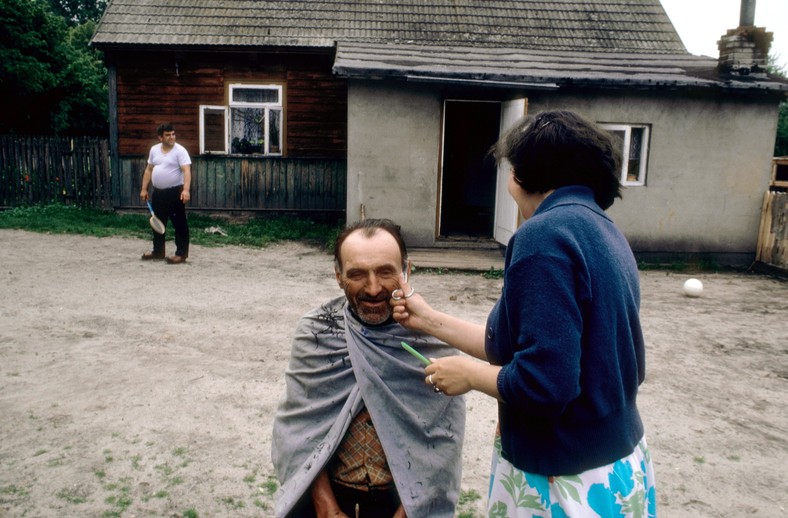
Crafts on June 4, 1989
Chris Niedenthal, our compatriot born and raised in Great Britain, speaks impeccable Polish. By sipping coffee, we talk about our experiences at that time.
– I envied all photographers who could tell this election campaign with one frame – I say. – I was a writer and I had to knock it hard on the keyboard. Present these joyful people on the streets, posters, spontaneous rallies. Donating this atmosphere in words was impossible, and in addition in English, in a concise agency message. Meanwhile, he went out into the street, Niedenthal, he snapped and already had the picture that replaces a thousand words. And he could go home.
Chris laughs indulgently and nods. I keep going: – In addition, I had to give background in every article that these elections are about these 161 places in the Sejm, which Solidarity candidates can apply. And 100 places in the newly created Senate.
I ask if he expected such a result that Solidarity would take all seats intended for the opposition in the Sejm and 99 per 100 in the Senate.
Niedenthal agrees that nobody had to say that these places were automatically reserved for the opposition. – It's easy to speak now. Of course, one could dream, although in 1989 people already had enough of what was happening that no thinking man would vote for what was. So it had to change – he says. – But it was only a dream, because in communism it is not so easy to do something like that. However, Poles succeeded. I didn't think there would be such a result.
The day after the election
Niedenthal agrees that for all journalists, June 4 was simply boring and that it was interesting until June 5.
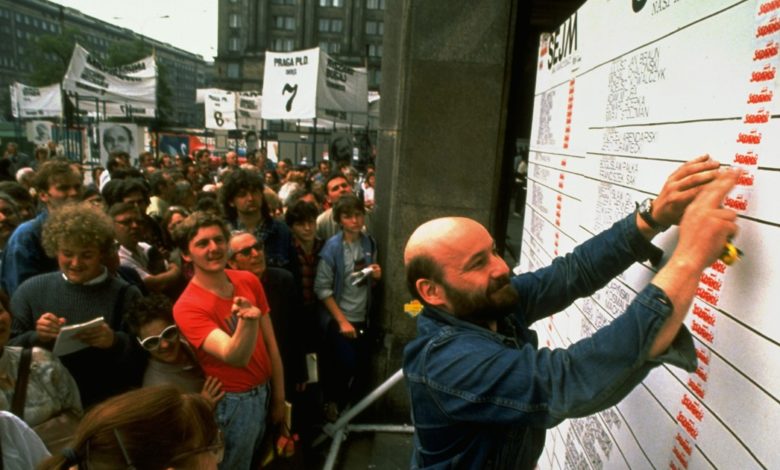
– I was at the Constitution Square from the morning [w Warszawie]a surprise in front of the cafe – he says. – There were these big boards. It should be remembered that there were no internet or large monitors at the time. And there I photographed how such a gentleman improved all the results on this board. And here is Solidarity, here Solidarity, here Solidarity, actually the whole sequence of solidarity on this board was.
For me, this morning was equally interesting, because I started it by checking the results posted on the door of the election committees. Everywhere Solidarity candidates won their duels with a huge advantage. I reached the editor in euphoria and I was unable to write anything.
Chris says he was also excited. However, he was more interested in people's reactions. “It was nice to see the faces of these people, because they were all extremely happy and you could see the joy on their faces,” he says. – And besides, today in these old photos you can see how we all looked then, what hair we worn, what clothes. And still these disputes and discussions.
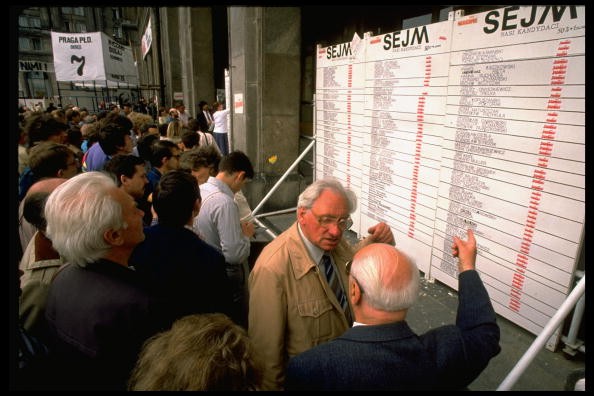
Discussions in front of the results board
“Were you not afraid that now” the Russians will enter “?
– Everyone had it in the back of his head. They did not have to enter, because they were already in several large bases. It is quite enough to put us. There was always this fear, but it was already at the meeting at the round table and if they went without any obstacles, it was already a sign that they would not particularly interfere.
– Have you seen this fear in people?
– It was a whole year when I went from country to country and everywhere there was the question “they would enter or not come in?”. However, this whole system could not be maintained and it had to break. Maybe they, these communists organized in this way to get out of it, they secured, because they knew that all this had to fry …
Faces and jeans
Niedenthal photographed virtually all leaders in Europe for “Time”. And he also made a lot of close -ups of ordinary passers -by on the street. So I ask him, have the faces of people changed since then?
“Faces are not, but the clothing has changed,” he says. – I once called it a denim revolution, because everyone then walked in jackets from denim, and in pants, also jeans. These jackets were some kind of European fashion. In all my photos, whether at the Berlin Wall falling or in the Prague velvet revolution, or in Poland, actually everyone wears denim jackets.
– Love for free America? – I'm asking.
“Maybe, maybe,” he laughs. – I look at my photos and I see these denim jackets everywhere. Not very nice, but what to do?
1989. Spring of Nations
In the memorable 1989, Niedenthal photographed the beginning of the round table session, events accompanying in Moscow Pierestroke Mikhail Gorbachev, Tiananmen Square in Beijing the day before the massacre of students demonstrating there, elections on June 4, creation of the first non -communist government of Tadeusz Mazowiecki, the escape of the Germans from the GDR, the fall of the Berlin wall and the end of the Berlin wall Revolution in Prague.
As he says, of the most important events of this year he failed to photograph only cutting the barbed wires when the Hungarian-Austrian border opened.
– When the round table deliberates in Poland, I worked practically permanently in Moscow and dealt with Gorbachev – he says. – Funny, because when the table was talked in Warsaw, I photographed at a large factory near Moscow, where the production of Lenin monuments went in full swing.
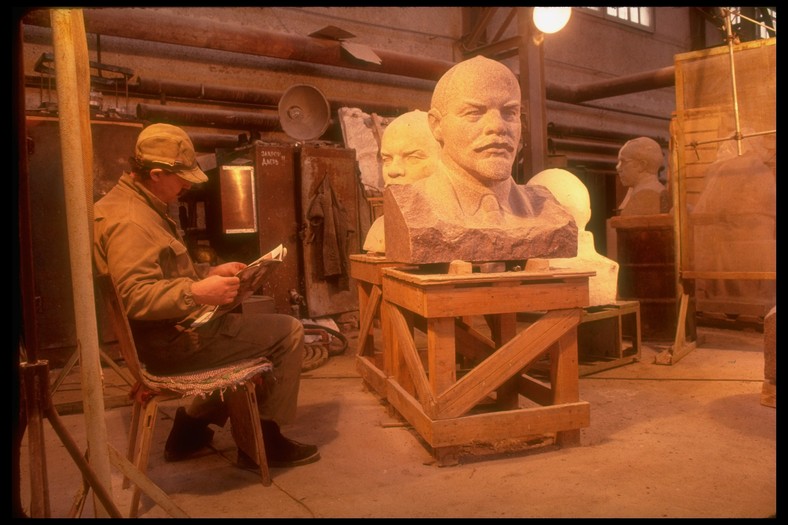
Lenin Factory in Mytiszczy near Moscow
During the anniversary of the June election at the European Solidarity Center in Gdańsk, an exhibition of photographs of Chris Niedenthal was opened, which he took in 1989.
– There is a photo at this exhibition that I took during the visit [ówczesnego kanclerza Nieniec Helmuta] Kohla – he says. – Kohl and Wałęsa laugh at some joke and this is the afternoon of November 9 and they do not know what will happen in Berlin in a moment. That they would start smashing the Berlin wall. Here I was extremely lucky, because for some reason I had a few weeks earlier a ticket to Berlin on November 10 in the morning. I bought it to have it. And I found myself under this wall before Kohl got there from Warsaw.
-I stood at the Brandenburg Gate and watched them playing a kitty and a mouse, because once on the wall serious East Germany stood, and when they went down, the crowd immediately came up with some makeshift ladders.
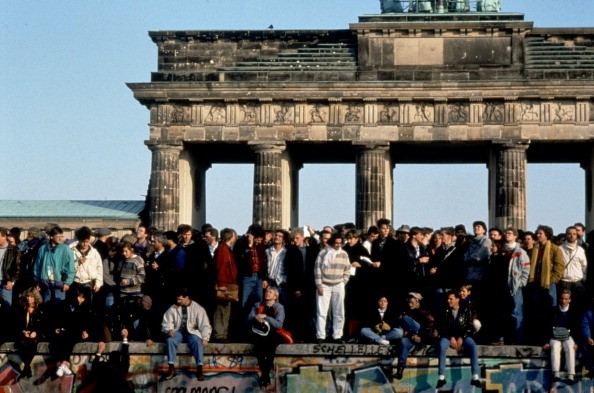
People are standing on the Berlin Wall
Photogenic overthrow of the Berlin wall
– When I listen to you, I understand why in the minds of the world there is a overthrow of the wall, not these boring Polish choices – I interrupt Chris's memories.
He wonders for a while and confirms: – Yes, the Germans won in this competition and although Poland initiated it all, and the strike in Gdańsk 9 years earlier was fantastic and visually effective, this whole transformation of 1989, which in Poland began with so much difficulty, was simply non -photogenic. It wasn't until the Germans “organized the” fall of the wall, it was already a self -science and it was a fantastic spectacle. And the world remembered that the end of communism was a destruction of the Berlin Wall, because this event was much more photogenic than our elections on June 4.