Russia could attack NATO in the next four years, warns the head of the German army. The countries “truly exposed to the Russians”

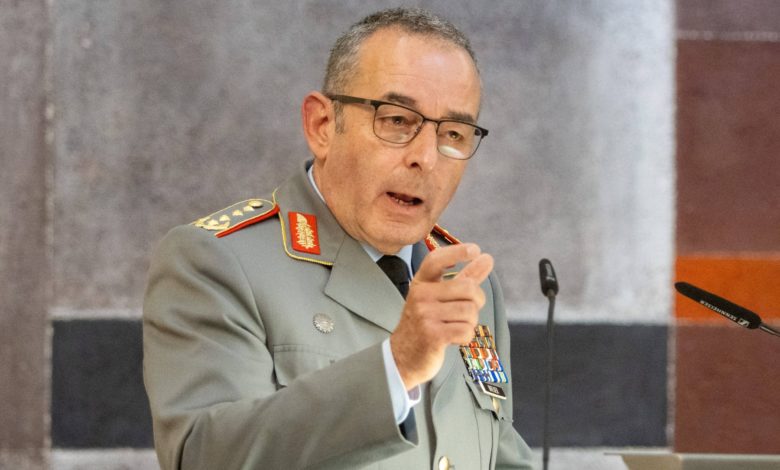
NATO members must prepare for a possible attack from Russia over the next four years, according to statements made by the head of German Defense for the BBC.
General Carsten Breuer said that Russia produces hundreds of tanks annually and that many of them could be used for an attack on NATO Baltic states in 2029 or even earlier.
He insisted that NATO remains united about the Ukraine war, despite the opinion differences recently expressed by both Hungary and Slovakia.
Gl. Breuer spoke in the margin of Shangri-La dialogue, a summit on defense issues that is organized in Singapore by the International Institute of Strategic Studies.
His remarks come a few weeks before the NATO summit in The Hague, where, among others, the defense budgets will be discussed.
“Baltic states are truly exposed to the Russians”
The German official believes that NATO is facing “a very serious threat” from Russia, one that he says he has never seen in the 40 years of military service.
At this moment, he said, Russia strengthens its forces in a “huge measure”, producing about 1,500 main fighting tanks each year.
“Not every tank goes to Ukraine, but it also enters into stocks, and in new military structures that always face the West,” explained Breuer.
Russia also produced four million 152 mm caliber artillery cartridges in 2024 and not all went to Ukraine, the general added.
“There is an intention and an accumulation of stocks” for a possible future attack on the Baltic states in NATO, warned the head of German defense.
“This evaluates the analysts – in 2029. So we have to be prepared until 2029 … If you ask me now, this is a guarantee that it will not be earlier than 2029? I would say no, so we have to be able to fight tonight,” he said.
General Carsten Breuer has highlighted the so-called Swalki corridor, which is bordering on Lithuania, Poland, Russia and Belarus, as one of the most vulnerable areas.
“The Baltic states are truly exposed to the Russians, aren't it? And once you are there, you really feel this … In the discussions we have there,” continued Carsten Breuer.
The Estonians, he said, made the analogy with a vegetation fire, when “you feel the heat, see the flames and feel the smell of smoke”, while from Germany “you probably see a little smoke on the horizon and no more.”
The German general explained that this highlights the different perspectives that the European states have in threat of a possible Russian attack.
“Everyone understands the threat that is approaching NATO at this time”
The perspective of Russia on the Ukraine war is different from that of the West, he added, as Moscow sees the war rather as a “continuum” in a wider conflict with NATO and, therefore, “try to find ways to enter our defense lines and test them.”
The head of the German defense invoked the recent attacks on the underwater cables in the Baltic Sea, the cyber attacks on the European public transport and the case of unidentified drones that were observed above the German electrical power stations and other infrastructure objectives.
Therefore, NATO members should consolidate their armed forces again, General Breuer said.
Asked by the BBC about the Alliance cohesion, given the closest relations of Hungary and Slovakia with Russia, the German general insisted that the Alliance is still healthy. He referred to Finland and Sweden's decisions to join NATO shortly after the outbreak of Ukraine. “I have never seen such a unity as now” among the nations and military leaders, “Breuer said.
“They all understand the threat that is approaching NATO at this time, everyone understands that we have to develop a discouragement direction, in the direction of collective defense. This is clear to everyone. The emergency is visible,” said the head of German defense, Carsten Breuer.