“The world doesn't tremble anymore.” Putin's failure exposed a nuclear bluff

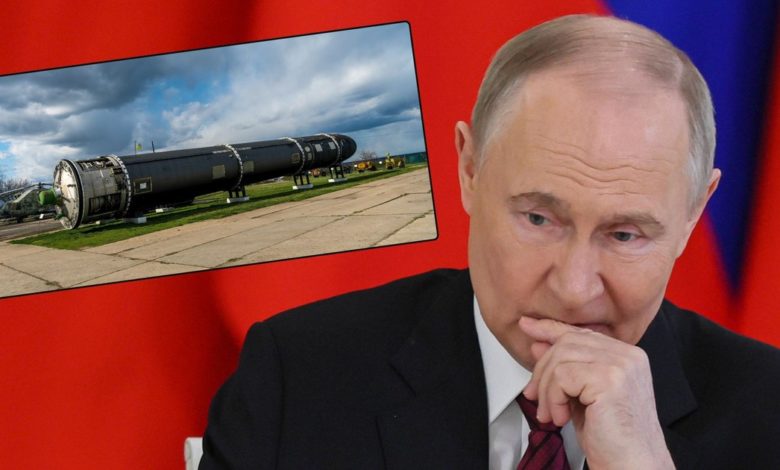
Recent reports on unsuccessful tests of intercontinental ballistic missiles (ICBM), including a spectacular failure only a few days after a broadly commented telephone conversation with [prezydentem Donaldem] Trump, reveal the crumbling state of the Russian nuclear arsenal and the emptiness of the Putin nuclear blackmail campaign. Result? The humiliating series of misfires, explosions and stray bullets, which mainly threaten Russian cities themselves.
From June 2023, at least six Russian ICBM tests ended in a disaster – the bullets did not shoot, exploded in silos or deviated from the course so much that they had to be destroyed so that they would not hit the territory of Russia.
Jars, Sarmat, Buława and Poseidon systems – advertised by Putin as the basis of the “undefeated” nuclear power of Russia – recorded a fatal failure. Sources indicate that there are many failures for every successful test, and some estimates suggest their attitude towards successes as a 3: 1.
The latest compromising slip -up, a test of the intercontinental ballistic shell carried out around 18 May 2025, ended in failure before leaving the launcher. Strictly monitored by the radars and space platforms, NATO has recorded every second of the Kremlin's latest defeat.
This disaster took place shortly after a recent telephone conversation between Putin and Trump, during which the Russian leader reportedly tried to use his nuclear arsenal to put pressure on American administration. It couldn't be worse for Putin.
Just when he tried to show his strength, his valuable JARS missile failed and did not start, joining the growing list of Russian intercontinental ballistic missiles that exploded on the starting platform, such as Sarmat Rocket in September 2024, leaving a 60-meter crater in Plesieck spacer.
Sarmat, named by the Western media “Satan II”, is a particularly painful point. This fuel -powered colossus, advertised by Putin as a weapon capable of destroying the world, which can move 10 tons of nuclear heads, consistently does not meet expectations.
Since the first test in 2017, Sarmat has been struggling with a series of failures, the most dramatic of which took place in September 2024. Experts suggest that the cause of the explosion that destroyed the silo was most likely liquid fuel, known for his sensitivity to improper handling of it. Meanwhile, JARS and solid fuel rockets are not doing much better – from 2023 many tests have been canceled or ended with a disaster.
Putin's nuclear threats, which are the basis of his strategy to intimidate Ukraine and its western allies, break down faster than the T-72 tank from Soviet times. His threats, like those delivered during the meeting of the Security Council in September 2024, are based on the perception of a powerful and terrifying nuclear arsenal – the reality is, however, much less dangerous.
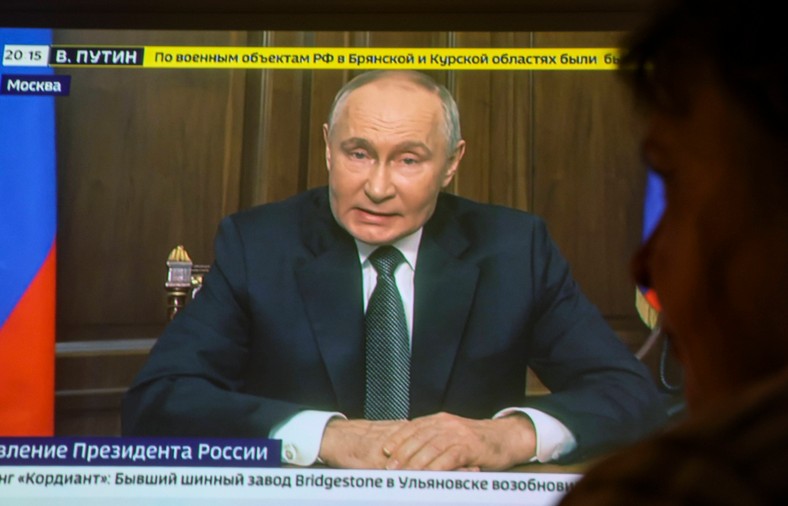
Television speech of Russian President Vladimir Putin, during which he announced a successful test of the medium scope of Orieszniki, Moscow, Russia, November 21, 2024.
Old, outdated technology does not meet the requirements
Russian intercontinental ballistic missiles, many of which were designed in Ukraine before 2014, are currently outdated relics, depending on the decreasing stocks of spare parts and poor maintenance. The head of Roskosmos Yuri Borisov boasted in September 2023 that Sarmat was fully operational. A longer list of documented failures means that the Kremlin's claims about “combat readiness” of systems are funny.
This is not just a technical problem – this is a strategic failure. Putin's nuclear blackmail, aimed at forcing the West to abandon Ukraine, loses its importance. Even an attack on Dnieper in November 2024 using the Orieser bullet, initially incorrectly recognized as an intercontinental ballistic missile, and later confirmed as an experimental medium -range ballistic missile, had less in common with the military effect, and more with a theatrical pose.
The President of Ukraine Wołodymyr Zelanski called the attack on Dnieper “cynical violation”, but pointed out that the world seems not to worry about this attack, which suggests that Putin's threats are not able to intimidate opponents.
American officials, informed about Russia's failures, consistently underestimate the threat, without noticing any changes in Moscow's attitude regarding nuclear weapons.
Putin's nuclear strategy, described by a former arms control clerk in the US government Chris Ford, is a twisted innovation: [to] The use of the threat of nuclear weapons not for defense, but to enable aggression against smaller neighbors such as Ukraine. However, with every unsuccessful test, the world sees the falsehood of this strategy.
The Russian nuclear arsenal, like conventional forces stuck in Ukraine, is a shadow of former splendor from the time of the Soviet Union. The aging rockets, cheesy engineering and addiction to components designed in Ukraine make Putin have a nuclear deterrence, which may also explode in his face, as to hit the target.
Irony is striking. Putin's threats, aimed at showing strength, only emphasize Russia's weaknesses. His intercontinental ballistic missiles, instead of arousing fear, become the subject of jokes around the world. While Ukraine is still opposing Moscow with the support of the West, and NATO observes how Russian bullets break and burn, Putin's nuclear blackmail is exposed as a desperate bluff of the regime, which ended with playing cards.
Nuclear tactics from the Cold War: disciplined deterrent
Let's compare Putin's powerless threats with those used by his predecessors during the Cold War (1947–1991). At that time, nuclear threats were carefully directed to dance between superpowers. The Soviet Union, with a huge arsenal of intercontinental ballistic missiles, ballistic missiles launched from submarines and strategic bombers, maintained a reliable deterrent due to strict tests, technological progress and a solid industrial base – in the 1980s, the USSR had over 40,000 efficient nuclear heads, and the world was trembling.
But now …
The world no longer treats, Vladimir. He laughs.
***
Chuck Pfarrerformer commander of the Seal Team Six squadron in the United States Navy, he is the author of the New York Times bestseller. As a journalist, he wrote many articles on Bengazi, and during the war in Afghanistan he reported events from Kabul and Bagram, participating in the Air Force Air Force air missions. Pfarrer performed as an expert for military and combating terrorism at CNN, ABC, BBC, CSPAN2, NPR, Al Jazera, CBC and MSNBC. He is the author of journalistic articles for “New York Times” and was a senior correspondent and editor -in -chief of the “Counterterrorist Journal”.