Trump's “golden dome” is a great risk. Russia can answer with Poseidon

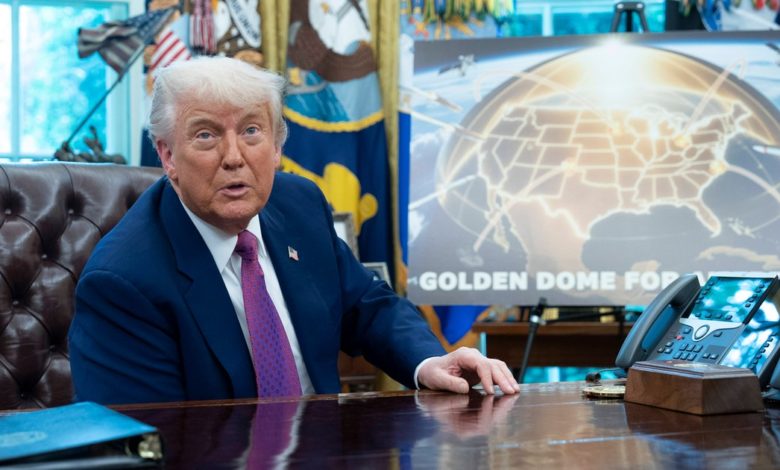
Just a week after the inauguration of President Donald Trump in January, he used the presidential decree to ask for the creation of a new anti -missile shield under the working name “iron dome for America”.
Then, speaking on March 4 during a joint meeting of the Congress of the United States, Trump announced: “I am asking the Congress to finance the most modern anti -cancer shield Golden Dome [ang. Złota Kopuła]which will protect our homeland and will be fully produced in the USA. “What is the project, will it be successful and what does it mean for Russia?
According to General B. Chance Saltzman, the head of the United States space forces, the “Golden Dome” is not a single initiative, but the “system of systems”. It will combine the existing elements of American anti -cancer defense and complement them with an ambitious new structure, which, according to the presidential decree, will provide “defense of the United States against ballistic, hypersonic, advanced maneuvering missiles and other new generation air attacks on the part of equal, similar and unpredictable opponents.” As a result, a multilayer missile shield will be created, significantly exceeding the existing United States defense systems.
“Golden Dome”: the main goal
Although the plan is still at an early stage, the new system is to be based on space technology. It will consist of the constellation of hundreds of detecting satellites, whose task will be to locate bullets and terrestrial, sea and air infrastructure, as well as precise tracking of bullets after launching. A separate fleet of combat satellites will capture bullets in the start phase by means of kinetic (i.e. intercepting bullets) or non -cinematics (e.g. lasers).
The main goal of the “Golden Dome” is to ensure comprehensive protection of the United States territory. However, the executive regulation of Trump suggests that this system could also include the anti -cancer defense of the war theater. In other words, it could be extended to protect the troops located on the front and US allies in Europe and Asia.
The planned development speed is another feature of the “golden dome”. As General Saltzman said: “If it were a traditional Pentagon development program, it could take 12 to 17 years.” Instead, the results are to be obtained before the end of Trump's term of office in January 2029. To achieve this, the project will be based not only on proven contractors from the defense industry, such as Lockheed Martin, but also on newer players such as SpaceX, Anduril and Palantir.
The SpaceX Falcon 9 rocket when launching Starlink satellites to orbit from the 39A start complex at the Space Center Kennedy in Florida, USA, April 12, 2025.
The motivation of Donald Trump
There are practical reasons for developing the “Golden Dome” project. The current United States anti -cancer defense system is based on 40 above -ground intercepting missiles at Fort Greely in Alaska and four additional in the Vandenberg Space Force Base base in California. This system is over 20 years old and has been designed to provide protection against accidental or uncontrolled launch of rockets, and not against the strategic arsenal of Russia or China. In addition, terrestrial capturing bullets provide limited protection against hypersonic weapons.
However, Trump's enthusiasm for this project results more from politics than for practical reasons. He understands the value of great symbolic projects. The promise of building a wall on the border with Mexico provided him with victory in the presidential election in 2016. Currently, he pressed Alcatraz, a famous prison in the San Francisco bay, as a symbol of his commitment to law and order. The same applies to the “golden dome”. Trump wants this project to be a great manifestation of its “Peace through strength” program.
What's more, this project says a lot about the sources of Trump's inspiration. As a cosmic system, the “Golden Dome” has a lot in common with the strategic defense initiative (SDI), the missile defense system proposed by President Ronald Reagan in 1983. The project name clearly indicates that Trump was under the influence of the Israeli Iron Dome system.
These similarities are not very encouraging. SDI, ridiculed by critics as “Star Wars”, turned out to be too technologically demanding and ended as a project in 1993. The Israeli missile defense system, whose iron dome is only one of the layers, is effective, but Israel is much easier to protect than the United States. Israel is smaller than the Hawaii and struggles mainly with primitive short -range rockets, not advanced ballistical or hypersonic missiles. Therefore, the question arises whether the “Golden Dome” project is feasible.
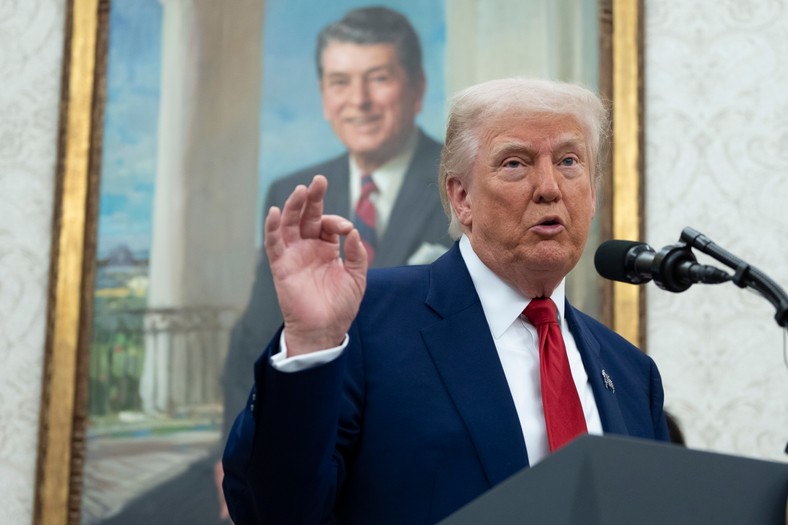
The President of the United States Donald Trump speaks against the background of the portrait of Ronald Reagan in an oval office in the White House in Washington, DC, USA, May 28, 2025.
Is the “golden dome” project feasible?
The first obstacle is technical. Despite the huge technological progress since the 1980s, the challenge related to the development of a space missile shield remains huge. The schedule is also optimistic. Project supporters point to the success of the “Manhattan” project, but it was a time of war when the United States was much more united around a common goal than today.
Costs are another obstacle. At the end of April, Republicans in the House of Representatives presented a bill that allocates $ 24.7 billion. [92 mld 730 mln zł] on the “Golden Dome” program. This is just the beginning. The study of the National Scientific Research Council of 2012 has estimated that the total cost of the cosmic anti -cancer defense system in the start phase may be up to $ 831 billion. in dollars from 2025 [3 bln 120 mld zł].
Proponents of the project say that currently several factors make it to be realized much cheaper. Over the past decade, the costs of raising satellites to orbit have dropped significantly. The SpaceX company, with 7000 Starlink satellites, also showed the ability to quickly create an extensive constellation of satellites at limited costs.
Other savings suggestions include the suggestion that detecting satellites could also perform other functions. This means that in addition to tracking missiles, they could perform commercial functions, thus enabling the division of costs within the American version of the military-civil merger. In April, the Reuters agency informed that SpaceX proposed to offer a “golden dome” as part of a subscription service, which means that satellites would not actually belong to the US government.
Russia's fears
What does all this mean for Russia? Trump presents a “Golden Dome” as a mechanism that promotes stability and peace. He has been skeptical about nuclear weapons for a long time, describing it as “great monsters” and saying that “it would be great if we all could give up nuclear weapons.” He hopes that the “golden dome” will allow the United States to reduce dependence on nuclear weapons. This is because if the United States has a reliable means ensuring the failure of the attack on their territory (scapering by preventing), they will need less ability to hit opponents (scapering through punishment).
Needless to say, that this is not how strategists in Moscow perceive this issue. In 2002, the United States unilaterally withdrew from a system of prohibition of anti -blanking rockets. Since then, Russian officials have been consistently warning against the destabilizing influence of the missile defense system. In 2019, the Russian Ministry of Foreign Affairs condemned the then more modest United States plans regarding missile defense as “Washington's aspirations to ensure the undisputed military domination in the world.” They are afraid that the United States protected by the defense system will not be able to be stopped from aggression.
Washington has always replied that his missile defense systems are only aimed at counteracting limited threats from North Korea and Iran and in no way weaken the extensive and advanced arsenal of Russia. This argument, which has never been fully accepted by Moscow, has now been rejected. As part of the epoch -making changes in the policy of the United States, the “Golden Dome” project is clearly directed not only against “disobedient opponents”, but also against “equal” and “almost equal” states, i.e. Russia and China.
Experts from Moscow remain convinced that even with the current possibilities, the strategic arsenal of Russia could defeat the “Golden Dome” thanks to counterators, such as apparent and disturbing devices. There is also an option of saturation, i.e. defending the defense by launching more missiles than you can capture.
However, in the world of deterrence, a high sense of confidence is not enough. Since the nation's survival is, strategists must come from the worst script and assume that the “golden dome” will be effective at least against the Russian second impact.
Moscow reaction possible
Russia will therefore have to react. This will require the acceleration of existing efforts to modernize each of the elements of the nuclear triad by replacing transmission systems from Soviet times with newer Russian constructions.
You can also expect re -pressure on an exotic weapon, which is to ensure the avoidance of all possible missile defense systems. In 2018, Putin presented the famous weapon, which was called “superbronia” nuclear. These include Buriewestnik, a ground maneuvering missile with nuclear drive and allegedly unlimited range, as well as a poseidon, nuclear torpedo designed for attacks on groups of aircraft carriers or coastal infrastructure. Because the “golden dome” focuses only on air attacks, it is likely that Posedon will become an even greater priority.
Another probable reaction is to double Russia's interest in nuclear weapons against satellites. The advantage of such a weapon is that it can quickly eliminate the entire constellation of American military satellites. The disadvantage is that it would cause huge side damage, destroying numerous civil satellites and causing indescribable disruption of life on Earth. However, if the choice was to lose the nuclear war or destroy the majority of world space infrastructure, the Kremlin would undoubtedly choose the latter option.
Consequences
The “Golden Dome” will therefore mobilize Russia to a new arms race, forcing it to allocate even greater resources for strategic forces when he can least afford it. The Russian defense budget is already overloaded with war in Ukraine, and the reconstruction of Russia's conventional forces will last summer. These huge expenses will require further redirection of civil sectors, which will have predictable consequences for the long -term condition of the Russian economy.
Russia's rush in the development of SuperBroni and nuclear weapons for space brings further threats. Poseidon and Buriewestnik are widely advertised by the Kremlin, but they still remain in the development phase, and the risk of accidents is high. Buriewestnik, powered by nuclear energy, is particularly concerned about “flying Chernobyl”. The unsuccessful test in 2019 caused the death of five engineers.
Ultimately, the “Golden Dome” may also never realize Trump's great ambitions. However, even if this happens, it will have serious consequences for strategic stability, and in particular for Russia.
This article was Originally published by Carnegie Endowment for International Peace.