Europe does not have to look at Trump. He has its own solid weapon against Russia

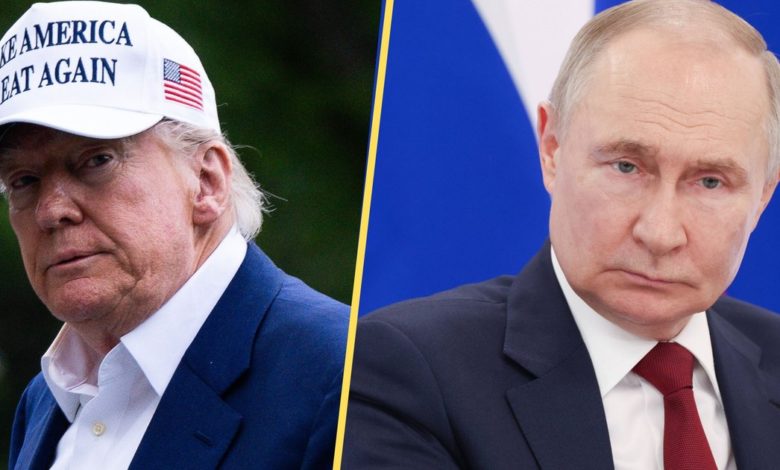
Vladimir Putin seems to be preparing for early Christmas. In the hope of rapid normalization of relations with America, the Kremlin asks Russian companies that sanctions would like the United States to bear first. America seems eager: recently Steve Witkoff, a messenger of the White House, said that the relief could come after the conclusion of a weapon suspension in Ukraine. On March 25, Russia agreed to ensure the safe flow of ships on the Black Sea, if the West lifts sanctions imposed on companies allegedly serving its agricultural industry (including a bank that helped finance Russian oil exports).
The West imposed more sanctions on Russia – almost 25,000 – than for six consecutive countries in total [Iran, Syrię, Koreę Północną, Białoruś, Mjanmę i Wenezuelę]. From February 2022, when Russia began a full invasion of Ukraine, America itself imposed almost 6,500 sanctions. Europe [zwłaszcza Szwajcaria, Francja, Wielka Brytania] She introduced them even more [w sumie około 9000]. Many of them concern people close to Putin, whose assets in the West have been frozen. Others are aimed at Russian industries, such as energy, reinforcement and financial, blocking access to technology, Western markets and dollars. It is these sanctions that the Kremlin wants to endure.
Although the United States [mimo ostatnich gróźb Donalda Trumpa] They may be willing to alleviate sanctions, in Europe such conversations remain taboo. If the USA is lifted by sanctions, it is possible that Europe will decide to support its own. Some geopolitical experts assume that it will not matter much. They claim that Russia really wants access to American technologies, currencies and payment networks. However, our analysis suggests that this is a wrong assumption. Without the support of Europe, Russia's trade, access to payment systems and foreign investment would remain seriously limited.
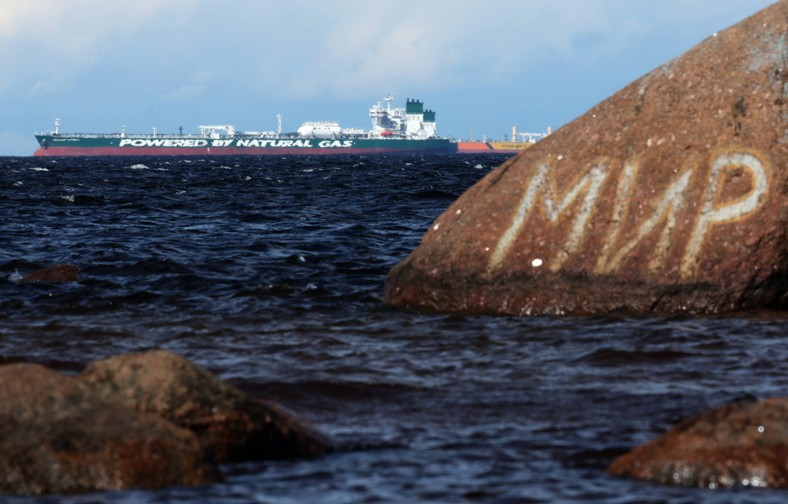
A tanker belonging to the Russian company Sovcomflot behind the rock with the inscription “Mir” (peace) in the Baltic Sea in the Leningrad region in Russia, May 3, 2025.
Limited possibilities and low trade profits
Let's take trade first. The abolition of American sanctions could revive trade in goods between these two countries, which in 2021–2024 shrunk by 90 percent. However, even before the invasion, the value of this trade was relatively small and amounted to $ 35 billion. [około 131 mld zł]. Any revival would be equally modest. For comparison, before the war, the value of Russia trade from the EU was EUR 258 billion [ponad 1 bln zł]. If Europe stays with its course, it will not return to the previous level.
Russia can count on more after the abolition of American sanctions for energy export, which is the main source of the Kremlin's income. America supports the introduction of a price limit by the G7, which prohibits insurers, transport companies and banks from the group of advanced economies to facilitate the sale of Russian oil, unless its price drops below $ 60. [około 225 zł] for a barrel. Before resigning from the position, Joe Biden also placed 155 tankers on a black list, which carried oil for Russia. The Kremlin, however, found new ships, as well as new ports in which they can moor, and the price restriction brought less results than expected. After a decline in January, oil exports increased to 3.5 million barrels a day, which is more than in 2021. The abolition of sanctions would not bring a significant impulse.
Also in the case of natural gas, the possibilities of improvement are limited. The abolition of sanctions at Arctic LNG 2, Russia's flagship project in the field of gas condensation, can help redirect part of the export, but it probably will not happen before 2026, when the surplus of gas is expected around the world. Putin closed the largest Russian pipeline to Europe in 2022. Although Russia could want to sell gas again, the purchase decision would belong to Europe.
What about the abolition of American export bans? From 2022, Russia avoided restrictions, bringing fakes from China or redirecting goods through Central Asia. Many valuable goods that could not be found – for example, technologically advanced machines – came from Europe earlier. There are some “double application” goods that can be used for both military and civil purposes, and which come mainly from America. However, even if other restrictions are lifted, the export bans of components to weapons may remain in force.
Logo of the Russian Energy Giant Gazprom in Saint Petersburg in Russia, December 30, 2024.
Financial black box and European advantage
International payments are the second area in which Russia hopes for progress. Excluding its banks from large Mastercard and Visa credit card networks, the SWIFT relay system and the “correspondents” network settling dollar transactions in America caused difficulties in its foreign transactions. These funds prevented, for example, Russian companies from repatriation of hard currency from China and India, the main buyers of Russian oil, which weakened the ruble. They also block Russia's access to assets worth EUR 274 billion [około 1 bln 164 mld zł]belonging to its central bank and stored in the West.
In the case of the abolition of American sanctions, these problems would be alleviated, but would not disappear completely. Most of the Russian central bank assets are in Europe and would probably remain frozen. Most Russian banks would still be cut off from the Swift system based in Belgium. They may also have difficulty obtaining dollars if American banks are reluctant to settle payments due to European sanctions. Three years of war turned Russia into a financial black box. Her membership in the special group for counteracting money laundering and financing terrorism, a world organization dealing with monitoring dirty money, was suspended. Russia would also be subject to divergent regulatory systems in various Western countries, which may be enough to discourage banks from accepting Russian customers.
International investments remain, which from the end of 2021 have shrunk by 43 percent. Foreign participation in Russian public debt has practically disappeared. The hopes for reversing this tendency helped strengthen the ruble by one -fifth since the inauguration of Trump. The re -influx of capital would strengthen the currency and give breath to Russian banks, which are currently the main creditors of the state. The actual economy of Russia also has great investment opportunities. However, the aviation and electric industry require modernization. Motor and logistics companies lack machinery and money. Vostok Oil in the north of Russia is one of the largest planned oil extraction projects in the world. It requires the construction of 15 new cities, three airports, 3500 km of power lines and many other elements, and its cost is estimated at $ 110 billion. [ponad 412 mld zł].
Companies with small assets may be willing to return: one of the traders raw materials claims that companies providing services for the oil industry are already focused on it. However, most of them will probably still be careful in investing in Russia, even if American sanctions are lifted. The restrictions can return if Russia breaks its promises or when a new president appears in the White House. Many investors in Russia have lost their assets after the invasion, and Russia can explode them again. This may cause the loss of reputation. Shareholders can rebel. All this for access to the economy smaller than Texas. In any case, potential investors may have difficulty finding a reputable bank that would agree to transfer their funds to Russia and back.
Independent actions: Europe's weapon against Russia
The abolition of American sanctions is unlikely to change the Russian economy. Europe may even try to sabotage relaxation, although it would threaten Trump's anger. European regulatory bodies could inform foreign banks that if any transfers related to Russia affect their European activities, they will be criminal liability. Many non -European transactions at some point go through Dublin, Frankfurt or London.
Europe could decide to abolish the oil price limit, instead prohibiting its transport companies and financiers to engage in the sale of Russian oil. Political decision -makers on the continent could prohibit tankers who transported Russian oil, docking in their ports. The most radical solution would be to suggest that buyers of Russian oil from third -country countries and banks serving their transactions may lose access to financial services and the common market. Such a move would involve high costs and the risk of serious consequences, especially from Trump, which could recognize the European relevance as undermining his agreement. For Europe to consider such “secondary” sanctions, a peace agreement proposed by America would have to be really fatal.
Trump's representatives have not yet talked to the EU about planned sanctions. “It's complete idiocy” – comments one of the trustees of European leaders. Europe has always been more important for Russia than America. In Trump, this means that Europe has good cards. Ignored and intimidated, he may be tempted to use them.