What is AI really? Two experts argue that not what it seems


Although it may seem that artificial intelligence is stormed by the world, there are people who consciously stick to the distance.
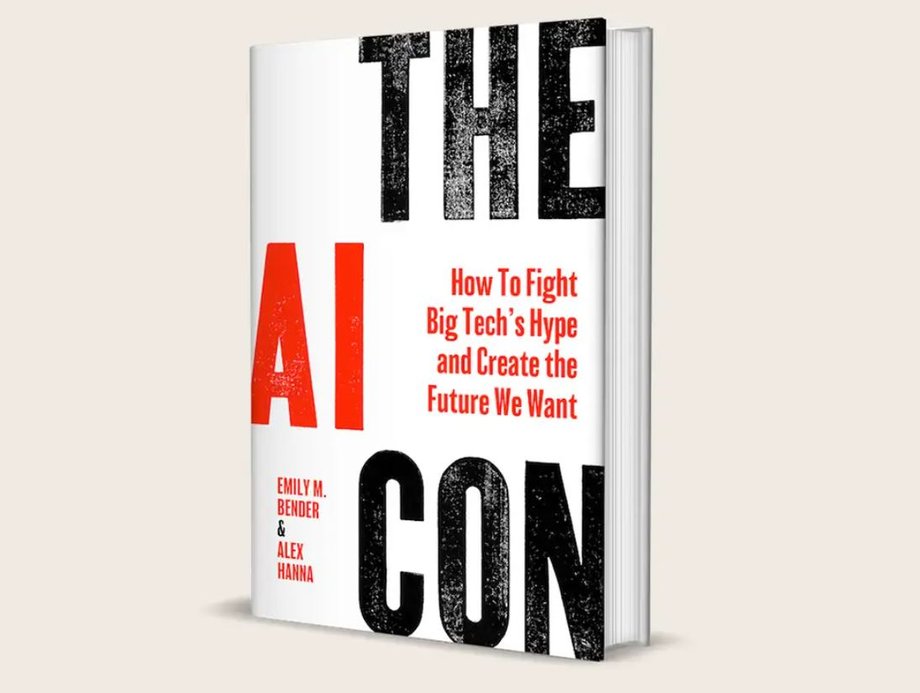
Emily Bender, a professor of linguistics at the University of Washington, and Alex Hanna, director of research at the Distributed Ai Research Institute and former AI ethics at Google, in her new book “The Ai Con: How to Fight Big Tech's Hype and Create The Future at Want” Technological giants do not present the authentic AI image.
Read also at Business Insider
They have been cooperating for years, they have been conducting the podcast “Mystery Ai Hype Theater 3000” together and belong to the group of the most expressive critics of contemporary AI solutions. Bender and Hanna want to remove the sensation envelope from these technologies and remind you that, to put it simply, the intelligence is not artificial.
With moments, a funny, sometimes malicious AI analysis, in which they describe artificial intelligence as a “mathematical matma”, “machines for spitting out the text” or, as they have been saying for years, “stochastic parrots” (“Stochasty” is a term in the field of mathematics and statistics, which means something that is related to randomness, probability and modeling of processes that change in accident) One goal: allow you to see automation as it is, without marketing illusion.
See also: Will AI deprive us of work and dominate a man? This is how the main scientist sees it
The following conversation was edited with transparency and appropriate length.
Business Insider: For many damage caused by AI is an abstraction. How to explain to people that these technologies also have serious, negative consequences?
Emily Bender: It is always worth remembering people. The whole narrative that it is like intelligence aims to hide them.
These people are all from programmers who made specific algorithmic decisions, by creators whose works were used or even stolen, to people who work on the data, i.e. A moderation of content, thanks to which systems do not show users of drastic or disgusting things.
Alex Hanna: The term “AI” does not mean one thing. This is a collective term for various forms of automation. The fact that the tool can write an e-mail should not obscure that this concept is used in a much broader context.
It is about systems used for everything, from making decisions about stopping someone in custody, through recruitment, to generating artificial content.
As in the case of clothes from chain stores or chocolate production, specific people are behind the maintenance of this chain.
So when you get an email generated by AI or a text that you did not want to write yourself, know that the whole structure, affecting people, their work, the environment and many other areas.
In the book you write about how much AI is based on exploitation and how it can worsen the quality of life. So why this mass fascination, almost religious faith in artificial intelligence?
Bender: Funny that you use such a term.
Many researchers note that especially talks about the so -called General artificial intelligence have a lot in common with Christian eschatology, i.e. a vision of salvation.
There is a thought here that we will create something that will save us, from boring duties, from great crises that we do not cope with, such as climate change, and even from the feeling of ignorance.
Of course, all this is not in reality. We do not live in a world where every answer is at your fingertips.
Belief that it is enough to throw a lot of computing power and data into the problem. And here comes the thread of exploitation. The ability to solve all problems is simply an illusion. This world with ready answers is not and never has been.
Hanna: People want computers to delight us. And here we have AI used everywhere: from social care, through health care, to art.
This is partly due to the need to create something “objective”, some impartial computing being.
Recently, there has been often talk about the “crisis of social capital”, “crisis of masculinity”, “crisis [tu wstaw dowolne zjawisko społeczne]”.
This refers to the book by Robert Putnam “Bowling Alone” and a few strange results of a nationwide social research from 2006, which suggested that people have more close friends today than before.
So there was a general thesis that we are more lonely. Perhaps there is something to it, but AI looks as a wonderful remedy for these social ills.
Meanwhile, we have much more serious tasks ahead of us: reconstruction of social infrastructure, restoring places of spending time together, strengthening the education system, repairing urban spaces.
But if there is a technology that seems to be able to solve all these problems at once, people easily fall into delight.
In the book, you put a lot of emphasis on the tongue and introduced a division into camps: doomers, boomers and boosters. Can you tell something more about these groups? What about readers who don't find themselves in any of them?
Bender: The division into boosters and doomers is very limited. We are dealing with a discussion that allegedly takes place on one axis. On one side there are doomers, i.e. those who say: “Ai is something that kills us all!” On the other side of the boosters say: “Ai is something that will solve all our problems!”
And very often the way both sides speak, suggests that this is the only possible range of views.
And yet you do not have to locate one or the other or even somewhere in the middle. We show that this is a very narrow fragment of possibilities.
These are two sides of the same coin, assuming that AI is something powerful and real, and this is complete nonsense, not supported by facts.
Most of the possible scenarios, including the one in which we are moving, are quite beyond this scheme.
Hanna: We hope that our book will help people involved in this division find a way out of it.
It can be a tool that will allow you to look at the subject from a different perspective, one that has not been taken into account before.
Because we found ourselves in a situation where at every step it is full of admiration over AI. It is difficult to break through it and see what these technologies really look like.
In the book, you also describe specific ways on how to rely on the ubiquitous introduction of AI. What to do when at work or on websites that you use, artificial intelligence is already built into everyday processes?
Bender: In every situation, when we talk about opposition, individual or collective, it is worth returning to the value. To the question: why do we actually do what we do?
You can ask yourself a number of questions about each technology. You have to remember that we have the right – and the opportunity to ask them.
The narrative about the “inevitability” of the development of AI is really an attempt to take away this agency from us. It is said: “This is something all -powerful, and soon it will be more powerful, so just adapt. You won't understand it anyway.”
But the truth is that we are all able to understand what it is and what values are behind it.
So we can say: “You suggest the use of automation, but how does this relate to our purposes and values? How do you know that it suits? Where is the assessment of effectiveness?”
Too often, we only hear: “Trust us.”
It happens that even people who know well at AI overestimate its possibilities and understand her mistakenly. So how should people without technical preparation think and talk about artificial intelligence?
Bender: The first step is always to break the concept of “AI” into parts. This is not one phenomenon.
You have to ask: what exactly is automated?
And immediately approach with great skepticism to all declarations. Because people who sell it very willingly use the magic that is associated with the term “artificial intelligence”, and at the same time, at the same time, they are very reluctant to reveal how their systems really work, on what data they were trained and what they actually do.
Hanna: We are dealing here with a certain tendency, partly economical, and partly resulting from the fact that some do not see the whole picture.
AI researchers are accustomed to looking at these issues through a specific prism. They are mainly interested in engineering breaks: how to teach parameters faster, how to perform specific tasks better, but these are not people who specialize in nursing, for example.
Meanwhile, it is people with domain knowledge that should use it to face this Hype.
The organization is a great example National Nurses Unitedwhich has prepared materials explaining the difference between AI and, for example, biometric supervision, passive listening or sensors mounted in doctor's offices and how it all affects everyday nursing practice.
That is why the resistance of the whole envelope and relying on your own knowledge is a really effective strategy.
How was the book accepted in your environments?
Bender: The reactions are very positive.
In the circle of linguists, which I come from, this is a particularly important moment, because from the language perspective we better understand why these “text -spitting machines” attract us so much.
The people I talk to are glad that our field is now playing an important role.
Hanna: The pickup was great.
Many of my friends are programmers or people working in related industries. I studied computer science, so my surroundings have always been full of technical enthusiasts. And almost everyone, as to one person, are opposed to AI.
They say: “I don't want Copilot”, “I don't want the code to write for me”, “I'm fed up with all this noise.”
It was probably the biggest surprise for me and at the same time the most building signal.
Because it is people performing technical work who promised the greatest benefits of AI in the form of speed and performance are increasingly becoming its most firm opponents.
|
press materials
The above text is a translation with American Business Insider edition