Despite the commercial threats and flip -flops, Washington has a very coherent policy in front of the Customs Conditions when it comes to American technology companies – he wants to provide them with global dominance. And he has a “friend” in the EU who can help in this.
For the White House, the fines recently applied by the EU on Giants Meta and Apple are a “innovative form of economic extortion”, which aim to escalate transatlantic trade tensions and to impose even more “non -commercial tariffs” on American companies.
Although Brussels wants to tighten the defense of its most important legal act – about digital markets (DMA) – must face the depressing reality – that it lacks unity in terms of technology regulations. Member States could not even work out one position as to whether it is possible to threaten American technology companies with additional taxes in the event of a possible trade war or not.
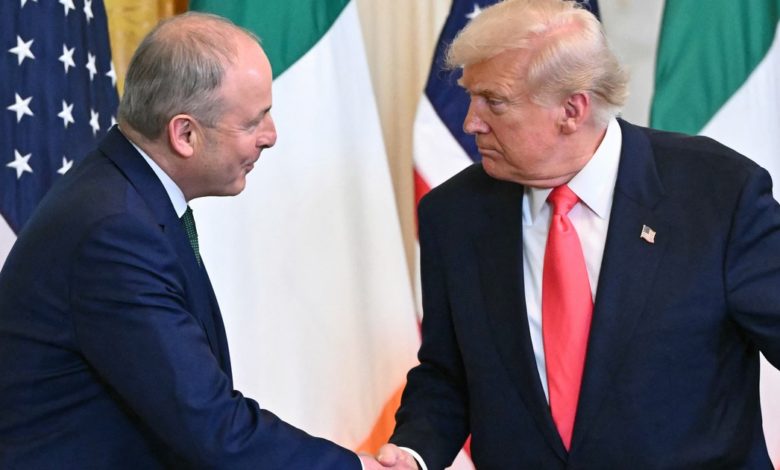
This time, however, the problem is not Germany, nor even the everbreaking Prime Minister of Hungary Viktor Orban – and Ireland.
Trump Trojan horse
For over two decades, she has been cooperating with American technology companies, deliberately striving to weaken EU technological provisions.
Perhaps it is a small EU member state. However, her dependence on American technology and pharmaceutical companies is unbelievable. In Ireland there are European headquarters of many technology companies – from the finish to Microsoft. Dublin also has its own “silicon docks” [“irlandzką Dolinę Krzemową”, w której znajdują się siedziby wielu firm technologicznych] and direct flights to over 20 places in the USA. The scale of travel between these countries is so large that Ireland remains the only location in Europe with American immigration and customs briefing at airports.
So forget about Greenland. Ireland is an island in the North Atlantic, which the United States already “has”. And when it comes to technology, Dublin is a Trump Trojan horse.
Currently approx. 15 percent Irish workforce – i.e. about 400,000 people – he works directly or indirectly for American companies. Almost 30 percent Ireland's total tax revenues in 2023 came from corporate taxes, mostly from American technology and pharmaceutical companies. For comparison – in Germany and France it was only 6 percent.
As noted by the Independent Irish Fiscal Council, Ireland would record a significant budget deficit each year without these high tax revenues. No wonder then thatThe Irish Prime Minister recently appealedthat Europe's reaction to the duties announced by Washington would be “thought out and balanced, and the actions are proportional.”
The subsequent declaration of Ireland that “opposes” EU digital taxes is actually powered by blind panic resulting from its financial dependence on American companies, and also from the fact that it has long been trying to submit the US interests to European interests.
Limited trust
Ireland has been in the scandal that has been ongoing for two decades, which she called. She collaborated with American technology companies to falsely “build credibility” of the Irish Data Protection Commission (DPC) and distract other EU members who questioned its impartiality in the enforcement of European provisions.
As a result, Ireland copes so badly with the enforcement of the EU work on data protection that the decisions of the Irish Personal Data Protection Authority [IDPC, Irish Data Protection Commision] They are constantly omitted by other national data protection agencies. It is not surprising that Brussels does not trust Dublin and does not believe in his declarations of Europeanness.
Continuation of the material under the video
If Brussels seriously approaches the issue of maintaining the integrity of its technology provisions, he must focus less on Washington, and more on the transfer of regulations from Dublin.
It is obvious that Ireland will never become a reliable regulator of American technology companies in Europe – this prevents its political closeness with the Silicon Valley and economic dependence. In fact, Ireland's dependence on the United States makes it an ideal partner for the White House, which intends to use technology companies and social media as a weapon in a broader trade and cultural struggle.
The EU needs a centralized agency that will supervise all European technology regulations, including DMA and the general data protection regulation. You need an authority regulating the activities of large technology companies in the EU at a pan -European level, an EU institution that will eliminate domestic prejudices from the decision on European significance.
Such a move would free Dublin from contradictory pressure of Brussels and Washington, and would also guarantee that no other EU Member State will potentially duplicate its mild regulatory system.
On one side
Even all future activities of Trump to reduce the attractiveness of Ireland in the eyes of American international corporations should be well received in Dublin – because they would lead to a slower but more sustainable economic growth of the Green Island. This is struggling with a shortage of apartments, poor public infrastructure and insufficient physical infrastructure. It would undoubtedly also increase its credibility on the EU arena.
However, do not make a mistake – the vast majority of American investments in Ireland will not disappear in the near future. Ireland is so deeply integrated into the American supply chains that it goes far beyond the actions of individual presidents or ideologies they proclaim.
Fortunately, there is a model for Europe that can be a role model. As a result of the 2008 financial crisis, supervision over 100 largest banks operating in the EU was transferred from national regulatory bodies to the European Central Bank. Effect? Despite Brexit, Pandemic, War in Ukraine and Trump's government 2.0, the European financial sector is currently stable, profitable and perceived by global investors as a safe haven.
Now it's time to apply this model in the technology industry. The time has come for Ireland to take one side. The time has come for Brussels to force her to do so.
I’m Ashley Davis as an editor, I’m committed to upholding the highest standards of integrity and accuracy in every piece we publish. My work is driven by curiosity, a passion for truth, and a belief that journalism plays a crucial role in shaping public discourse. I strive to tell stories that not only inform but also inspire action and conversation.