The truth about the crosses at the edge of the road that Trump said are tombs of the White South Africans. Their story, reported by locals

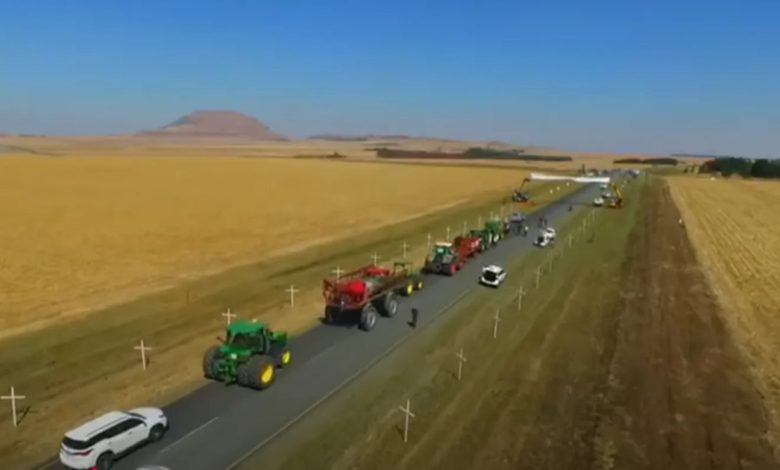
Among the evidence of alleged mass killings of the whites, who have presented by Donald Trump at the tense meeting in the Oval Office with the South African President Cyril Ramaphosa, there is a registration that would capture graves along a country road. The locals explained for the BBC, in a report, which is the significance of those crosses and the story behind them.
The video to which Donald Trump was referred to photo capture you tube via bbc
The US president claimed that the images capture the tombs of the white farmers, but the reality is different, the locals say.
The photos were taken in the area of an asphalt road that connects Newcastle and Normandein towns of South Africa and marks a memorial, not a cemetery, said one of the locals interviewed by the BBC.
The crosses were raised to mark the killing of two Afrikander farmers in the local community, a crime that took place five years ago.
How did a small country road reach the global attention
The P39-1 road, with a single sense, is a narrow highway portion that connects Newcastle and Normandein in South Africa, four hours to Johannesburg.
Throughout it there are farms, in an area of hills in the Kwazu-Natal province.
On Wednesday, many South Africans watched live, along with viewers around the world, as Trump attacked his South African counterpart, Cyril Ramaphosa, sprouting him with a video recording that he claims is a proof that South Africans are persecuted in South Africa. Previously, the US president had stated that a “genocide” of whites takes place in South Africa.
The most striking scene in the recording was an aerial shooting of dozens of white crosses on the roadside, an alleged “funeral place” of Afrikander farmers in recent years.
But the locals know better than anyone that this statement is not true, writes BBC.
The BBC visited the place on Thursday, the day after the confrontation at the Oval Office, and discovered that these crosses have long disappeared.
There is no cemetery there, and the road looks like any other. A new cereal mill has been built along the road portions.
Roland Collyer, a farmer from the Afrikander community in South Africa, reported that his aunt and his uncle, Glen and Vida Raffirty, were beaten to death five years ago.
They were killed at their farm by attackers who left with valuables. Their death angered the local community, and the crosses were temporarily located by Afrikander to condemn crimes.
By pointing down the hill, to a village where many families of color people live in clay huts, Collyer explains: “There were crosses planted by both sides of the road, representing lives taken on farms, crimes that took place on farms.”
“The crosses were symbolic, for what was happening in the country.”
The story behind the crosses
Rob Hoatson, a businessman, was one of Raffirty family neighbors. He admits that Trump is prone to exaggeration, but does not bother him that the images have been shown.
Locals say the two children of the Raffirty family left after killing their parents. The youngest son, he explained, moved to Australia, while the eldest son sold all his goods and gave up agriculture to move to the city.
In 2022, two locals, Dr. Fikane Ngwenya and Sibongiseni Madondo, were convicted of killing the Raffirty and robbery family, being sentenced to life imprisonment.
For many community Afrikander, it was an act of rare justice, thousands of crimes remaining unresolved. President Ramaphosa II told President Trump that he failed to find a solution to control the high crime rate, which continues to grow. In South Africa, they had 26,000 crimes last year. The vast majority of victims are color, according to security experts.
The killing of the Raffirty family has triggered a period of increased racial stresses in the area.
The Minister of Police of South Africa was forced to visit the place to re -render the calm, against the background of the Afrikandelers and the accusations of some members of the local community regarding the mistreatment by the white farmers.
“The entire procession aimed to increase the international media coverage of the entire event”says Collyer. “And for them to understand what we actually go through and what life we have to lead here, in South Africa, at this time.”
“A person must enter the house before leaving the darkness, we live behind electrified fences.”
Bethuel Mabaso, a 63-year-old local, says he was surprised by the news that his community has reached international attention and especially the fact that the US president has quoted it as “proof” of attacks on white farmers.
“Nothing like this happens here,” he says in his native language, Zulu. “We were shocked when the crimes took place and we are sad.”
“I live here since I was a kid and it is a quiet area. This has not happened here since then.”
In the years after the death of the Raffirty family, there were reports about accusations from some inhabitants of the farms, according to which the local police did not manage the cases that involve people with the same emergency as the death of the couple.
Another local agricultural worker, Mbondisi Shibe, 40, explains what the relationships between farmers and their staff, mostly color.
“We solve any problem arises through discussions, and if it does not work, we ask the police to intervene”, he says. “Usually, there are incidents like those in which our animals enter their fields and the police help us to recover them and vice versa. ”