Trump's commercial rates can generate recession, says the chief economist of an important local bank

Romania is the only country in the region where the volume of service exports to the US has exceeded the volume of goods exports to the US over the last ten years, an analysis said on Thursday Hotnews.ro by the chief economist of Alpha Bank, Ella Kallai. However, the potential negative effect of Trump's commercial tariffs can generate recession, she warns.
As a counteracting measure, the central banks in the Czech Republic and Poland have reduced the monetary policy interest at the latest meetings in the Ministry of Foreign Affairs. In Romania there is not yet this possibility.
The conclusion of Elle Kallai is in line with the analysis published these days by the National Bank, which showed that the impact of Trump's tariffs is as much as the growth of the economy in the first quarter of this year.
We remind that, starting April 10, 2025, the prospects for European markets have improved after announcing a 90-day tariff break from April 2, when the new US tariff policy has been launched. However, all European markets remain targeted at a minimum rate of 10%, some products, such as cars, being pricked by 25%. The increase of other rates is not excluded.
The demand for exports to the US, which became more expensive, will decrease
The effects by which the rates could affect the European economies, including Romania, are multiple. The direct effect, generated by the decrease of the exports and implicitly of the commercial receipts and the indirect effects created by the possible global slowing, the tightening of the financial conditions and the redistribution of the trade of China, whose products were charged by 125%.
The demand for exports to the US, which has become more expensive, will decrease. Because the redirect of these exports to other markets will require time, it is possible that the exports to the US may be reduced or even disappear.
Indirect exports to the US (through the EU Member States) have been calculated under the hypothesis that exports of the region countries to EU countries will be re -exported to the USA in the same proportion to the share of exports to the US in total exports from each EU country.
In Romania, direct exports in the US have increased easily as a percentage in the gross domestic product (GDP) from 1.1% in 2013 to 1.5% in 2023 (fig. 1A).
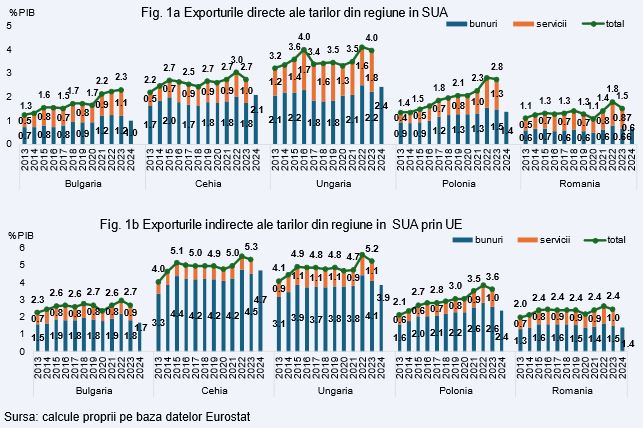
However, the volume of exports has remained the smallest in the entire period compared to the countries in the region. The volume of direct exports to the US increased in Bulgaria from 1.3% to 2.3%, in the Czech Republic to 2.2%, Poland from 1.4% to 2.8% and in Hungary from 3.2% to 4%. Romania is the only country in the region where the volume of service exports to the US has exceeded the volume of goods exports to the US over the last ten years.
In 2023 the volume of service exports (0.87% in GDP) exceeded 0.2% of GDP exports (0.66% in GDP). In the other countries in the region the exports of goods in the US have exceeded the exports of services in the US by 0.1% of GDP in Bulgaria, 0.2% of GDP in Poland, 0.4% of GDP in Hungary and 0.8% of GDP in the Czech Republic.
The volume of indirect exports (through the EU member countries) in Romania exceeds the volume of direct exports to the US.
This is the case in the other countries in the region. As with direct exports, indirect exports also have a smaller volume in Romania than in the other countries in the region.
Unlike direct exports, in the case of indirect exports the volume of service exports is lower than the volume of exports of goods as in the case of other countries in the region. In 2023, indirect exports as a percentage of GDP were 2.4% of GDP compared to 2.7% in Bulgaria, 3.6% of GDP in Poland, 5.2% in Hungary and 5.3% in the Czech Republic, and indirect exports were 1.5% compared to 1.8% in Bulgaria, 2.6% in Poland, 4.1% in Hungary and 4.5% (Fig. 1b).
The EU chains through which indirect exports of countries in the region are intermediate to the US are mainly EU member countries that have the highest direct exports to the US. Between 2013-2024, six EU member states generated almost 80% of EU export of goods in the US. Germany remained the largest exporters of goods to the US in the EU, although the share of its exports in total EU exports decreased from 36.4% in 2013 to 30.3% in 2024 (fig. 2A).
France and Belgium are the countries that have lost market share in EU exports to the US
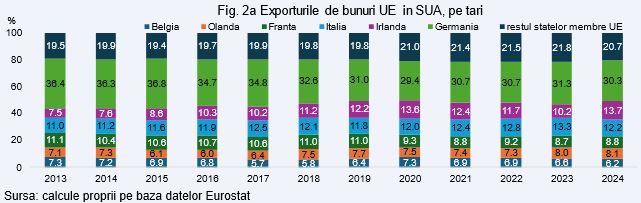
France and Belgium are the countries that have lost market share in EU exports from 11.1% and 7.3% in 2013 to 8.8% and 6.2% in 2024. While France went from second in 2013 to fourth in 2024, Belgium went from fifth place to sixth place in the ranking of the largest EU to the US. Ireland, Italy and the Netherlands were the countries that earned the market share in EU exports from 7.5%, 11%, 7.1% in 2013 to 13.7%, 12.2% and 8.1% in 2024 reaching the second, third and fifth of the largest exporters in the US to 2024.
Between 2013-2024, these six countries intermediates indirect exports of goods from the region to the US 80% in Romania, Czech Republic and Poland and about 70% in Bulgaria and Hungary (fig. 2b). In 2024 the proportion of indirect exports of goods to the US intermediated by Germany was 39% in Bulgaria, 41% in Romania, 47% in Hungary, 50% in Poland and 54% in the Czech Republic. Italy brokered 19% respectively 18% of the indirect exports of Romania and Bulgaria, 10% of the indirect exports of Hungary and 7% respectively 8% of the indirect exports of Czech and Poland.
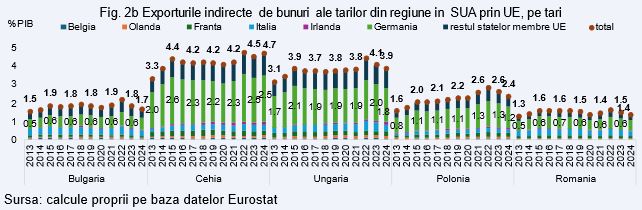
Other important branches that have intermediated after the six major EU countries the largest percentages of indirect exports in the US in 2024 were Austria for all countries in the region, Hungary and Spain for Romania; Slovakia and Poland for the Czech Republic; Poland and Slovakia for Hungary; Greece and Romania for Bulgaria.
The six great EU goods exporters in the US are also big service exporters in the US. These countries generated three quarters of EU service exports to the US in 2013-2023. As with the goods, Germany is also a leader in the exports of services to the US, its market share being 21.3% in 2023 decreasing from 24.5% in 2013 (fig. 3A).
Service exports to the US, Italy and Belgium increased slower than EU exports to the US, the share of their exports in EU exports from 15.4%, 6.8%, 6.6% in 2013 to 14.1%, 4.4% and 5% in 2023.
The share of the exports of the Netherlands in the EU exports to the US fluctuated in 2013-2023, reaching in 2024 at the same level as in 2013 (10.5%). The volume of Irish exports increased progressively, the share in EU exports to the US increase from 8.4% in 2013 to 16.9% in 2023, Ireland reaching the second largest service exporter from EU to the US.
Germany has brokered the highest proportion of indirect region service exports to US
Between 2013-2024 indirect exports of region services to the US were intermediate by these six countries in the same proportion as exports of goods (around 80% in Romania, Czech Republic and 70% in Bulgaria and Hungary, fig. 3b).
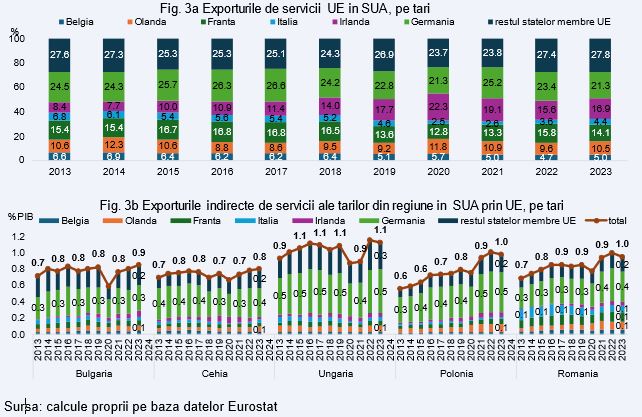
In 2023, Germany brokered the highest proportion of indirect exports of the region to the US (37% in Bulgaria, 38% in Romania, 44% in the Czech Republic, 47% in Hungary and 49% in Poland). The second largest intermediate of indirect service exports to the US was Ireland for Bulgaria (10% of indirect exports), the Netherlands for the Czech (7% of indirect exports), Hungary (7% of indirect exports) and Poland (10% of indirect exports) and France for Romania (12% from indirect exports).
Other important branches that have intermediated after the six major EU countries the largest percentages of indirect exports in the US in 2023 were Spain, Hungary, Sweden for Romania; Cyprus and Romania for Bulgaria; Poland and Austria for Hungary; Poland and Slovakia for the Czech Republic; Sweden and Denmark for Poland.
Overall in Romania the volume of exports of goods at risk in 2024 represented 2% of GDP, of which 0.6% of GDP direct exports to the US and 1.4% of GDP Indirect exports to the US intermediates by EU Member States. In the case of services, the volume of risk exports in 2023 represented 1.9% of GDP, of which 0.9% of GDP direct exports and 1% of GDP Indirect exports intermediate by EU countries.
In the countries of the region, risk exports are higher for both goods and services (except the Czech). The volume of exports of goods at risk in GDP represented 6.8% in the Czech Republic, 6.3% in Hungary, 3.8% in Poland and 2.7 in Bulgaria, and the volume of risk exports in GDP represented 1.8% in the Czech Republic, 2.9% in Hungary, 2.3% in Poland and 2% in Bulgaria.