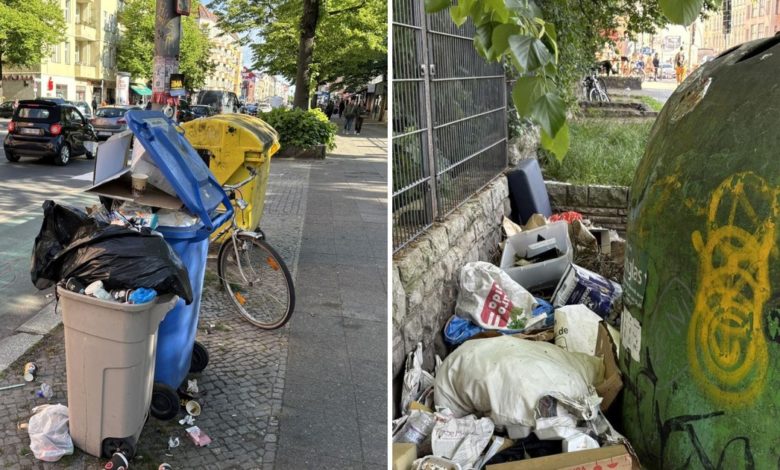
Mert Aydin (changed name) looks from the window of your parents' apartment to the street. Sees plastic bags, bottles, cigarette butts and individual clothes. On the other side of the street lie leftovers from the fridge. “It's still fine today,” says the 18-year-old. – The worst is on Sunday evening because people know that BSR is coming on Monday morning – he adds. BSR is a Berlin company dealing in garbage collection.
Kopfstrasse in the Berlin district of Neukovln is One of the most polluted places in the capital. Aydin claims that it is mainly residents who carelessly throw garbage. When he notices such cases, he draws attention to people. However, greater impurities are thrown into the street mainly in the evening and at night, when nobody sees it.
Aydin points to the red steel door across the street. – Behind them are garbage containers. Many residents are too lazy to open the door, so they just leave rubbish in front of them – complains. For him, growing up surrounded by garbage was not a pleasant experience.
Berlin-Neukolln is just one of many places of this type in Germany. Cities throughout the country are more and more struggling with the problem of littering. The survey, which was conducted among the 15 largest cities and their waste management companies by the “Die Welt” newspaper, shows that littering of public space has increased almost everywhere.
Not only Berlin
Przedsiębiorstwo Gospodarki Waste in Stuttgart informs: “In recent years, the degree of pollution has deteriorated. The main reason is the main reason social changes: public space is increasingly seen as a place of consumption. Mutual respect and a sense of responsibility decrease, the tendency to throw things up is growing. “
Also, enterprises dealing with the utilization of waste in Frankfurt say about the change of “user behavior and spending free time”.
The ordinal services of the city of Hamburg write that especially since the coronavirus pandemic, it is noticeable to increase the use of public space and the associated littered. There is information from Dortmund that illegal waste storage in the downtown districts “is currently recorded every day in increasing quantities.”
Berlin enterprises dealing with maintaining cleanliness in the city attribute this problem “a constant increase in population”.
How Berlin fights with the lagoon of garbage
“It's also a cultural problem,” says Mert Aydin. There are a lot of migrants on his street. Children imitate adults. The yards look worse than public streets. – Of course, not everyone throws garbage on the street, but unfortunately he does so many people – he adds. It also suspects that the reason is Educational problem.
Ruben, who does not want to reveal his name, does not think that littering has something to do with migration. The 38-year-old is a occupational therapist and is just leaving the customer's house at Kopfstrasse. – I think it is mainly related to education – says.
Continuation of the material under the video
– I would be in favor of all the children at school once a month or at least once a quarter to devote two lessons to cleaning garbage in their area – he adds. Ruben is convinced that this would change the situation.
The ruling CDU in Berlin indicates progress. Currently, companies that explore garbage can take several items, even if only one of them has been reported to the Public Order Office – informs Danny Freemark, a spokesman for the CDU Fraction for Environmental Policy in the Deputies' Chamber. – Two years ago, for example, you could only take a reported bathtub, but not a mattress next to it – he adds.
Also introduced Free large -scale garbage collection days and a sharpened catalog of fines. The National Parliament has recently decided to increase penalties for discarding garbage. Throwing the cigarette butt to the ground will cost 250 euros (1 thousand PLN) instead of the existing 55 euros (233 PLN). You will have to pay 4,000 for illegal throwing of large -size garbage. euro (16 thousand PLN) instead of 150 euros (636 PLN).
The most littered places
“Subjectively, it doesn't always seem to be cleaner,” Freemark adds. The truth is that since the coronavirus in Berlin it has been again More tourists And a large part of the inhabitants are people with migration origin. – In many countries of origin there are no five garbage containers on one street, so the approach to waste is different – he explains.
Nevertheless, he is optimistic that cleanliness in the city will improve. “We want to raise cleanliness to a new level,” he says. This is a “larger puzzle”, but the CDU and SPD national government is working on this issue.
Nicolas Walter / Die Welt
Garbage on one of the streets in the Neurln district in Berlin
The Berlin alternative to Germany (AfD) believes that previous actions are not enough. Alexander Bertram spokesman for the environmental policy faction says: “Higher fines are correct, but at the same time senseless if the perpetrators are not caught. Therefore, we want to introduce specific means against neglect through parliamentary initiatives“
As part of the campaign, its faction is currently calling Berliners to send photos of the eye -catching places. These “worst” will then be “awarded” with the negative award of the mayor of the district. “We want to make residents aware of the situation in the city,” says Bertram in a recent interview. On average, three reports regarding littered places in Berlin come from the start of the campaign, according to the data of his party.
“In recent years, nothing has changed”
Sociologist Florian Kaiser from the University of Magdeburg believes that Society also has duties in this respect. – Nowadays, social environment rarely requires proper behavior from us. Therefore, it is easier to simply throw something because you are not responsible for it – he explains. Kaiser suspects that one group is primarily responsible for garbage. – I imagine that Young men aged 17 to 25 They are not too interested in conformism, and more like all kinds of civil disobedience – he says.
In addition to changing the way of thinking of society, according to Kaiser, it would make sense to introduce structural agents, such as increasing the number of garbage bins or dumps, whose design would be more conspicuous. – An alternative strategy that seems to be the most sensible to me is to increase the costs of littering through, among others A drastic increase in penalties for throwing garbage and enforcing these penalties, as in Singapore – he adds. In this Asian country, the perpetrator must pay up to 1 thousand for the first offense. hole. (PLN 3.7 thousand). Berlin goes a similar path.
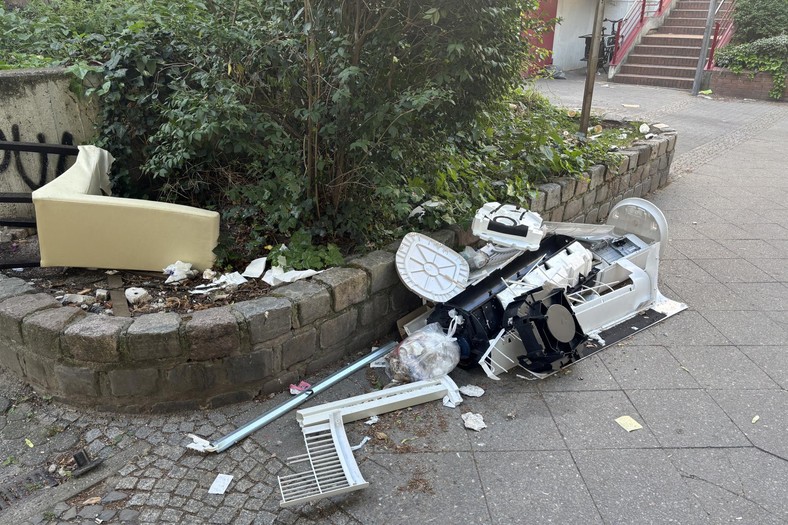
A young man, who is just crossing Herrmannstrasse street, vividly describes the situation in Neurln. – Just go along the street once, and then you have half the apartment of the apartment – he says. According to the district office, about 10,000 are thrown here. Siśc. bulky waste and electrical equipment. The authorities take “comprehensive actions” to counteract the problem. However, the topic is in the district “so dominant that the full list of activities would go beyond the scope of” “Die Welt” queries.
Mert Aydin claims that he does not believe that something has changed in the coming years. – Politicians have long known what the situation looks like. Despite this, nothing has changed in recent years – he says. Soon he and his family intend to move out.
I’m Ashley Davis as an editor, I’m committed to upholding the highest standards of integrity and accuracy in every piece we publish. My work is driven by curiosity, a passion for truth, and a belief that journalism plays a crucial role in shaping public discourse. I strive to tell stories that not only inform but also inspire action and conversation.