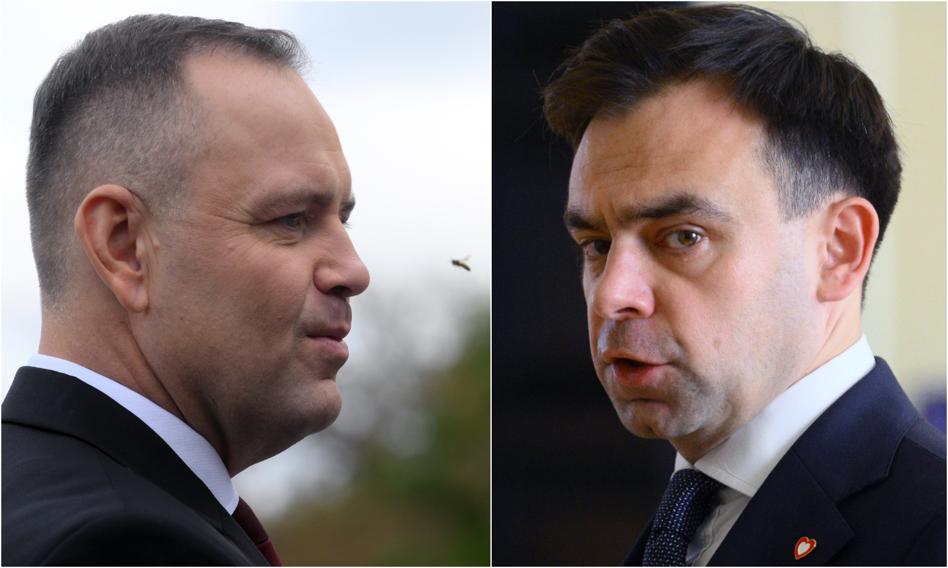
Prof. Leszczyński: Grzegorz Braun's result in the first round of the presidential election “shockingly high”

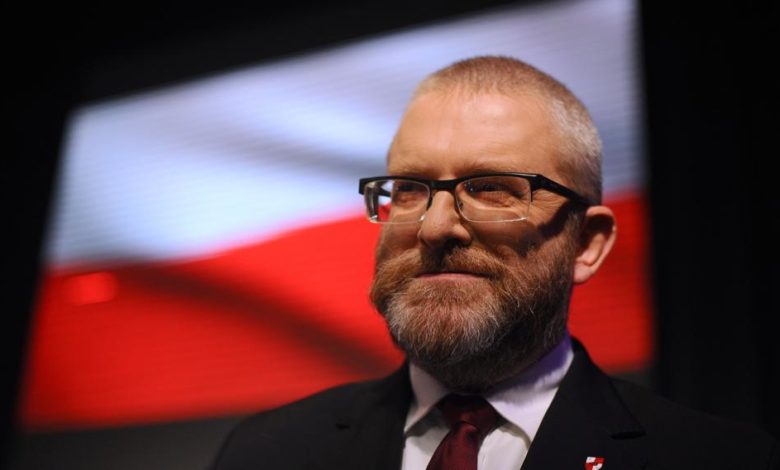
The result of Grzegorz Braun in the first round of the presidential election is “shockingly high” – believes the director of the Institute of Political Thought Gabriela Narutowicz prof. Adam Leszczyński. The views, thanks to which he came in fourth place, is a combination of xenophobia, fears and crazy level of nationalism – emphasizes the professor.
According to the official results and rounds of Sunday presidential elections given on Monday, the candidate Ko Rafał Trzaskowski won 31.36 percent. votes, and Karol Nawrocki, supported by PiS, 29.54 percent It is these two candidates who will compete in the second round of elections, which will take place on June 1.
Over 1.24 million people (6.34 percent) voted for Grzegorz Braun on Sunday. It was the fourth result out of 13 candidates.
“The result of Grzegorz Braun is shockingly high. He is a man who has been working hard for many years for his recognition and not without talent for public performances. However, the content of views that made him land in fourth place is moving. This is a combination of xenophobia, fears and crazy level of nationalism,” said prof. Adam Leszczyński, director of the Institute of Political Thought Gabriela Narutowicz.
In his opinion, the vision of conservative order, patriarchal, religious order, closed to the influence of the world, in which there is no place for Ukrainians, may emerge in the views presented by Grzegorz Braun. As the professor assessed, the right -wing policy of anti -Ukrainian rhetoric is socially more socially than, for example, anti -Jewish. “She is currently better resonating,” he noted.
According to prof. Leszczyński, A good Brauna result can mean a shift of the debate in Poland to the right. He pointed out that PiS, seeking Braun's support or his marginalization, could take over at least this kind of rhetoric. “This is not about the person of Grzegorz Braun and his views, but about the fact that PiS, who never wanted to have competition on the right, will conclude that he must move in this direction” – he emphasized.
When asked who the voter Grzegorz Braun is, the professor replied that 1.2 million votes means that this is a combination of various electorates: the core is a radically conservative-religious and nationalist voter. According to prof. Leszczyński, one should examine who this voter had voted earlier, although – as he said – intuition tells him that to some extent it was a PiS electorate, which later felt disappointed in the rule of this party.
Grzegorz Braun said during an election evening in his staff that “mainstream media” used to him a “brutal, absolute campaign of silence and distortion.”
Prof. Leszczyński, then, how Braun managed to reach his political project to the electorate, said that the politician worked for many years. “He developed such a technique of meetings with voters that strengthened him. Secondly, the success of this type of candidates is also possible in the event of a bypass of traditional media. We reach directly to voters through Tiktok, through social media, by sending on YouTube,” he said.
According to the scientist, the ranges and the influence of traditional media, such as television or radio, not to mention the press, clearly decreases, and they previously “filtered” such views.
“We may wonder if + filtered + them rightly or not, whether it is democratic or not. Social media – on the contrary, they strengthen extreme and polarizing views. Grzegorz Braun is an intelligent man and he benefited, unfortunately for democracy in Poland” – said prof. Leszczyński.
When asked whether Braun could translate the success in the presidential election into a larger parliamentary representation, he replied that above all, it should be examined to what extent this electorate is attached to the leader; Is it as stable as voters of Jarosław Kaczyński.
“I think that this is not a stable electorate yet, because this kind of support is built for decades. However, it seems to me that the main impact on democracy will not even be that he will introduce some deputies. The main importance is that his presence normalizes certain views in public space and shows that in some sense (…) you can have them. I think it is extremely dangerous,” said the professor.
Adam Leszczyński is a historian and sociologist, lecturer at the SWPS University in Warsaw. He was a journalist of Gazeta Wyborcza and co -founder OKO.press. In April, he was appointed by the Minister of Culture and National Heritage Hanna Wróblewska as the director of the Institute of Political Thought Gabriela Narutowicz, who deals with research, dissemination of knowledge and culture, as well as the implementation of memory policy in the field of Polish history. (PAP)
Szf/ Par/ KTL/