Germany has a growing problem with work. “Gloomy perspectives”

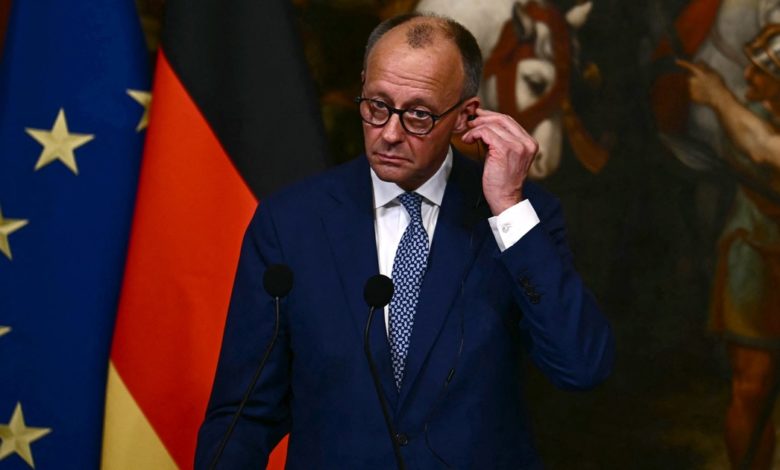
Until 2035, 4.8 million older German employees – 9 percent Working force – will retire, and Merza's coalition must convince younger generations to devote most of his free time to support the largest economy of Europe.
In the coming years, Germany will be one of the first and most important examples of how fast aging western economies will deal with the problem of a rapid increase in the number of pensioners.
Economists warn that the central element of Merz's growth strategy, i.e. an expenditure plan based on debt of 1 trillion euros (PLN 4.2 trillion), can also make the solution to the dilemma related to working time become even more urgent.
– just increasing financial outlays will not build any roads or bridges – for this An additional employees are needed – says Clemens Fuest, head of Think Economic Tank IFO.
The dynamics of the labor market in Germany is unique on the scale of a developed world, but this does not mean that Germany is the nation of the lazy – emphasizes Bernd Fitzenberger, director of Think Tank Iab, who deals with the labor market.
The number of employees and the total number of hours worked in the German economy reached another in 2024 record level – partly thanks to immigration, because over the past decade the number of foreign employees has increased almost twice, to 6.3 million. Four out of five people of working age have a job – it is One of the highest professional activity rates among rich countries.
“Long -term perspectives are quite gloomy”
“In general, Germany works more than ever before,” says Fitzenberger.
However, the average working time for an employee fell last year to a record low level, not counting the year Covid-19, 2020 pandemic. According to OECD data, Germany has the shortest average working time among all rich economies.
With the departure of the demographic boom generation from the labor market in the next decade, shortening the work week is threatened with deepening the shortage of labor, which is already affected by some sectors, such as health care, education and part of the machine industry.
– Long -term perspectives are quite gloomy – warns Martin Werding, a member of the German government economic experts, which forecasts that in the next decades a limited supply of labor in the country may cause a decrease in already a decrease in already poor economic growth potential by up to 0.6 pp
69-year-old Merz is The second oldest chancellor of Germany At the beginning of the term after Konrad Adenauer (Adenauer was 73 years old when he was first elected in 1949). Although he may be a role model for people working longer and harder, convincing the rest of the country to take similar actions will not be easy.
Post -war employment relations in Germany were shaped by a long campaign trade unions For the five -day working week in the 1950s and 1960s, the initiative was used by the famous poster with a child, which stated: “Samstags Gehort Vati Mir” (“On Saturday, dad is mine”).
“Collective amusement park”
In the 1980s, the trade unions organized one of the longest strikes in history, trying to shorten the working week from 40 to 35 hours for full -time employees. Currently, countless collective systems in the country predict an average of 37.8 hours as a normal work week.
In 1993, the then Chancellor Helmut Kohl caused a stir, claiming that the Germans were beginning to resemble the “collective amusement park” due to a short work week and widespread retirement – since then the average working time of the employee fell by 13.5 percent.
Decision taken in 2007 by the Angela Merkel government increasing the retirement age It remains very unpopular among German voters by two years to 67 years and still persecute the social democrats who supported her.
The coalition between the Centroplent Christian Democratic Union of Merza and the Social Democrats has committed itself in the Treaty specifying the political program for the next election to introduce incentivewhich are to convince the Germans to extend the working time and delay retirement.
Economists like the fact that The new government sees a growing problem decreasing supply of labor in Germany.
“Bureaucratic nightmare”
However, “ideas are still too unclear, and the devil is in the details,” says Andreas Peichl, a professor of economics at the University of Munich and senior economist IFO.
New encouragement will probably be “ineffective, very expensive or will be a bureaucratic nightmare” – he adds.
One of the largest sources of increasing the supply of workforce is a huge number of employees employed in incomplete hours. According to the data of the National Statistical Office, since the early 1990s, the part -time employees have increased more than twice, reaching 30 percent. workforce, mainly thanks to women.
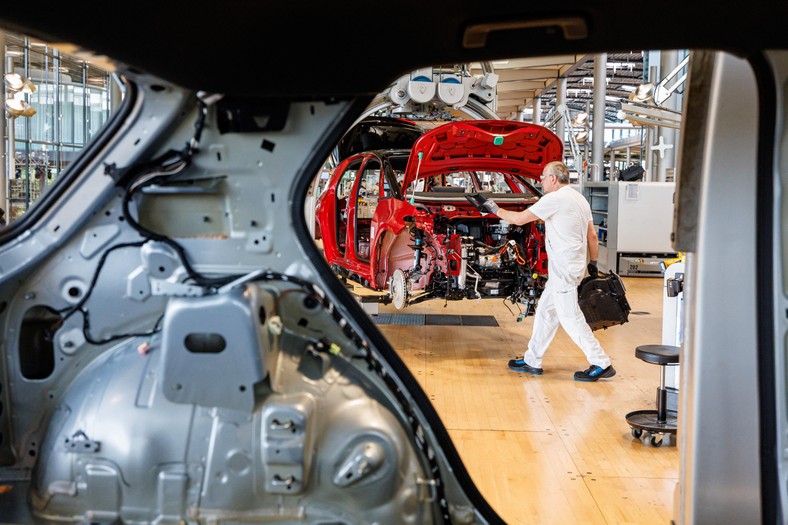
Volkswagen car factory in Dresden, illustrative photo
Sebastian Dullien, director of Think Tank Economic IMK, emphasizes that a part -time work boom distorts statistics regarding the number of hours worked by one employee. People who currently work part -time, “in the past they were not part of the labor force at all,” and therefore reduce the general average.
Employees employed in full -time working time in Germany currently work on average 40.2 hours a week, i.e. only one hour less than in 1991. However, after taking into account the huge increase in the number of part -time employees who were not employed in the past, the average working time per person is just over 34 hours a week – by 7 percent. less than the EU average IO 16 percent less than in Greece.
Studies show that Many part -time employees in Germany would gladly extend their working time, but they encounter numerous problems. The largest of them is the lack of proper care for children. Full care of children is inaccessible, uncertain and expensive especially in larger cities.
“Political minefield”
-After the birth of my daughter seven years ago, we were first worried if we could find a place in a nursery, then in kindergarten and later in the common room-says Ina Schmidt, a 47-year-old mother from Munich. She indicates that her daughter's primary school ends at noon.
Schmidt works 25 hours a week in the Department of Children's Psychiatry – in the field in which there is a lack of qualified employees. He says that she would gladly work up to 10 hours a week more, but she can't do it because she is not satisfied with the quality of help in doing homework her daughter receives after school.
Stephanie Pogemeller, the founder of the Work & Family Coaching Coaching Group, claims that the lack of good childcare is “one of the most repetitive issues” that hinders mothers to return to work in full -time, and “women are often left alone“.
Merza's coalition has other funds at his disposal, but none of them would be with a positive reception.
Even a simple idea, such as the abolition of constantly free days from work, the number of which varies depending on the location, but this year it can be up to 13, did not gain much support. According to IFO estimates, such a move could bring an additional EUR 8 billion (PLN 34 billion) of GDP per year.
Further increasing the retirement age and increasing the pension deductions for people who retire early would also be “very effective” – says Werding from the Council of Economic Experts. – But all such ideas are a political minefield.
© The Financial Times Limited 2025. All rights reserved. It is not allowed to spread, copy or modify in any way. Onet bears the sole responsibility for the translation, the Financial Times Limited does not bear any responsibility for its accuracy or quality.