The leaders of Germany and Italy reject the idea of sending troops to Ukraine: “We are far from this”

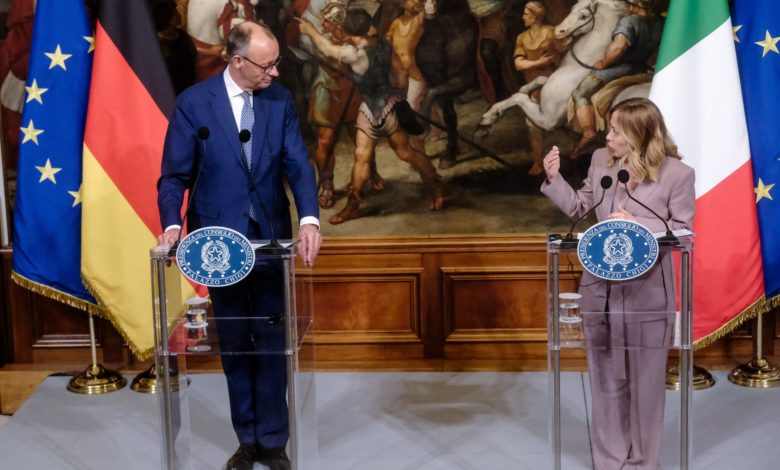
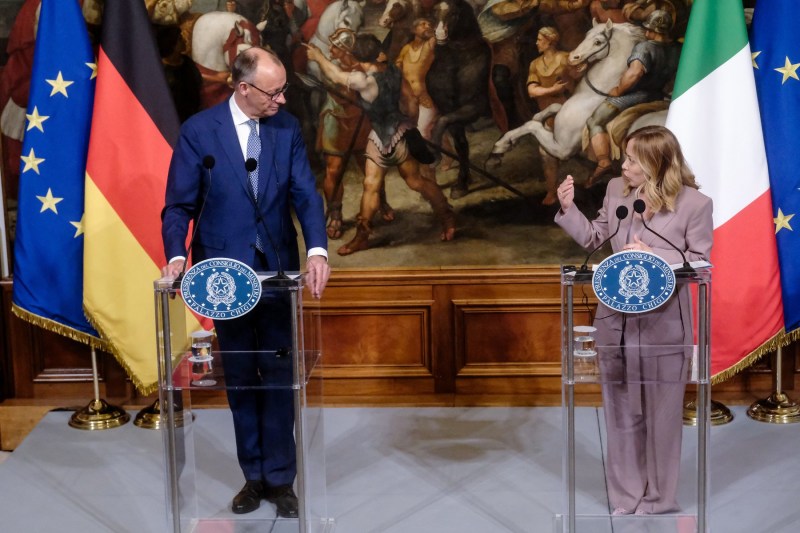
The Prime Minister of Italy Giorgia Meloni and the Chancellor of the Federal Republic of Germany, Friedrich Merz, in Palazzo Chigi, the headquarters of the Italian government in Rome. Photo: Scrobogna / LaPressse / Shutterstock Editorial / Profimedia
Europe is far from discussing the sending of troops to Ukraine, as all efforts are currently focusing on obtaining an unconditional cessation from Russia, German Chancellor Friedrich Merz and Italian Prime Minister Giorgia Meloni said on Saturday.
“The next step must be the clarification of the format in which peace discussions can take place, as well as what security guarantees could be needed, at one point, for Ukraine,” Merz said, specifying that these aspects are impossible to anticipate.
“There is no reason to talk about (troops n. Red.) At this moment, we are far from this. We want the anti -aircraft weapons to stop, that the bloodshed will cease … These are our priorities now, not others,” added the German Chancellor.
The leaders of France, Germany, Great Britain and Poland, together with the Ukrainian President Volodimir Zelenski, met on Friday, in the margin of a summit in Albania, to discuss the situation in Ukraine. European leaders and Zelenski also called for US President Donald Trump, who announced on Saturday that he would talk to Russian President Vladimir Putin.
Meloni did not participate in the meeting-an absence that the Italian press described as a deliberate affront, suggesting that French President Emmanuel Macron would not have wanted her involvement.
Meloni told journalists on Saturday that Italy is open to participate in any international format that follows the conclusion of the war, but warned the risk of divisions within the West.
“The unit of the West was our greatest strength since the beginning of the invasion of Russia. At such a delicate moment, it is important to set aside any personal differences that could undermine this unit,” she said.
Meanwhile, the European Union is working on a new sanctions package to intensify Moscow pressure because of the war, after the first face -to -face discussions between Russia and Ukraine in the last three years, held on Thursday, have not led to a cessation of fire – although Russia has agreed to continue negotiations.
“Yesterday's discussions from Istanbul ended under our expectations, despite the extremely constructive position of Ukrainian negotiators,” Merz said.
Merz's position regarding the sending of peacekeeping troops reflects that of his predecessor, Olaf Scholz, who also put on the foreground for a peace agreement, to the detriment of military presence on the ground.
British Prime Minister Keir Starmer has previously expressed the availability to send peacekeeping troops, but only under the conditions of a clear security commitment to the United States for European countries.
The United Kingdom and France are the nations that have led European efforts to provide a peacekeeping plan for Ukraine, after US President Donald Trump has started putting Kiev to accept a peace agreement.
Russia has repeatedly rejected the idea that soldiers from member states of the NATO military alliance will be carried out on the territory of Ukraine.
It follows the latest developments in the 1179th day of the LiveText Ukraine on Hotnews.ro.