Europe has no choice – it must be armed. He has a gate, where to get money and charm Putin

Everyone agrees that Europe must arm. There are doubts as to whether America under Trump will help with its former allies in the event of war.
The US President does not like that most EU countries spend much less money on their armies, and some of them do not even achieve the purpose of the current NATO, which is an expense of 2 percent. GDP. That is why he threatens that he will not take part in the next NATO summit – and it would be like a gift for Putin. Europe must work quickly, although it has only two options.
Perhaps it was thanks to the threat of Trump that the debate has recently gained a new pace. The German Foreign Minister Johann Wadephul supported the claim of the American president regarding the increase in expenditure on the army. During the meeting of foreign ministers of NATO countries in Turkey on May 15, CDU politician said that he shares his opinion, that it is necessary.
To solve this problem, the head of NATO Mark Rutte invented a trick that has recently been specified in his letter to the Member States: In the future, defense expenditure would be divided into “hard military expenses” and a softer part, which Rutte calls “defense -related investments”.
According to reports, the “hard part” of defense expenditure is to amount to 3.5 percent. Instead of the previous 2 percent It mainly includes national defensive budgets. These are Purchase of classic military equipment, such as howitzers and rockets. In the case of Germany, this would mean expenses of around EUR 150 billion (635 billion 670 million).
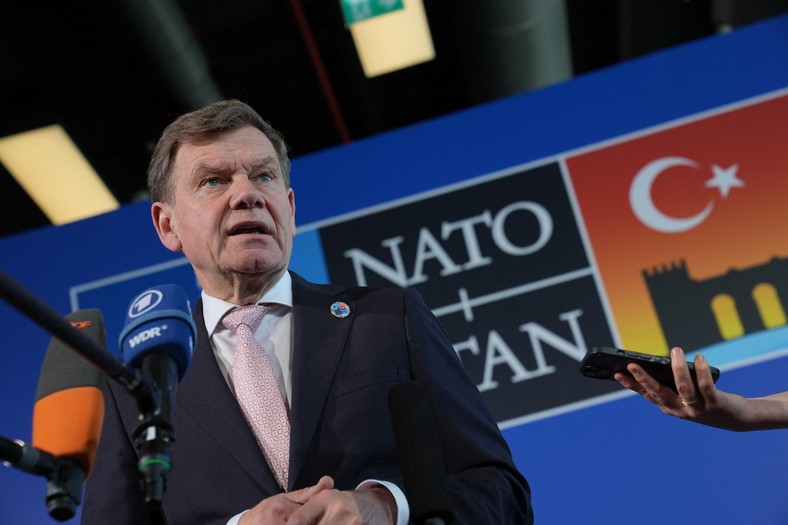
German Foreign Minister Johann Wadephul before the informal meeting of NATO foreign ministers in Antalya, Turkey, May 15, 2025.
The “soft part” (1.5 percent) would include investments in infrastructure, such as road repairs or bridges of military importance, but probably also to protect population and – under the pressure of some countries, such as Italy and Spain – expenses for the protection of external borders.
Nevertheless, the amounts in question are huge. Last year, Germany spent the equivalent of $ 98 billion on defense. (PLN 370 billion 479 million), which is over 2 percent. GDP. To achieve a new 5 % goal, $ 233 billion would have to be allocated to reinforcement. (880 billion 833 million PLN) per year, i.e. by $ 135 billion. (PLN 510 billion 354 million) more than today.
France would have to incur additional expenses of around $ 89 billion. (PLN 336 billion 456 million). Italy, which in 2024 allocated only $ 34 billion to defense. (PLN 128 billion 534 million), they would have to collect over $ 80 billion. (PLN 302 billion 824 million), which is almost three times more. In Spain, the defensive budget would increase from $ 21 billion. (79 billion 491 million PLN) to over 60 billion dollars (PLN 227 billion PLN 118 million).
Germany and several other EU Member States would be able to cope with such financial effort. For example, Poland should reach 4.7 percent this year, which would be the highest value on the continent and would significantly exceed the current 3.4 percent. America. However, for countries such as France, Italy and Spain, higher expenditure on the army seems almost impossible. They lack money for it. They also cannot afford new loans in this amount. For example, in France, the debt indicator – i.e. the ratio of liabilities to GDP – is 113 percent, and in Italy up to 135 percent.
Strategic dilemma
The only chance for these countries is a common European debt. So far, Germany has definitely wanted to avoid it. However, Wadephuls's initiative can direct Europe in this direction. This would be perverse if it was the Berlin minister – probably unconsciously – he broke the great taboos, which are Eurobligacja.
Even economists who have categorically rejected Eurobligations so far see the strategic EU dilemma that can only be solved by some debt.
– France, Spain and Italy – the three largest economies of the European Union – have a debt indicator exceeding 100 percent. – notes Veronika Grimm, a member of the Council of Economic Experts. – This significantly reduces their freedom in financial policy. These countries are not able to finance higher defense expenses through additional debt – he adds.
Even without additional expenses on the army, highly indebted countries face huge challenges, says Grimm. In the coming years, many low -interest tax bonds will have to be refinanced at much higher interest rates. Interest expenses can in this way increase rapidly to a level that will be difficult to bear.

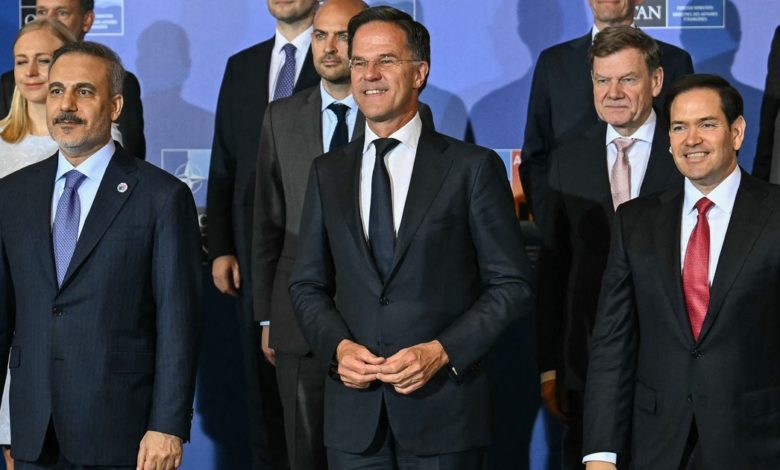
From left to right: Senator Lindsey Graham, NATO Secretary General Mark Rutte, German Foreign Minister Johann Wadephul, French Foreign Minister Jean-Noel Barrot, Italian Foreign Minister Antonio Tajani and the British Foreign Minister David Lamma in Antalya, Turkey, May 15, 2025.
In Italy alone, bonds worth EUR 818 billion (3 trillion PLN 468 billion) will have a maturity date over the next three years. Currently, the average interest rate of Italian tax bonds is 2.8 percent. However, for new bonds with a ten -year incidence, the Ministry of Finance in Rome must currently pay 3.65 percent, and for five -year papers – 2.83 percent. This means that interest costs are rising even without incurring new debts.
Even greater the risk of refinancing occurs in France. The average interest rate of existing public debt is only 1.8 percent. However, over the next three years, bonds worth EUR 858 billion (3 trillion PLN 637 billion) will expire – also in this case there is a risk of significant additional charge due to interest rate growth.
If Germany, as part of the debt and special fund financed by the debt, sought to alleviate European debt principles, they would have to offer political counterweight to the other euro zone countries. One of the possible options would be joint European defense bonds. However, it would be a condition to transfer state competences to the European level.
– Of course, the risk that a good loan rating of Germany will suffer, increases with the increase in common debt – indicates Grimm. – But security has various components, it is not only about financial security, but also about military security. Geopolitical opponents, such as Russia or China, will carefully observe these weak points of Europe.
A welcome guest in Washington
“It would be ideal to use this dynamics to really speed up the creation of a stronger political union,” says Grimm. – We are forced to deepen the European Union, a combination of forces, because in this more complex and stronger dominated by the policy of the world forces, as a single country in Europe, we will have a really difficult task – he adds. This means that some decisions, for example regarding defense, should be made at European level.
The first joint debt for defensive purposes has already been approved. The Commission wants to take out loans of EUR 150 billion (635 billion 880 million) and transfer them to Member States on favorable terms. However, many countries are hesitating. France, Italy and Spain do not want to make more commitments.
The problem is that although the EU can borrow money on more favorable conditions than most governments, loans, which it then grants to states, causes an increase in public debt. Whoever borrows from Brussels, therefore, risk frightening markets and even deterioration of credit rating. That is why several countries of southern Europe prefer subsidies that do not need to be repaid – and which are financed from Eurobligtion.
In this way, Johann Wadephul could become a welcome guest in Washington in the future. However, new friends in the White House can mean angry old friends in Europe. A surprisingly decisive Berlin initiative regarding 5 percent. It will probably cause irritation here. Unless the new NATO goal becomes a catalyst for the project of shared debt.