The frost has changed the appearance of Lake Cincis. The great expanse of ice in western Romania


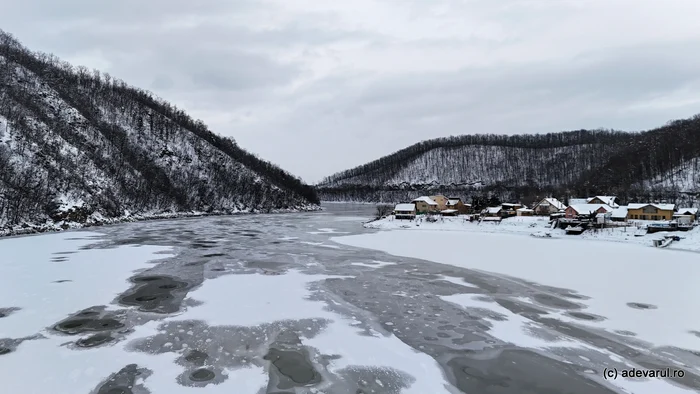
Frosty days and snowfalls have turned a large part of Lake Cincis into an ice bridge on which wild animals move. Upstream, the white expanse joins the shores of the lake, offering a spectacular view for tourists.
Lake Cinciș from Hunedoara, in winter. Photo: Daniel Guță. TRUTH
The series of days with negative temperatures and heavy snowfall changed the appearance of Lake Cinciș in Hunedoara, one of the largest reservoirs in western Romania. Almost half of its surface, 250 hectares, is covered by ice.
The ice takes over Lake Cinciș
The area that took on the appearance of an ice rink is located upstream, where the width of the lake is narrower, the forested slopes are steeper and cause sunlight to penetrate for a shorter period in the narrow valley, and the water depth is shallower, affected by the alluvium that has shaped it in the more than six decades since the establishment of the hydrotechnical arrangement.
In the past, when the lake was frozen, many fishermen could be seen on its surface, piercing the ice to fish with a lure. However, the thin layer of ice poses risks for those venturing on the lake, and in addition, the number of fishermen has gradually decreased, as most of the land on the right bank has become private property and the owners have fenced it off, making access to the lake difficult.
One of the attractions of Lake Cinciș is the former Roman Catholic church in the village of Baia Craiului, abolished in the 60s with the development of the lake. Its ruins, over two centuries old, remain a tourist landmark of Hunedoara. Near the church, a vast expanse of ice covers the waters, the lake here being transformed into a natural bridge used by wild animals.
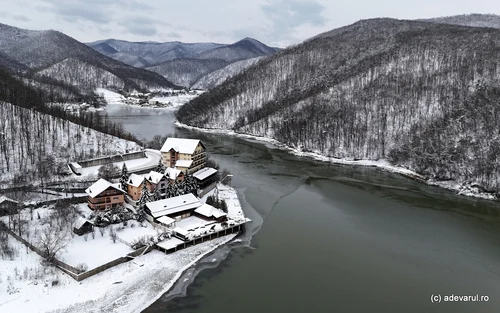
Image 1/10:
Lake Cincis in winter Photo Daniel Guță THE TRUTH (15) JPG
“Lots of deer, wild boar and waterfowl hide in the reeds at the tail of the reservoir near the old church,” says a local.
Lake Cinciș, a history of over six decades
Lake Cinciș was developed at the beginning of the 60s, on the hearth of Cinciș and Cerna villages and neighboring hamlets on the Cerna valley. It has an area of over 250 hectares and a capacity of almost 30 million cubic meters of water, being initially used as a supply source for Hunedoara and the steel plant. Located about ten kilometers from Hunedoara, the Cinciș dam was built in only 14 months, during the period 1962–1963, and inaugurated in 1964.
Its structure is made of concrete, with a thickness of 14 meters at the base and 4.5 meters at the crown, with a total volume of 43.5 million cubic meters. It has the shape of an arch connecting two slopes, a length of 221 meters and a height of 48 meters, rising about 300 meters above sea level.
On the Iuba hill, near the dam, the Cinciș-Cerna village was built in just a few months, in 1962, by the locals displaced from several settlements on the Cerna valley, swallowed by Lake Cinciș.
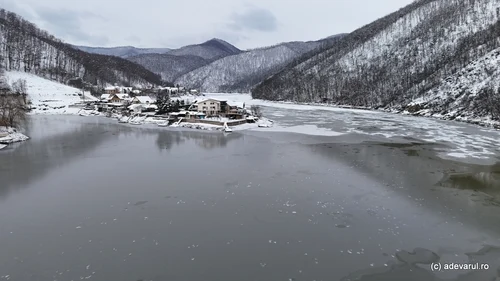
Image 1/13:
Lake Cincis in winter Photo Daniel Guță THE TRUTH (2) JPG
The settlement, located 8–10 kilometers from Hunedoara, has a dramatic story. More than 100 houses, along with churches, schools and cemeteries in the old settlements, ended up under water. Most of the buildings were demolished. Then the people moved up the hill what they could save from their houses and churches, some even taking the graves of their families, but many remained in the flooded valley. The church in the village of Cinciș-Cerna, built in the 60s, preserves the vestiges brought from the old church of the Huniazis, which ended up under the waters of Lake Cinciș.
Around the lake, the forest swallowed up other villages, isolated by the hydrotechnical development and gradually abandoned by the people.