The most important proof of the wars between the Dacians and the Romans. An impressive monument of antiquity, made of the Dacian gold

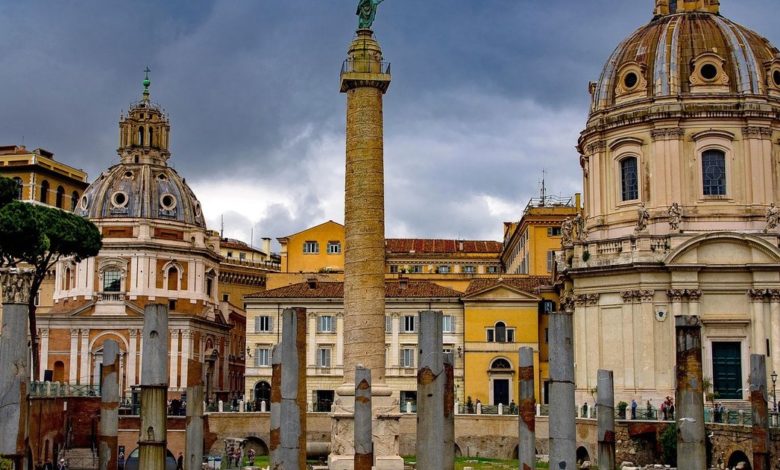
On May 12, 113 AD, the largest relief sculpture of antiquity was inaugurated in the Capital of the Roman Empire. It was about Trajan's Column, a true chronicle carved in stone of Trajan's wars.
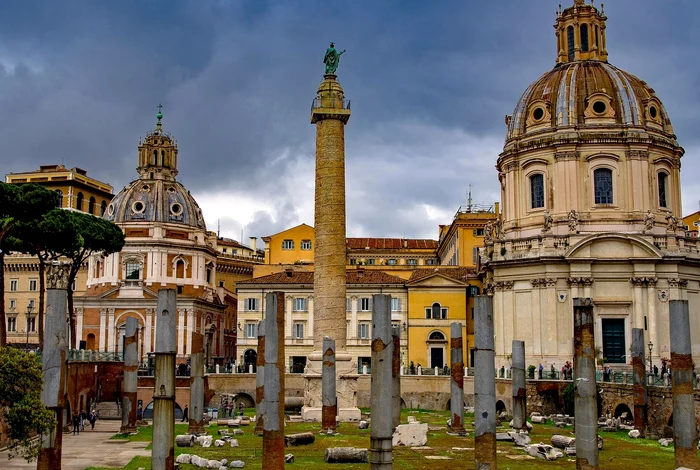
Trajan's Column in Rome Pixabay
Trajan's Column is the most important ancient source regarding the Dacian wars with the Romans. The faces of the Dacians, as well as scenes of the events that marked this extremely harsh and important conflict for the geopolitics of the central-east European region, are torn down. Without Trajan's column, we would have known much less about the clothing, the physical appearance or the military equipment of the Dacians. In addition, some of the events carried out in the wars of 101-102 AD and 1015-106 AD were reconstituted on the basis of the metopes of Trajan's Column. Beyond the documentary character and a crucial historical source for understanding our ancient history, Traian's Column was also a special artistic representation in the ancient world.
The greatest relief sculpture of antiquity
Trajan's Column was inaugurated on May 12 of 113 AD, seven years after the end of the Daco-Roman wars. It was made by the famous architect Apollodor from Damascus, the one who also built the bridge from Drobeta. The column was located in the Forum of Trajan, the last imperial forum built in Rome, also by Apollodor from Damascus. Trajan's forum is spread over an area of 275,000 square meters between the Capitol and Quirinal hills. This incredible monument of the ancient world represented an area with marble, full of impressive columns and buildings. For her arrangement, almost a whole hill was excavated. At the entrance to the Forum of Trajan there was a three-entrances of Triumph with a statue of Emperor Trajan in a six-horsepower. Another equestrian statue of the emperor, made of golden bronze, was in the middle of the Forum Market.
The entire market was surrounded by a porch decorated with Dacian busts, including Decebal's bust. In the force was also arranged the basilica Ulpia, an impressive building that housed a true gallery of Roman celebrities, but also war prey. Behind this basilic was raised Trajan's column. On both sides of the Column were two libraries. For the entire arrangement of the forum, funds from the prey obtained from the Dacians were used. It was an area dedicated to wars with the Dacians, a victory that shone the reign of Trajan. The most impressive monument in Traian's forum was Column. It was about 40 meters and was in the form of a longing column, built of 19 marble blocks, with a weight of over 30 you each.
“The column imitates, on a huge scale, the shape of a long column, placed on a cubic pedestal, based in the form of a huge laurel wreath (Dafin). The marble spindle was built from nineteen marble blocks (drums), heavy over 30 tons each, put on one another, The perspective, a process invented by Greeks hundreds of years ago ”said Radu Oltean in the work “Dacia. Wars with the Romans. Volume I. Sarmisegetusa”. At the top of the Column there was a golden bronze statue of Emperor Trajan. At the same time, inside the column is a mark, which can be reached at the top. At the base of the Column is deposited the ballot box with Trajan's ashes, died in 117 AD, only four years after the inauguration of the monument.
A lively chronicle, in lost colors
Trajan's Column was made by Greek craftsmen, specialists, well trained people and with a special experience in such works. Basically, it is a chronicle in marble of Trajan's wars with the Dacians. The text of Trajan's work, “De Bello Dacico”, today lost, was transposed into the frieze that “envelops” the entire spindle of the Column. As if today a movie was made on the basis of a book, one of the most beautiful carved reliefs in all the ancient world resulted.
“The frieze has 200 meters and contains over 2500 carved figures. The sculptor craftsmen, probably of Greek origin, the best of the best, have left one of the most beautiful carved reliefs in the whole Roman art.”says Radu Oltean in the already mentioned work. Although, today, Trajan's Column is monochrome, in antiquity, the battle scenes on her marble spindle have been painted in bright colors.
“The texts and photographs in fluorescent light have shown that the reliefs have been painted in bright colors. The exact colors are no longer known, currently having several proposals to reconstruct, but all hypothetics”adds Radu Oltean in “Dacia. Wars with the Romans. Volume I. Sarmisegetusa”.
The mysteries of a war under silence
Daco-Roman wars are among the most famous and well-known events in the ancient history of Romanians. Although everyone thinks he knows what happened between Dacians and Romanians, in reality, things are known and more intuitive, based on an incredible ancient spring: Trajan's Column. About Trajan's wars with the Dacians wrote a lot in antiquity. It was probably one of the most important wars with the barbarians from the beginning of the 1st millennium D.Hr. The Dacians represented a powerful tribal union that constantly attacks the Roman provinces. Moesia was not safe as long as the Dacians were not pacifications. The Romans tried many methods, bought them peace with large amounts of money, tried to organize reprisals in the north of the Danube, tried to attract them in the Roman world through trade, but nothing worked. The Dacians were a constant danger to the Roman world.
That is why Traian decided to end the Dacian threat. In addition, the territory occupied by these barbarian tribes had important resources for the empire. The wars with the Dacians were very heavy for the Romanians. They required very large military and material resources. This is why the victory over the Dacians in 106 AD, was presented as a very important historical event. About the wars with the Dacians, Trajan himself wrote, in the famous “De Belo Dacico”, but also the great learned of the time. For example, the doctor Criton, present in the Dacia campaigns, wrote a book called “Getica”. For his part, Dion Chrysostomos, another contemporary, wrote a book with the same title, “Getica”. Appian, Ammianus Marcellinus, Arrian, poet Florus or Dio Cassius also wrote about this conflict. The peak, all these works have been lost mysteriously. Actually, only literary springs about the Daco-Roman wars remained. Column remains the main historical source of these conflicts.