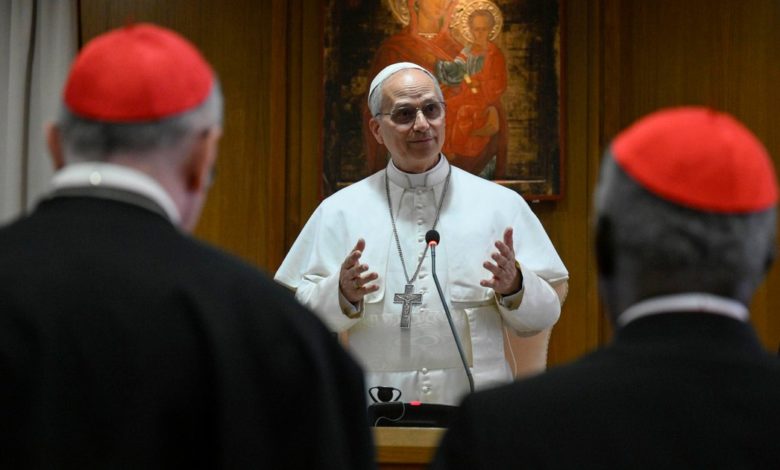
Beyond the spiritual aura and the role of shepherd of the Catholic Church, the new pope Leon XIV takes over an inheritance that far exceeds the altar and the word on Sunday. Throughout the last century, the pontifies intervened, sometimes visibly, sometimes silent, in the big moves on the world chessboard-including in America.
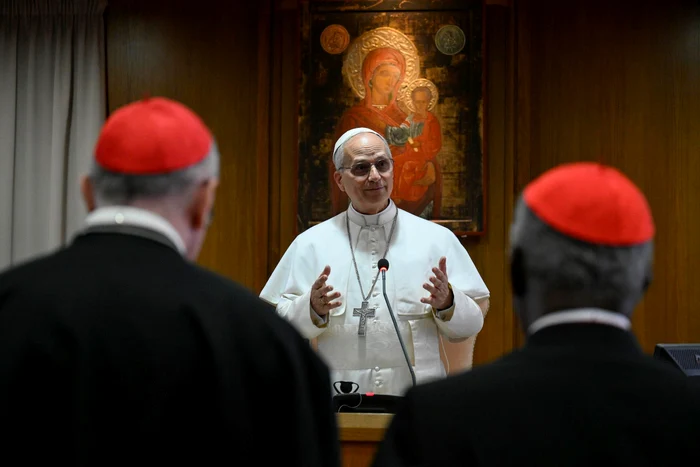
Pope Leon XIV/ Photo: X/ Vaticannews
For more than a century, the papacy has modeled American business – through spiritual and cultural guidance – but also by discreet influence of major geopolitical changes and cultural developments.
From the diplomacy during the Cold War to modern discussions about climatic and human rights, various popes have interacted with American leaders behind the scenes, acting as mediators, moral voices and sometimes catalysts for historical changes.
Some historians have suggested that the medieval papacy was the pioneer of the concept of ambassadors, said Ben Wiedemann, a lecturer at Cambridge University, specialized in the political role of medieval papacy, quoted by Newsweek. “The papal court was the place where international tensions were resolved.”
“The kings had semi-permanent” supervisors “at the Papal Court“He told Newsweek.” In the Middle Ages, the papal court was the place where international disagreements were mediated. “
Diplomacy in white clothes
The most famous example is probably the intervention of Pope John Paul II in the context of the Cold War. His 1979 visit to Poland under Soviet occupation was perceived as a gesture of courage and as an inspiration for the movement of solidarity. That moment is considered by the historian John Lewis Gaddis a turning point in the fall of communism: “When John Paul II kissed the Earth at the airport in Warsaw, the process that would lead to the end of communism began.”
Former US President Ronald Reagan, who would obtain his first mandate at the White House the following year, said at that time: “I had a feeling, especially during the Pope's visit to Poland, that religion could prove to be the heel of Achilles of the Soviets.”
Equally revealing was the involvement of Pope Francis in normalizing the relations between the US and Cuba in 2014. With a silent diplomacy, he sent personal letters to Barack Obama and Raúl Castro, requesting the resumption of dialogue. Both sides later recognized his merits.
“We will put an end to an outdated approach, which for decades did not bring benefits,” Obama said at the time. “And we will begin normalizing relationships.”
Grant Kaplan, professor of theology at Saint Louis University, explained why he thinks that the popes can play such a unique role in global politics.
“Many of the recent popes were actually former diplomats.”he told Newsweek, “Therefore, this type of diplomatic network that the Catholic Church has is an advantage in the sense that it is not a state that has economic interests or who wants to expand its territory or something like this – it is naturally seen as a kind of specific place to Switzerland.”
“You don't have to worry about their perspective on things, so you can trust them more.”he added. “The Vatican always sends people to intervene in the Middle East, in Ukraine – sometimes it is not very successful, but sometimes it is very successful.”
The moral voice of Catholic America
The papal influence does not stop at the level of diplomacy. According to the latest data of the US Census Bureau, about 53 million Americans identify as Catholics – about 20% of the population. Thus, the Pope has a direct connection with a significant segment of the American society.
“There are many Catholics in the United States who take seriously what Papa says as part of their faith,” Kaplan said. “So, even if the Pope does not try to talk to leaders, he can influence political victories talking to people as leader of their religious community.”
He quoted the theology of the body of Pope John Paul II, who learned that sexuality was more than just a biological impulse, but rather a “sacrament” – a sign of God's love.
“Basically, it is insisted that the person cannot be separated from the body,” Kaplan explained. “He said the famous statement that” the problem with pornography is not that it reveals too much, but that it reveals too little, “in the sense that it separates the soul from the body as an object.”
John Paul II held 129 lectures on this topic between 1979 and 1984, in the years after the American sex revolution of the 1960s and early 1970s.
Kaplan believes that such cultural interventions have a more durable impact than political ones: “Politics is influenced by culture. If you change culture, you change everything.”
Theology “has become very popular and was taught at the parish level and in schools,” Kaplan said. The conference of the United States Catholic bishops included it in the doctrine and its family planning resources.
Kaplan claimed that this type of power held by the Pope could actually be stronger than its force related to diplomacy.
“The cultural and spiritual impact matters more in the long term”he said. “One of the expressions that people use is that” politics is downstream of culture “and, in general, I think this is a good way to understand the influence.”
Between the altar and geostrategia
In an era marked by international realization and multiple crises-from wars to collapse in institutions-the pope's figure remains one of the few constants perceived as disinterested. With a reliable capital to match, the pontiff can negotiate where classical diplomacy fails. And it can influence a nation not by veto or sanctions, but by the word spoken in the quiet of a sermon.