The Soviet satellite was out of control could hit Bucharest on Saturday. Floated drifting for 53 years

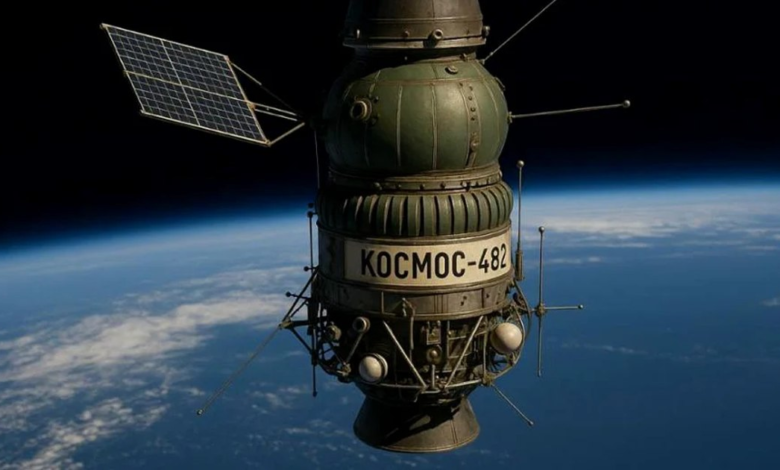
The Soviet space ship Kosmos 482, out of control, goes to the ground. Astronomers predict that the 500 kg landing module could hit the planet on Friday afternoon.
Cosmos 482 Photo: x
A threatening map reveals the big cities of the world that could be hit, and Bucharest is among the cities that could be hit by the fall. Other capitals that are directly in the firing line are London, Brussels, Budapest, Abu Dhabi, Hiroshima, Rio de Janeiro and many more.
Kosmos 482 is estimated to return to the atmosphere within 14 hours before or after 10:34 (Romania time) on Saturday morning, May 10.
There are still many uncertainties about the ship's re -entering trajectory, because even the small movements of its orbit could cause major changes, writes the Dailly Mail.
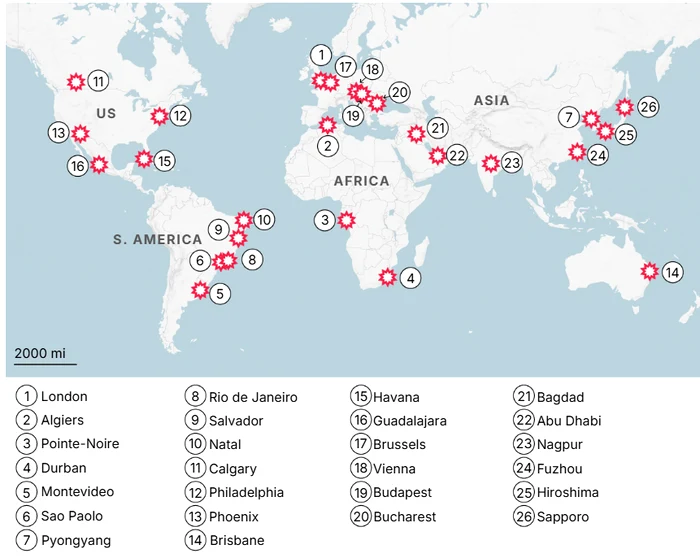
Great cities that could be hit by the Soviet spacecraft out of control under control
Although the chances of being hit by Kosmos 42 are small, scientists warn that a direct collision with a populated city could prove deadly.
Dr. Marco Langbroek, astronomer and satellite follower at the Technology University in Delft, used the latest observations of this spacecraft to calculate the place where it could fall.
Previously, Dr. Langbroek calculated that the landing module could hit anywhere between 52 degrees north and 52 degrees south.
Now, additional observations of Kosmos 482 have allowed Dr. Langbroek to calculate the trajectory that the module will follow during the fall and the cities it will pass.
Comparing this trajectory with a list of cities with over one million inhabitants, there are a significant number of dense populated areas that could be in danger.
In Europe, the ship could affect London, Brussels, Vienna, Budapest, Bucharest or a number of other important cities.
In North America, Phoenix, Philadelphia, Calgary and Havana are all under the re -entering trajectory.
Meanwhile, in South America, Brazil is particularly exposed to risk, with São Paulo, Rio de Janeiro, Salvador and Natal, all in the firing line.
The rest of the world is not completely safe, the big Asian cities such as Hiroshima and Sapporo in Japan, Fuzhou from China, Nagpur from India and Pyongyang of North Korea are all under the landing trajectory.
Neither Australia, slightly populated, do not escape risks, brisbane being directly under the possible landing.
In a blog posting in which he shares his conclusions, Dr. Langbroek states: “The risks involved are not particularly high, but they are not zero: with a mass of a little below 500 kg and a dimension of 1 meter, the risks are somewhat similar to those of an impact to a meteorite.”
In addition, the risks of a substantial impact are higher due to the unique construction of Kosmos 482.
The spacecraft known as Kosmos 482 was launched by the Soviet Union on March 31, 1972, from the Baikonur Cosmodrom in Kazakhstan.
The ship should have been Venera 9, one of the missions of the Soviet Union to the nearby planet.
However, after, due to motor problems, the spacecraft remained blocked on the orbit of the Earth, the Soviet space program covered its mistake renovating the “Kosmos” ship – a generic title for orbit objects.
During that fatal defect of the engine, the Kosmos 482, religious ship, broke into four pieces.
Two of these pieces burned over the new Zealand in a few days – although the USSR denied any involvement at that time.
Scientists now believe that an object that goes to the ground at a speed of 17 000 mph is the landing module of Kosmos 482, the last missing piece.
Professor Patrick Hartigan, an astronomer at Rice University, told Mailonline: “It could very well cling together as it enters, because it was designed to survive Venus, so it is built as a small tank. “
Although the landing module was initially built with a parachute landing system, experts suggest that they either have already been carried out and would be destroyed or have given up.
This means that, besides rubbing with the atmosphere, the landing module will not be able to slow down too much.
Professor Hartigan plays that the ship “It will initially approach about 8 km per second (17 895 miles per hour), but will slow down long before impact, up to about 150 miles per hour. “
He adds: “I think of his impact as at the mass and speed of a motorcycle at speed. ”
Therefore, although a collision with a populated area could certainly be deadly, it will not be as devastating as a collision with a large asteroid, which would release a deadly energy explosion. Also, because the ship is quite small, the chances of a person being hit are extremely small.
“Statistically, it will probably reach the ocean, but it could hit the ground. You should have a colossal bad luck,” says Professor Hartigan.
However, at this moment, it is impossible to say with certainty where it will land.
Because the spacecraft is so low from the earth, it is invisible during the day and hidden in the shadow of the earth during the night, which means that astronomers can only make rapid observations at dawn and dusk.